Pipeline Review Agenda: A 45-Minute Template That Works

A good pipeline review agenda has five parts: close out last week’s actions, scan pipeline movement, inspect the few deals that decide the period, plan next steps for each, and end with a spoken forecast call. Run it the same way every week, keep it to 30 or 45 minutes, and spend most of the time on deals, not on the CRM fields around them.
Below is the full template with timings, what everyone should bring, how the agenda changes for a forecast meeting, and the mistakes that make reps dread the calendar invite. I’ve sat on both sides of this meeting. Most bad reviews fail for the same reason: nobody agreed on what the meeting is for.
TL;DR
- Use a fixed agenda: last week’s actions, pipeline movement, deal inspection, next steps, forecast call. Same order every time.
- Pipeline reviews check the health of the whole pipeline. Forecast meetings focus on the deals that make up this period’s number. Don’t blend them.
- Review three to five priority deals per rep, not every opportunity. Ask for evidence of buyer progress, not rep opinion.
- Every deal discussed ends with an action that has an owner, a due date and a reason.
- Reps bring updated CRM data and a short list of deals where they want help. Managers bring questions, not a script.
Table of Contents
- Pipeline review vs. forecast meeting: pick the purpose first
- The 45-minute pipeline review agenda
- The 30-minute version
- A forecast meeting agenda for managers and leadership
- What to prepare before the meeting
- Who should attend, and how often
- Coaching or forecasting? Decide which one you’re doing
- How to document decisions and follow-ups
- Common mistakes that make reviews unproductive
- Perspective: the review should cover the space between calls
- Make the review easier to run with TrailerCast
- FAQ
- Sources
Pipeline review vs. forecast meeting: pick the purpose first
People search for “pipeline meeting agenda” and “forecast meeting agenda” as if they were the same thing. They overlap, but the goals differ, and the agenda should too.
A forecast review aims to understand the deals that make up the current period’s forecast, while a pipeline review monitors the health of the overall pipeline. That second job is what tells you what “$5 million in pipeline for Q2” actually means. Chief’s glossary frames it similarly: a pipeline review looks at deal health and performance against quota, while a forecast call estimates what will close in a defined window and why.
In practice:
| Pipeline review | Forecast meeting | |
|---|---|---|
| Main question | Is the pipeline healthy enough to hit the number? | Which deals will close this period, and how sure are we? |
| Typical format | Manager and rep, 1:1 | Managers and leadership, often with RevOps |
| Focus | Deal health, coverage, stage movement, coaching | Commit and best-case deals, risk, call by manager |
| Output | Next steps per deal | A number leadership can stand behind |
| Cadence | Weekly | Weekly or biweekly, tighter near period end |
If you can only run one meeting, run the pipeline review and add a five-minute forecast call at the end. If you run both, keep them on separate calendars so coaching doesn’t get squeezed out by number-chasing.
The 45-minute pipeline review agenda
Here is the template I recommend for a manager and rep. For a team-level review, multiply the deal inspection block, not the other blocks. If 45 minutes is too long, use the 30-minute version further down.
1. Last week’s actions (0:00 to 0:05)
Open with “Let’s review last week’s action items.” Rework’s guide to pipeline reviews recommends exactly this opener before any new deals come up, because it creates accountability from the first minute.
Go through each item: done, not done, or no longer relevant. If actions routinely aren’t done, that’s the real topic of the meeting, and it’s worth a blunt conversation.
2. Pipeline movement (0:05 to 0:12)
A quick scan, no storytelling. Cover:
- Deals that advanced a stage since last time, and what the buyer did to cause it
- Deals that slipped or went quiet
- New opportunities created, and from where
- Deals closed-won or closed-lost, with the one-line reason
The goal is to see shape. Is there enough early-stage pipeline to feed next quarter? Are late-stage deals piling up with no movement? For the numbers behind this scan, our piece on four pipeline metrics for reliable forecasts covers which ones are worth looking at.
3. Deal inspection (0:12 to 0:32)

This is the core. Pick three to five deals: the biggest, the closest to closing, and any that worry you. Spend roughly four to six minutes per deal using a consistent inspection frame. Rework’s suggested frame runs: deal context (1 to 2 minutes), qualification validation using BANT or MEDDIC (3 to 5 minutes), progression evidence (3 to 5 minutes), risk assessment (2 to 3 minutes), and an action plan (2 to 3 minutes). You won’t hit every sub-timing on every deal, but the order is sound.
Translate that into questions you can ask out loud:
- Who have we actually spoken to, and who hasn’t been on a call? Single-threaded deals die in meetings you weren’t invited to.
- What has the buyer done since the last review? Not what the rep did. A buyer who booked a security review is a signal. A buyer who “seemed positive” is a mood.
- What’s the compelling event? If the answer is “end of quarter” and it’s our quarter, not theirs, that’s a risk.
- Where is the champion’s story weakest? Usually it’s the CFO or security stakeholder who wasn’t there.
- What would make this deal slip? Make the rep say it first.
If you need to sharpen the qualification side, our discovery questions for SaaS sales are a good companion.
4. Next steps and help needed (0:32 to 0:40)
Every deal discussed gets an action. Not “follow up” but: what, who, by when, and why it matters. Rework recommends documenting each of those four elements so the next review has something concrete to check.
This is also where managers earn their seat. Offer a specific kind of help: join a call, make an executive introduction, review a proposal, role-play the pricing conversation.
5. Forecast call (0:40 to 0:45)
Close with a spoken call. Each rep states commit, best case and what they’d need to see to move a deal between categories. Say it out loud so it’s recorded in the notes and can be compared with the outcome later. Over a few months, you’ll learn who tends to call high and who sandbags.
The 30-minute version
Short on time? Compress it like this:
| Segment | Minutes |
|---|---|
| Last week’s actions | 3 |
| Pipeline movement | 5 |
| Deal inspection (3 deals) | 15 |
| Next steps and help needed | 4 |
| Forecast call | 3 |
Three deals in 15 minutes is tight, so the rep must have prepped. That’s a feature. Weekly reviews work when preparation happens before the meeting, not during it.
A forecast meeting agenda for managers and leadership
When the audience is a sales leader, RevOps and frontline managers, flip the weighting. Here is a 45-minute structure, based on how published forecast call agendas order the time. SalesOpsClub’s forecast call template, for example, puts commit inspection first, roughly minutes 5 to 25, because that’s where the period is won or lost and attention is freshest.
- Roll-up and changes (0:00 to 0:05). Total commit, best case and closed to date, plus what moved since last week.
- Commit inspection (0:05 to 0:25). Walk the deals in commit. For each: buyer evidence, remaining steps, paper process, and who on the buyer side has signed off.
- Best case review (0:25 to 0:35). Which deals could realistically move into commit, and what would have to happen.
- Escalations (0:35 to 0:40). Where does a deal need an executive, legal or a pricing exception? Our guide to sales contract approval helps when the blocker is internal sign-off.
- Manager calls (0:40 to 0:45). Each manager gives a spoken number and a confidence level.
Plan to document one thing above all: the reason a deal sits in a category. “Commit because the CFO verbally approved budget and legal is reviewing” can be checked next week. “Commit because it feels good” can’t.
What to prepare before the meeting

The agenda only works if people show up ready. A short prep list for each role:
Reps bring:
- Up-to-date CRM records for every open deal: stage, amount, close date, next step, contacts. If hygiene is a recurring problem, a 15-minute weekly CRM cadence fixes it without a big cleanup project.
- Their three to five priority deals, with notes on the buyer’s latest actions
- One or two deals where they want help, and the specific help
- Their own commit and best-case numbers
Managers bring:
- A scan of the pipeline before the meeting, so the movement segment is a confirmation and not a discovery
- Two or three pointed questions per priority deal
- Notes from last week’s actions
- Calendar space to offer real help, such as joining a call
RevOps brings (for team-level or forecast meetings):
- A coverage and stage-conversion snapshot
- Deals with no activity in a set number of days
- Changes to close dates and amounts since the last forecast
A useful rule of thumb on effort comes from the 40/20/40 idea: roughly 40% preparation, 20% discussion and 40% follow-up. Whatever your exact split, the lesson holds. The meeting itself is the smallest part of the work.
Who should attend, and how often
For the pipeline review, keep it small: one manager and one rep. That’s the format where candid coaching happens. Group reviews tend to turn into performances, with reps defending numbers in front of peers.
Group sessions have a role, though. Use a team pipeline meeting monthly or at the start of a period to look at coverage, shared patterns and process changes. Bring in a sales engineer or solutions consultant when technical validation is the bottleneck, and invite the person who knows the deal best, not the most senior person available.
For cadence, weekly is the common standard for 1:1 pipeline reviews, with the same day and time each week. Forecast meetings run weekly during the period and often more tightly in its last couple of weeks. Consistency beats frequency: a review that happens every Tuesday does more good than a daily scramble followed by silence.
Coaching or forecasting? Decide which one you’re doing
There’s a trap in pipeline reviews, and Jason Jordan described it well in Sales and Marketing magazine: if the discussion revolves around close dates, probabilities and deal sizes, the manager is forecasting, not coaching. The primary focus should be helping reps build a game plan to move deals forward.
A quick self-test. After your next review, ask:
- Did we talk more about fields in the CRM or about people in the buying group?
- Did the rep leave with a new idea, or only a new deadline?
- Could the rep have sent me this information in a message instead?
If the answers lean toward fields, deadlines and messages, move the number-checking into the forecast call segment and spend the rest of the time on strategy.
How to document decisions and follow-ups
A review that doesn’t produce written commitments evaporates by Wednesday. A simple template for every action:
- What: one concrete step (“Send CFO-specific pricing summary”)
- Who: one owner, not a team
- When: a date, not “soon”
- Why: the risk or milestone it addresses
Store these where both manager and rep can see them, and open next week’s review with them. If you want a broader framework for turning meeting notes into tracked tasks, this step-by-step automation checklist shows how to structure owners, due dates and reminders so follow-ups don’t depend on memory.
There’s a reason this matters beyond tidiness. One vendor study claims that without an automated follow-up system, 44% of action items assigned in meetings are never completed. Treat that as a directional figure, but the pattern will look familiar to anyone who has chased the same task three weeks running.
To measure whether your review is working, track a few simple things over a quarter:
- Percentage of actions completed by the due date
- Forecast accuracy: commit called versus commit closed
- Number of deals that slipped without warning in the review
- Rep feedback: ask once a month whether the meeting helped them win something
Common mistakes that make reviews unproductive
Reviewing everything. Forty deals in 30 minutes means nothing gets inspected. Pick the few that matter.
Accepting opinions as evidence. “The champion loves us” isn’t progress. A scheduled meeting with finance is.
Skipping the previous actions. If nobody checks them, nobody does them.
Letting the manager talk most of the time. In a coaching review, the rep should do most of the talking. If you’re lecturing, you’re not learning anything about the deal.
Mixing in admin. CRM cleanup, comp questions and territory politics belong elsewhere.
No next step, no deal. If a rep can’t say when the next conversation happens and what it should accomplish, the deal belongs in a follow-up sequence, not the forecast.
Ignoring the buying group. The deal that dies after a great demo usually dies in an internal meeting you weren’t part of, because the person who was there couldn’t answer the CFO’s or CISO’s questions. Ask who hasn’t been involved yet.
Perspective: the review should cover the space between calls
We built TrailerCast around one observation: the calls were never the problem, the space between them was. A champion leaves a strong demo and walks back to a CFO who wasn’t there, a security lead who needs answers buried in a recording nobody will rewatch, and a PDF they’re expected to re-sell from memory.
That’s exactly the part pipeline reviews struggle to see. Reps summarize from memory, managers ask for updates, and the CRM holds whatever someone typed in last Thursday. The review becomes a discussion about a deal’s story instead of its evidence.
This is why we designed TrailerCast as one workspace for the whole deal: calls, demos, buyer-facing decision rooms, eSignature and handoff. One AI follows the opportunity from the first call, remembering every call, demo and message, so the manager and rep can walk into a review with a shared, current picture of what the buyer has actually done. We think a review agenda gets sharper when that picture is already on the table.
Whatever tools you use, hold on to the principle: inspect buyer evidence, agree on specific actions, and check them next week.
Daniel
Make the review easier to run with TrailerCast
If prep time is what’s killing your reviews, it helps to have the deal’s history in one place. TrailerCast is an AI sales platform that combines conversation intelligence, AI-edited demo trailers, buyer-facing deal rooms with engagement analytics, embedded eSignature and post-close handoff briefs. It also covers pipeline and QBR reporting, so the data your agenda depends on lives next to the deals themselves.
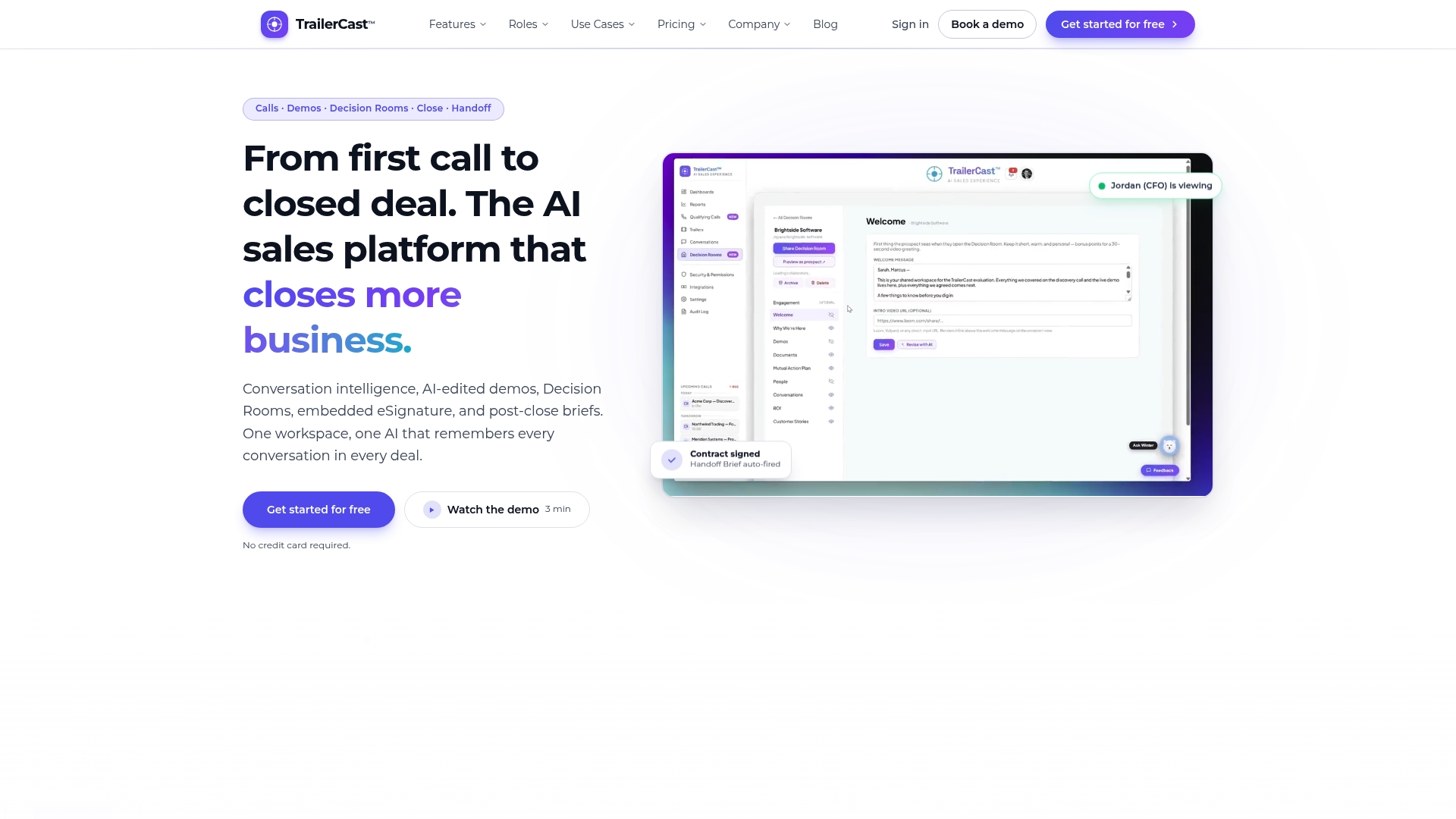
There is one plan with every feature, priced from $59 per month per seat, with a free trial first. If you coach reps, see how sales coaching for managers works, or look at the features stage by stage to decide where to start.
FAQ
What should be on a pipeline review agenda?
Start with last week’s action items, then scan pipeline movement, inspect three to five priority deals, agree on next steps with owners and dates, and finish with a spoken forecast call. Keep the order the same every week so reps know how to prepare.
How long should a pipeline review meeting be?
Thirty minutes per rep works for most weekly 1:1 reviews, and 45 minutes suits deal-heavy teams or forecast meetings. If you regularly run over, you’re probably reviewing too many deals. Cut the list, not the discussion of each deal.
What’s the difference between a pipeline review and a forecast meeting?
A pipeline review checks the health of all active opportunities and coaches reps on moving them forward. A forecast meeting concentrates on the deals expected to close in a specific period and how confident the team is. Many teams run the forecast call as the last five minutes of the review.
Who should attend a pipeline review?
For a 1:1 review, the rep and their direct manager. Add a sales engineer or solutions consultant when a technical evaluation is the blocker. Leadership and RevOps usually join the forecast meeting instead.
How do you keep a pipeline review from becoming a status update?
Ask about buyer actions, not rep feelings, and limit the discussion to a few priority deals. End every deal with a documented action, and open the next meeting by checking those actions.
Sources
- What Is a Sales Pipeline Review? Purpose and Focus (Chief)
- Pipeline Review: Cadence, Structure, and Best Practices (Rework)
- Forecast Call Agenda (SalesOpsClub)
- Coaching: The Winning Game Plan for Pipeline Management (Sales and Marketing)
- Meeting Effectiveness: How to Measure and Improve (MeetingTango)
- Marketing Automation Checklist: Step-by-Step Guide for SMBs