4–6 Line Sales Discovery Summary Templates Ready to Send Within Two Hours

A sales discovery summary is a short, structured record of a discovery call that captures the buyer’s current state, a quantified gap between where they are and where they want to be, the people who’ll decide, and what happens next. Write it in four to six lines, log it in your CRM, and send a recap to the buyer within two hours. Skip any of those pieces and the deal stalls somewhere you won’t see it happen.
TL;DR:
- Accurate, structured discovery summaries enable better deal forecasting, guide tailored demos, and prevent misaligned internal communications.
- Running timeboxed discovery calls with clear outputs at each stage improves the quality and usefulness of the gathered information.
- Asking implication questions in a strategic sequence reveals deal urgency and helps identify key stakeholders and decision-makers.
- Writing and logging the summary immediately after the call, along with a timely recap email, maintains momentum and reduces information loss.
- AI-powered tools can automate transcription and summary creation, ensuring consistent documentation and stakeholder-specific content.
Table of Contents
- What Is a Sales Discovery Summary, and Why Does It Matter?
- How Should You Structure a 30 to 45 Minute Discovery Call?
- What Questions Should You Ask, and in What Order?
- How Do You Turn Call Notes Into a CRM-Ready Summary?
- How AI Tools Handle Discovery Documentation: A TrailerCast Workflow
- What Discovery Calls Get Wrong Most Often
- Ship Consistent Discovery Summaries Without the Manual Work
- Sources
- FAQ
What Is a Sales Discovery Summary, and Why Does It Matter?
Most reps treat discovery like a form to fill out. Ask the questions, check the boxes, move to the demo. That’s the wrong mental model, and it’s why so many deals go quiet after a great first call.
Discovery isn’t a gate you pass through once. It’s a running thread that stretches across the entire deal, and a sales discovery summary is how you keep that thread visible to everyone who touches the opportunity after you. The Harvard Business Review notes that discovery done well shapes everything downstream, from which demo you build to how confidently you forecast the deal. Skip the summary, or write a sloppy one, and your sales engineer builds the wrong demo, your manager forecasts blind, and your champion has nothing solid to forward internally.
This is also where sales discovery and qualification get confused. Qualification asks “should we pursue this account?” Discovery asks “what does this account actually need, and from whom?” A discovery call can qualify a deal in the first five minutes and still run another 30 for genuine needs assessment. The summary you write afterward is the artifact of that needs assessment, not a scorecard.
The numbers back up why this matters. Conversation intelligence research from Forrester points to measurable productivity gains when reps get visibility into call patterns instead of relying on memory and gut feel. And the pattern shows up directly in how top performers run their calls: Rework’s analysis of discovery best practices cites Gong data showing top performers talk roughly 46% less than average reps and ask 11 to 14 substantive questions per call. That’s not a coincidence. Reps who listen more and ask sharper questions produce better raw material for the summary, and better summaries produce better next steps.
The uncomfortable truth: a mediocre discovery call with a great summary often beats a great discovery call with no summary at all. Information that lives only in your head dies the moment you get pulled onto another deal.
How Should You Structure a 30 to 45 Minute Discovery Call?
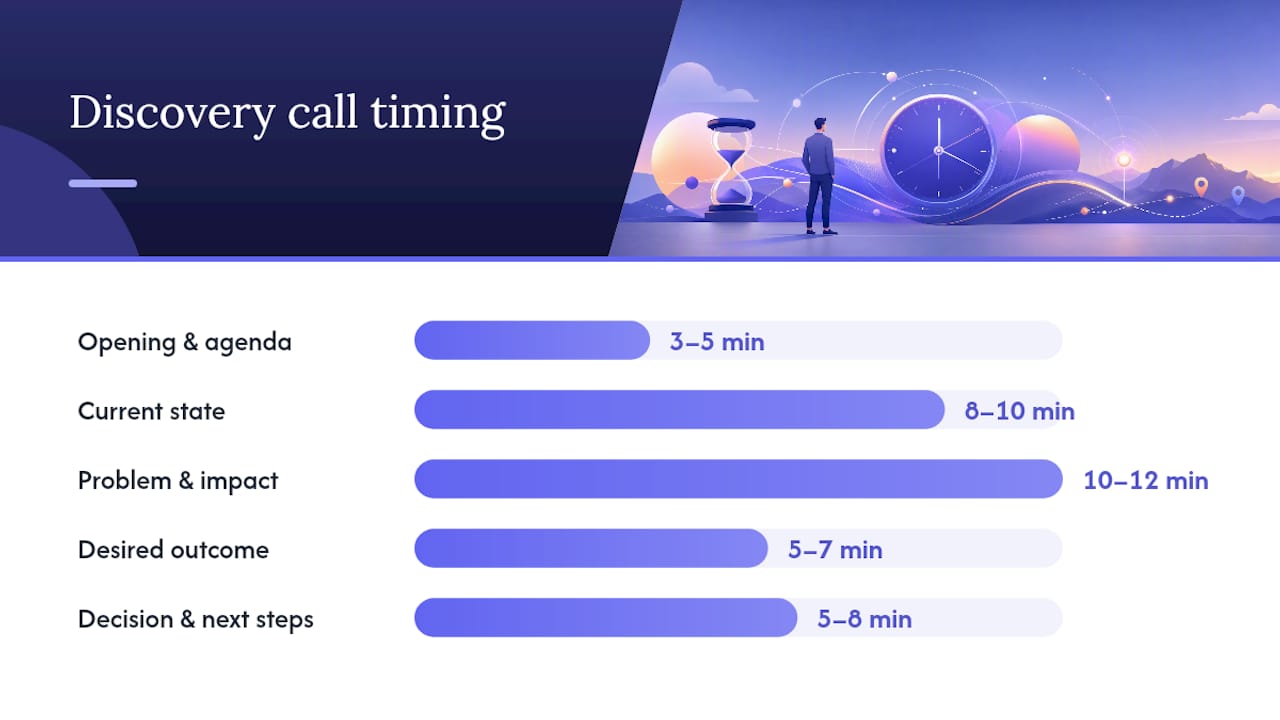
A discovery call without a timebox turns into a friendly chat that goes nowhere. The strongest reps run a five-stage agenda, and they know roughly how many minutes each stage deserves before the call even starts.
Here’s the structure, timed for a 30 to 45 minute call:
- Opening and agenda-setting (3 to 5 minutes). Confirm the time, state what you’ll cover, and ask what the prospect wants to walk away with. This single question resets a call that would otherwise be entirely rep-driven.
- Current state (8 to 10 minutes). Get the buyer describing how things work today: tools, process, team, workarounds. Resist the urge to react or pitch here. You’re building the baseline the rest of the call measures against.
- Problem and impact (10 to 12 minutes). Move from “what’s broken” to “what does broken cost.” This is where implication questions live, and it’s the stage most reps rush past.
- Desired outcome (5 to 7 minutes). Get the buyer to articulate, in their own words, what success looks like and by when. Write down the exact phrase they use. You’ll reuse it in your recap.
- Decision process and next steps (5 to 8 minutes). Ask who else needs to weigh in, how the organization typically buys, and what a realistic timeline looks like. Lock a calendared next step before you hang up.
Highspot’s guide to discovery calls recommends this kind of timeboxed agenda specifically because it prevents any one stage from swallowing the call, which is exactly what happens when a rep gets a talkative buyer and never makes it to decision process.
Each stage should produce something you can point to when you write the summary. Not a vague impression, an actual output:
- Opening produces a one-sentence account summary you could say out loud to your manager.
- Current state produces a plain description of the buyer’s existing setup, free of your own assumptions.
- Problem and impact produces a quantified gap, ideally in dollars, hours, or a percentage the buyer stated themselves.
- Desired outcome produces named stakeholders and the buyer’s own words for what “solved” looks like.
- Decision process produces a calendared next step, not a vague “let’s touch base.”
Frameworks that treat these as gates rather than suggestions tend to catch more. Ganguly’s guide to sales discovery argues that gating each stage with a written output stops reps from pivoting into a demo before they’ve actually earned the right to give one. If you can’t produce the quantified gap, you’re not ready to demo, no matter how eager the buyer seems.
Talk-ratio is the benchmark most reps ignore and shouldn’t. You’re doing a monologue with interruptions. Track your own talk time for a week and the number will probably surprise you.
What Questions Should You Ask, and in What Order?
The single most common discovery mistake isn’t asking bad questions. It’s asking good questions in the wrong order, specifically skipping straight from “what’s your current situation” to “would you like to see a demo” without ever asking what the current situation is actually costing the buyer.
That middle step, called implication, is where deals get their urgency. An Articulate blog post on discovery questions makes the case that implication questions are the most predictive signal of a genuinely motivated buyer, more predictive than budget confirmation or even stated timeline. A buyer who can quantify the cost of inaction is a buyer who will fight internally for your deal. A buyer who can’t is a buyer who’ll let the deal die quietly in Q3.
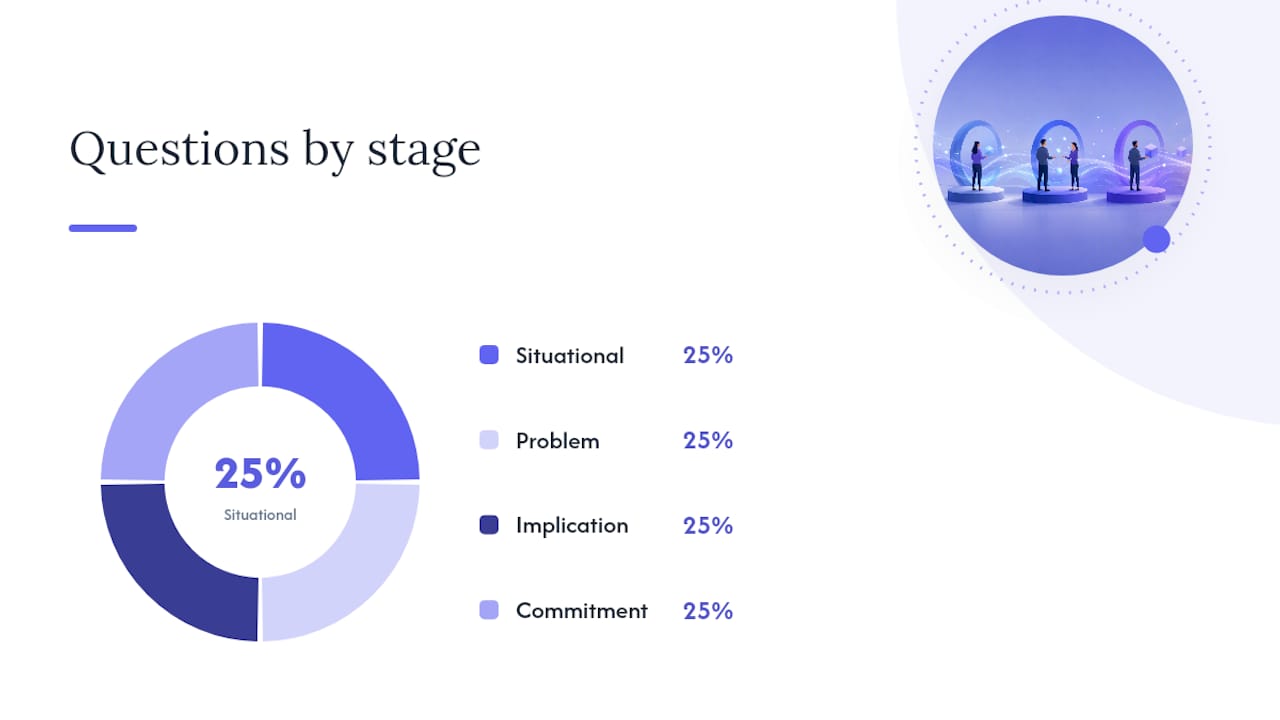
Sequence your questions in four stages:
- Situational (establish the baseline): “Walk me through how your team handles this today.” “What tools are involved, and who owns each piece?” “How long has this process looked the way it does now?”
- Problem (surface the friction): “Where does this break down most often?” “What have you already tried, and why didn’t it stick?” “If nothing changes, what happens in six months?”
- Implication (quantify the cost): “What does that delay cost you in a typical month?” “Who else feels this pain, and how?” “What’s the knock-on effect when this goes wrong for your team downstream?”
- Commitment (test readiness): “If we solved this exactly as you’ve described, what would need to be true for you to move forward?” “Who besides you would need to sign off?” “What’s realistic for a decision timeline given your fiscal calendar?”
That’s 12 questions, and you won’t ask all of them on every call. You’ll pick four or five per stage based on where the conversation naturally goes, then follow up on whatever answer surprises you.
When you hit a multi-stakeholder account, add an escalation probe: “Who on your team would push back hardest on a change like this, and why?” That question alone surfaces political risk that a straightforward stakeholder list never will.
Pro Tip: Keep a running list of the exact phrases buyers use to describe their pain. When you write the summary and the follow-up email, quote them back verbatim. Buyers trust a recap that sounds like their own words far more than one that sounds like your pitch deck.
How Do You Turn Call Notes Into a CRM-Ready Summary?
The gap between a good discovery call and a good discovery summary is usually just discipline. You have the information. The question is whether you capture it before it evaporates.
Do this immediately after the call, while the conversation is still fresh:
- Write the one-sentence current state. Force yourself into a single sentence: “Acme Corp runs manual invoice matching across three tools with no single owner.”
- Log the quantified gap. Use the buyer’s own numbers: “Finance estimates 20 hours a week lost to reconciliation errors.”
- Map the stakeholders. Name names and roles, not just titles: “Maria (Ops Director, champion), David (CFO, budget approval), unnamed IT contact (security review, not yet identified).”
- Note the timeline. Buyer’s stated urgency, not your hoped-for close date.
- Confirm the next step. What’s calendared, with whom, and by when.
That’s your CRM-ready summary. It reads like this:
Account: Acme Corp. Current state: Manual invoice matching across three disconnected tools, no single process owner. Gap: Finance estimates 20 hours/week lost to reconciliation errors, roughly $4,000/month in labor cost per the buyer’s own figure. Stakeholders: Maria Chen (Ops Director, champion), David Ruiz (CFO, budget approval, not yet engaged), IT security contact TBD. Next step: Technical demo scheduled Thursday 2pm with Maria and IT; David to review ROI summary async.
Your follow-up email should mirror that structure in plain language, sent within two hours:
Subject: Recap: our conversation today
Hi Maria,
Good talking through your invoice reconciliation process today. Here’s what I heard, and what’s next:
You mentioned your team loses roughly 20 hours a week to manual matching across your three current tools, and that this has been a growing headache since your last system migration. You’d like a solution in place before your Q1 close.
Next step: Thursday at 2pm, we’ll walk through the reconciliation workflow with your IT contact. I’ll also send David a short ROI summary he can review on his own time.
Let me know if I got any of this wrong.
Update these CRM fields the same day, not the same week: opportunity stage, quantified pain (custom field if you have one), stakeholder roles, next step date, and a one-line risk flag if you sense one. Practical post-call guidance from Sparkle puts the CRM update and the recap email on the same clock: same-day for the CRM, within two hours for the email, because both accuracy and buyer momentum decay fast once the call ends.
Attach evidence where you have it. A direct quote from the call, a screenshot of a workflow the buyer showed you, or a short recap video pulled from the recording all outperform a plain text summary when a stakeholder who wasn’t on the call needs to get up to speed fast. If you’ve got a tool that can auto-generate that kind of demo recap video, the champion forwarding it internally looks a lot more credible than a bullet list they typed themselves.
The two-hour rule isn’t arbitrary. Sparkle’s research on discovery call follow-up frames it as a momentum window: send fast and the buyer reads your recap while the conversation is still top of mind, catching errors and confirming details while it’s cheap to fix. Wait a day and you’re re-litigating what was actually said.
How AI Tools Handle Discovery Documentation: A TrailerCast Workflow
Manual note-taking during a live call has a ceiling. You can listen closely or you can write a clean summary, but doing both well, in real time, on every call, isn’t realistic for most reps. This is where AI-assisted workflows earn their place, not as a replacement for good questions, but as the infrastructure that makes your summaries consistent instead of dependent on how alert you were at 4pm on a Friday.
A typical AI-assisted discovery workflow runs in four steps:
- Pre-call signal prep. Before the call, the system pulls prior touchpoints and account context so you’re not starting cold or re-asking questions already answered in an earlier email thread.
- Live transcription during the call. An AI notetaker joins the call automatically, transcribing speaker by speaker, so you can stay present in the conversation instead of typing while someone talks.
- Post-call structured summary extraction. The transcript gets converted into the same structural pieces this article recommends: current state, quantified gap, stakeholder map, and next steps, without you retyping any of it.
- Stakeholder-specific artifacts. From that same call, the system can cut a short trailer aimed at a specific stakeholder, a CFO cut that leads with cost, a security cut that leads with implementation risk, so your champion has something built for the person who wasn’t on the call.
The practical payoff shows up in two places: less time spent on documentation, and more consistent CRM entries across a whole team, since the structure doesn’t depend on any individual rep’s note-taking habits that day. A short structured summary paired with a stakeholder-specific artifact also tends to pull far more engagement from people who missed the live call than a summary alone, since a two-minute video gets watched in a way a wall of bullet points rarely does.
What Discovery Calls Get Wrong Most Often
The biggest failure I see isn’t a bad question. It’s pitching before the gap is quantified. A rep hears “yeah, that’s a problem for us” and immediately pivots to features, skipping the implication questions that would have told them how big that problem actually is and who else feels it.
The second failure is treating the buying committee as an afterthought instead of a discovery output. If you don’t leave the call with names, you’ll spend the next three weeks guessing.
Fix both with a weekly coaching rhythm: review five recent discovery calls against the five gating outputs (account summary, quantified gap, stakeholders, timeline, next step). Don’t grade the rep’s charisma. Grade whether those five things exist in writing. Teams that adopt a shared summary template and actually measure against it close the implication gap faster than any script rewrite ever will.
— Daniel
Ship Consistent Discovery Summaries Without the Manual Work
Some AI sales platforms offer an alternative to stitching together a call recorder, a note-taking habit, and a separate video tool for every stakeholder recap. An AI system can follow the deal from the first discovery call through close, so the current state, quantified gap, and stakeholder map captured on an earlier call are still available, structured and searchable, when writing a recap for a later call.
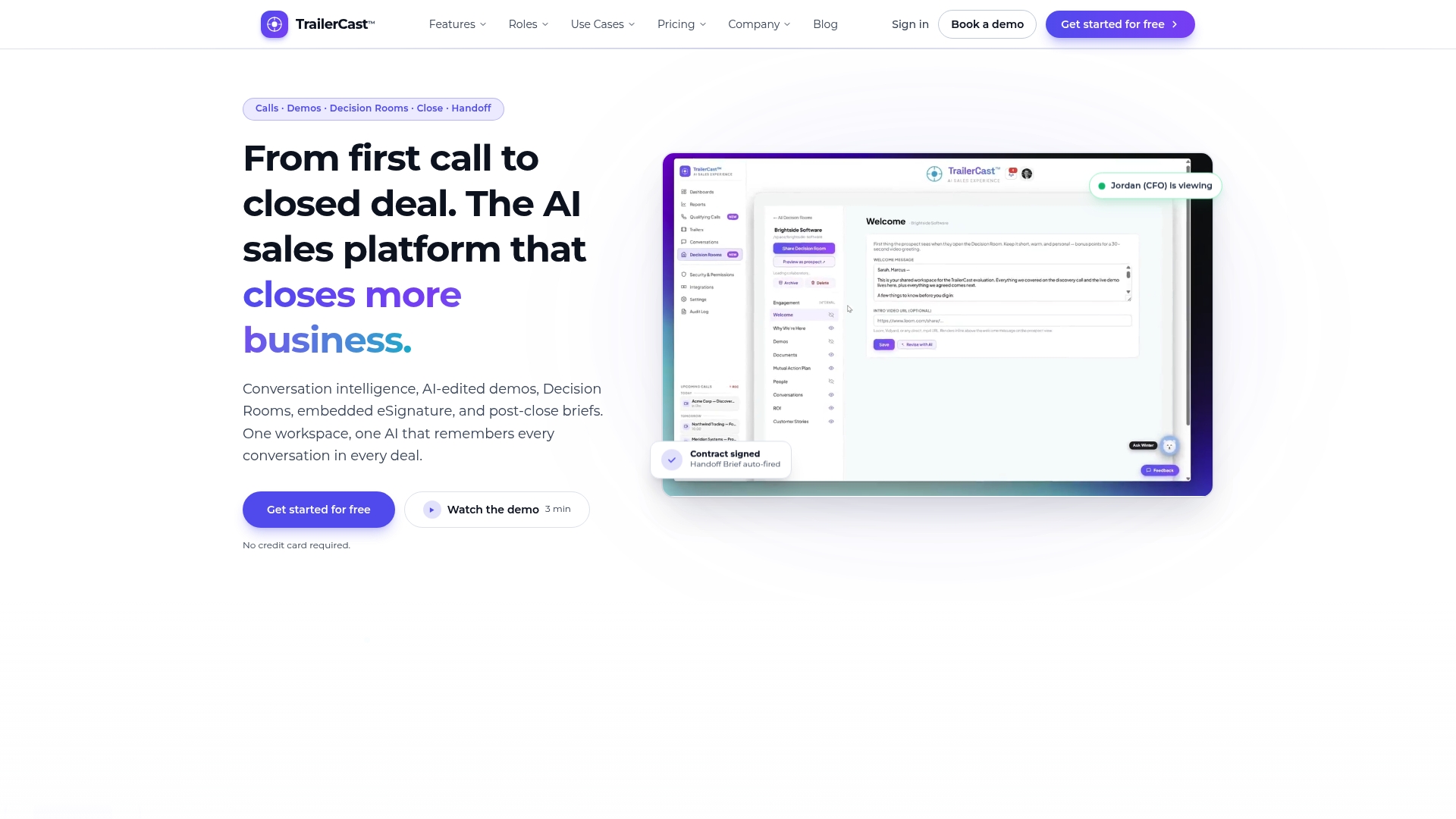
The AI notetaker for discovery calls transcribes speaker by speaker and produces the structured summary this article walks through automatically, so the CRM fields update themselves instead of waiting on you to type them at 6pm. When a stakeholder misses the call, an AI-edited demo trailer built for that specific person, CFO cut, security cut, gives your champion something worth forwarding instead of a PDF nobody opens. Everything lives in one workspace at one plan with every feature included, starting at $59 per seat per month billed annually, no feature gating between tiers.
Start a free trial, no credit card required, and run your next discovery call through it to see your first structured summary generate itself before you’ve even opened your CRM.
Sources
- Harvard Business Review — The new sales imperative
- Forrester blog — Conversation intelligence is the key to unlocking sales productivity
- Rework — Sales discovery best practices
FAQ
What Is the Sales Discovery Process?
The sales discovery process is the structured set of conversations a rep runs to understand a buyer’s current state, the cost of their problem, who’s involved in deciding, and what a realistic timeline looks like. It typically happens across one or more calls early in the deal cycle, before any demo, and produces the written outputs a summary depends on.
What Are the 5 Cs of Sales?
Definitions of the “5 Cs” vary by source and industry, so there’s no single agreed-upon version worth stating as canonical. Most sales teams get more mileage from a documented five-stage discovery framework, covering opening, current state, problem and impact, desired outcome, and decision process, than from memorizing a Cs acronym.
What Is the 30-60-90 Rule in Sales?
The 30-60-90 rule most commonly refers to a new hire’s ramp plan, mapping goals across their first 30, 60, and 90 days on the job, rather than a rule specific to discovery calls. It’s worth distinguishing from call-length guidance, since a discovery call itself typically runs 30 to 45 minutes, not 30 to 90.
How Do You Write a Sales Summary?
A strong sales discovery summary fits in four to six lines and covers the account’s current state in one sentence, a quantified gap, named stakeholders with roles, the buyer’s stated timeline, and a calendared next step. Write it immediately after the call and log it in your CRM the same day, since same-day accuracy matters more than polish.
When Should You Send a Discovery Call Recap?
Send the recap email within two hours of the call ending, while the conversation is still fresh for the buyer and easy to correct if you got a detail wrong. Waiting longer risks the buyer moving on to other priorities before confirming the next step you agreed to.
Can AI Tools Help Write Discovery Summaries?
Yes. Tools like Trailercast’s AI notetaker transcribe calls speaker by speaker and extract the current state, quantified gap, and stakeholder map directly into a structured summary, cutting the manual work of turning notes into a CRM-ready record.