Discovery Questions for SaaS Sales: What to Ask and Why

The best discovery questions for SaaS are open, specific and tied to a decision: why the prospect took the meeting, what the problem costs, who has to say yes, and what has to be true technically before they can. Below you’ll find examples for each stage, what to listen for in the answers, and a clean way to end the call so the deal doesn’t stall in the space between conversations.
TL;DR
- Open with why they took the meeting, then move to goals, pain and the cost of doing nothing.
- Ask about the buying process directly: who is involved, how it gets funded, what has to happen before a signature.
- Sales engineers should cover architecture, data flow, SSO, security review and implementation ownership early, not after the demo.
- Treat discovery as a curious conversation, not a checklist. Follow-ups matter more than the script.
- Close by confirming fit, naming what is still unknown and agreeing on dated next steps.
Table of Contents
- Discovery is a conversation, not a questionnaire
- Opening questions: why this meeting, why now
- Questions that uncover goals, pain and the cost of waiting
- Timeline, budget and buying process
- Technical discovery questions for sales engineers
- Implementation questions: who will actually do the work?
- Questions for the champion who has to re-sell your product
- What to listen for: a quick reference
- How to close discovery well
- Capture every answer, then use it
- FAQ
- Sources
Discovery is a conversation, not a questionnaire
Most reps know the questions. What goes wrong is the delivery: ten questions fired in a row, answers half heard, and a prospect who feels interviewed instead of helped.
PostHog’s public sales handbook makes the point well. It frames discovery as understanding the real problem through natural conversation, and it recommends “what” and “how” questions and softer openers like “Tell me” or “Describe to me” over interrogation. I agree with that, and I’d add something from watching a lot of calls: the question list is a map, not a script. If the prospect volunteers their budget process in minute three, don’t hold it until question twelve.
A few habits that keep it conversational:
- Ask one question, then stop talking. The silence after a good question is where the real answer lives.
- Follow the answer, not the list. “Tell me more about that” beats your next scripted question almost every time.
- Repeat their words back. If they say “messy handoffs,” ask what messy looks like. Don’t swap in your own label.
- Take notes you can use. The details are what you’ll need when the champion walks into a room you aren’t in.
If you want the full structure for a 30-minute call, we broke one down in our discovery call framework.
Opening questions: why this meeting, why now
The first two minutes tell you whether this is a real project or a curiosity. You want to know what changed.
Start with the most direct version. PostHog suggests asking what prompted the prospect to reach out, and follows with the team’s roadmap, what they’re trying to accomplish this quarter and what success looks like. Adapt it to how the meeting was booked:
- “What prompted you to take this call?”
- “What’s happening right now that you’d like to change?”
- “What are you and your team trying to get done this quarter?”
- “If this goes well, what does success look like six months from now?”
If you cold-emailed them, be honest about it: “I know I reached out out of the blue. What made you say yes to this one?” It’s disarming, and the answer is often more useful than anything on their website.
What to listen for: a trigger event (a new VP, a missed quarter, a failed rollout, a renewal coming up). Triggers create urgency. “We’re just looking around” usually doesn’t.
Questions that uncover goals, pain and the cost of waiting
Pain you can’t quantify rarely survives a budget review. Your job in this section is to get from “this is annoying” to “this is costing us something we can name.”
Omnitas, a sales consultancy, suggests a sharp one: what challenges would you regret not solving six months from now? It forces prioritization. A prospect will list ten irritations, but only one or two make the “regret” list.
The same guide also asks how much the challenge has cost the business. Combine them into a sequence:
- “Walk me through how this works today.” (current process)
- “Where does it break down?” (pain)
- “How often does that happen?” (frequency)
- “What does it cost you when it does, in time, money or missed deals?” (impact)
- “What have you tried already?” (history, and why it didn’t stick)
- “What happens if nothing changes by next quarter?” (cost of inaction)
PostHog’s team argues that understanding goals lets you frame the conversation around outcomes rather than product features. That’s the right instinct. If you can restate the goal in the prospect’s words later in the demo, you’re selling their outcome, not your feature list.
What to listen for: numbers, even rough ones. Hours per week, deals slipped, churned accounts, headcount. If they can’t give you a number, ask who could.
Timeline, budget and buying process
This is the part reps skip because it feels pushy. It isn’t pushy if you frame it as helping them move, and it saves you from the deal that looks great and then dies in procurement.
Omnitas lays out the territory: how the company will make a confident yes or no decision, who is involved in each step, how the project will be funded, and what must happen to get an agreement executed by a given date. Turned into questions you can actually say:
- “Can you walk me through the steps you and your company need to take to make a confident yes or no on this?”
- “Who else will have a voice in the decision, and what will each of them care about?”
- “Is there budget set aside already, or does this need to be requested?”
- “Is there a date this needs to be live by, and what’s driving it?”
- “If you decided today, what would have to happen before a contract could be signed?”
That last one surfaces legal review, security questionnaires and procurement steps before they become surprises. Security review in particular can add weeks, so it’s worth knowing early how it works. Our guide to the security review process walks through it from request to sign-off.
What to listen for: people you haven’t met. In multi-stakeholder deals, the CFO who wasn’t on the call or the security lead who only appears in week five often decide the outcome. Ask your champion directly: “Who’s going to push back, and what will they say?”
Technical discovery questions for sales engineers
If you’re a sales engineer or solutions consultant, your discovery has a different job. You’re not qualifying budget. You’re building a credible path to “yes, this will work here,” and finding the landmines before the proof of concept.
Modern Presales suggests covering existing architecture, integration priorities, data flow, authentication methods such as SSO, logging and monitoring requirements, and any compliance or data residency needs. That’s a good checklist. Here is how I’d phrase it in a live call.
Environment and architecture
- “Walk me through your current setup for this workflow. Where does the data originate, and where does it end up?”
- “Which systems does this need to touch on day one, and which can wait?”
- “What’s custom or heavily configured in those systems that we should know about?”
Integrations and data
- “What writes to what, on what cadence, and who owns it?”
- “Do you need data to flow both ways, or is read-only enough?”
- “Where does the source of truth live today?”
The “who owns it” part matters. An integration nobody owns tends to stay on the roadmap forever.
Security, identity and compliance
- “How do your users sign in today? Is SSO required?”
- “What does your security team need to see before approving a new vendor, and how long does that usually take?”
- “Are there data residency, retention or audit requirements we need to plan for?”
Enterprise buyers often treat SSO as a gate, not a nice-to-have. If you sell into larger accounts, our primer on SAML SSO for SaaS covers what to have ready, and the admin checklist for SAML SSO in sales tools is useful when you’re the one evaluating.
Keep it credible, not exhaustive
Technical discovery fails in two ways: the SE asks nothing and promises everything, or asks so much that the prospect feels audited. Aim for the middle. Gather enough to say honestly what fits, what needs work and what you’d test first. Never promise compatibility you haven’t verified, especially early in a deal.

Implementation questions: who will actually do the work?
A great product with nobody to set it up is a stalled deal. Ask about implementation before you hand over a proposal, not after.
- “Who would own implementation on your side?”
- “Who owns integration work, and what else is on their plate this quarter?”
- “If this is a fit, what would the first 90 days look like?”
- “Who will use this every day, and have they seen it?”
- “What would make you say the rollout was a success?”
What to listen for: hesitation on ownership. If the answer is “probably someone in IT, I’m not sure,” you’ve found a risk worth naming out loud. It’s also useful information for whoever inherits the account, which is why we built a handoff brief that carries those answers into onboarding.
Questions for the champion who has to re-sell your product
Here’s the scenario that costs deals. Your champion loves the demo. Then they walk into a meeting with the CFO, the CISO and a VP who weren’t on the call, and they have to explain what you said from memory.
Discovery should prepare for that moment:
- “Who else needs to be convinced, and what will they ask first?”
- “What does your CFO care about most on a purchase like this?”
- “What would your security lead want to see?”
- “If you had to forward one thing to them after this call, what would it need to say?”
- “Have you bought something like this before? What went wrong?”
The answers tell you what to send afterward, and to whom. Different stakeholders need different material: pricing and payback for finance, controls and compliance for security, workflow and effort for end users.
What to listen for: a quick reference
| Topic | Strong signal | Warning sign |
|---|---|---|
| Trigger | A specific event or deadline | “Just exploring” |
| Pain | A number, a name, a recent example | Vague frustration |
| Urgency | Cost of waiting is stated | No consequence if it slips |
| Budget | Funding source is identified | “We’ll figure it out later” |
| Buying process | Steps and owners are clear | Nobody knows who signs |
| Stakeholders | Champion names the skeptics | Only one contact, ever |
| Technical fit | Systems and owners are named | Integration owner unknown |
| Implementation | A person and a timeline | “Someone in IT, probably” |
When you see a warning sign, don’t panic. Name it, ask the next question and note it in your deal record.
How to close discovery well
A lot of calls trail off with “great, I’ll send something over.” That’s how deals lose momentum. The last five minutes deserve the same planning as the first five.
- Summarize what you heard. “So the main issue is X, it costs you roughly Y, and you need it solved before Z. Did I get that right?” Let them correct you.
- Confirm fit, honestly. Say what looks like a match and what you still need to check. If it’s not a fit, say so. You’ll earn trust and save both sides time.
- Name the open questions. Security review, an integration detail, a stakeholder you haven’t met. Say who will find the answer.
- Agree on next steps with dates and owners. “I’ll send a recap by tomorrow. You’ll bring in your finance lead. We’ll meet Thursday.” A next step with no date is a hope.
- Ask what could get in the way. “Is there anything that would stop this from moving forward?”
Then follow through quickly. A short written recap sent soon after the call keeps your champion equipped to carry the story forward, and our discovery summary templates give you 4 to 6 line formats you can send within a couple of hours. Good follow-up is also a form of lead nurturing strategies: keeping a prospect engaged between conversations with something relevant, not another “just checking in.”
Our perspective: the deal lives between the calls
I built TrailerCast on one observation: the calls were never the problem. The space between them was.
Discovery is where you learn the most about a deal, and it’s also where that knowledge starts to leak. You hear the CFO’s concern in minute 22. By the time the proposal goes out, it’s a half-remembered line in your notes. Your champion remembers a different half. The security requirement is buried in a recording nobody will rewatch.
That’s why we think discovery questions only work if what you learn stays attached to the deal. Our AI notetaker joins your calls, produces structured summaries and action items, and builds a Deal Brief that grows across every conversation. Nothing gets lost when a teammate steps in or when the deal moves from sales to onboarding.
We designed TrailerCast so the same workspace handles what comes next: trailers tailored to each stakeholder, a buyer-facing decision room, eSignature and a handoff brief. One AI follows the entire opportunity, so the answers you worked to uncover show up where they’re needed.
Daniel
Capture every answer, then use it
Good questions are wasted if you can’t recall the answers three weeks later. If you want your discovery notes to turn into follow-up that actually reaches the CFO and the CISO, take a look at our AI call notetaker for discovery calls. It transcribes speaker by speaker, summarizes the call, flags next steps and feeds a running Deal Brief.
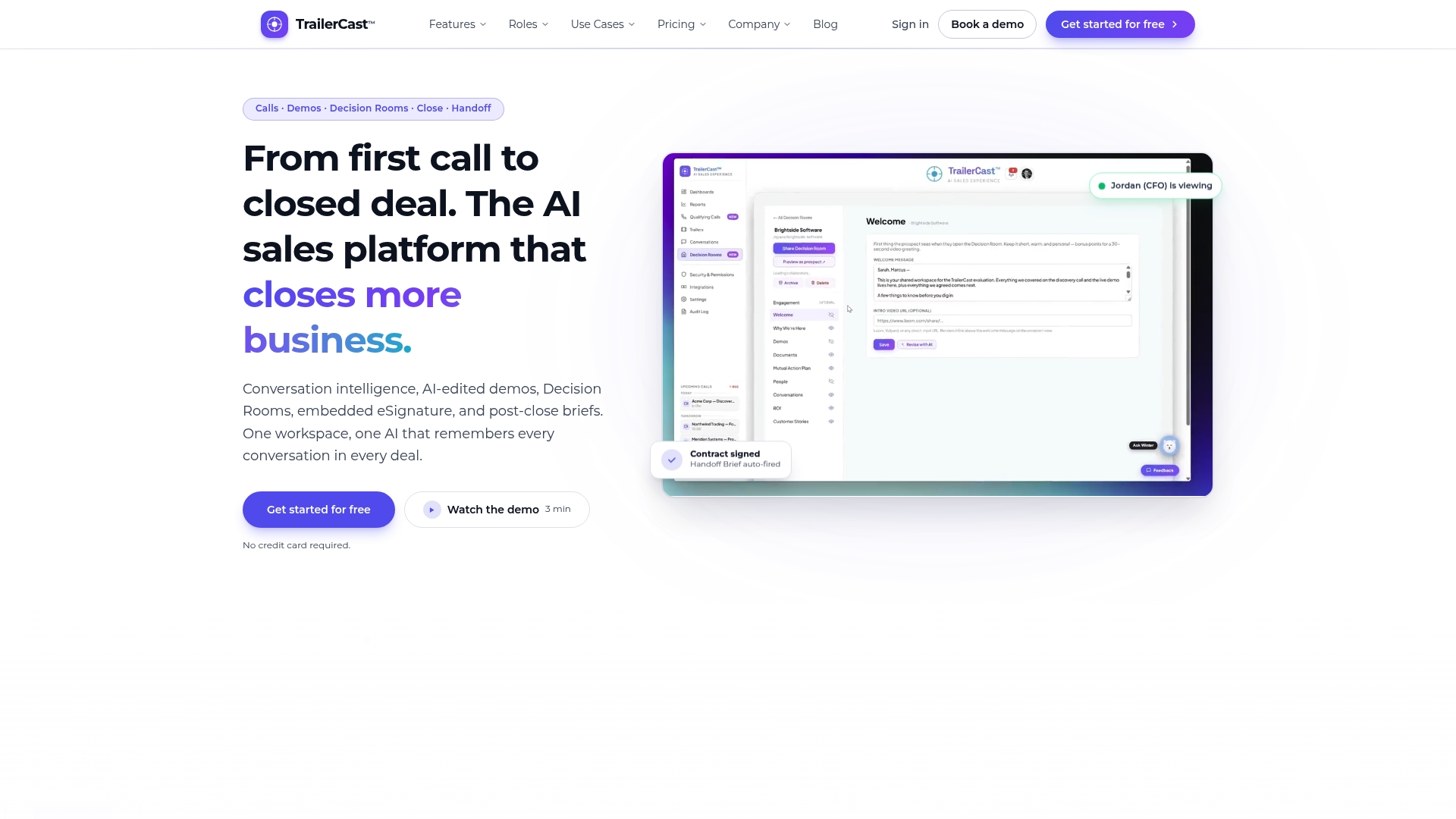
TrailerCast has one plan with every feature included, priced from $59 per month per seat. You can see everything on the plan page, or start from the TrailerCast homepage to see how the full deal lifecycle fits together.
FAQ
How many discovery questions should I ask on one call?
There’s no magic number. Most good calls cover a handful of themes: the trigger, the problem and its cost, the people involved, the buying process and the technical fit. Prepare more questions than you’ll use, then let the answers decide which ones you ask.
What are the best discovery questions for a first call?
Start with why they took the meeting and what they’re trying to accomplish this quarter. Then ask how the process works today, where it breaks and what it costs. Finish with who else is involved and what the decision process looks like.
What technical discovery questions should a sales engineer ask?
Ask about architecture, where data originates and ends up, integrations and who owns them, how users authenticate, and what the security team needs to approve a vendor. Also ask who would own implementation internally. Those answers shape the proof of concept and expose risk early.
Should discovery questions be different for SaaS than for other products?
The fundamentals are the same: understand the problem, the impact and the decision process. SaaS adds a few extras, such as integration with existing systems, SSO and security review, data handling, and who will adopt the product after the contract is signed. Subscription renewals also make early success criteria important.
How do I stop discovery from feeling like an interrogation?
Use open “what” and “how” questions, follow up on what the prospect just said and explain why you’re asking when a question is sensitive, such as budget. Pause after questions. Treat the list as a guide and let the conversation move naturally.
Sources
- How to do discovery, PostHog Handbook
- The Ultimate Guide to SaaS Discovery Questions, Omnitas
- 50+ Technical Discovery Questions, Modern Presales
- Lead nurturing explained: boost conversions with effective strategies