How to Summarize Sales Calls: A Practical Guide for Reps

The fastest way to summarize a sales call is to let an AI notetaker record and transcribe it, then turn the transcript into a short, structured recap: who was there, what they care about, what was agreed, and who does what by when. You review it, fix what’s wrong, and send it the same day. The AI handles the typing. You handle the judgment.
That’s the short version. The rest of this guide covers what a useful summary contains, a template you can copy, how the transcription step works, what to check before you record anyone in the US, and where most summaries quietly fail.
TL;DR
- A good summary records outcomes, not a replay of the conversation: decisions, commitments, objections, and next steps with an owner and a date.
- Send it the same day. Guidance on meeting summaries recommends inside the hour when you can.
- AI works best when the transcript knows who said what. Speaker attribution is what separates customer needs from your own follow-ups.
- Federal US law sets a one-party consent minimum for recording, and states can be stricter. Say it out loud at the start of the call.
- A summary is only the start. The real value is what the champion can forward to the people who weren’t there.
Table of Contents
- Why your call notes die in a notebook
- What a sales call summary should capture
- How to write the summary yourself in five minutes
- How to transcribe sales calls and turn them into notes
- What to look for in an AI notetaker for sales
- Where your summary goes next: the handoff
- Before you record: US consent basics
- Perspective: the calls were never the problem
- How TrailerCast summarizes your calls
- Common mistakes that make summaries useless
- A simple workflow you can start this week
- FAQ
- Sources
Why your call notes die in a notebook
Every rep has been here. You finish a strong discovery call, type three bullets, and tell yourself you’ll clean it up later. Two weeks on, the prospect’s CFO asks a question the champion can’t answer, and the thing you needed was a throwaway comment from minute 31.
The deal dies in an internal meeting you weren’t part of. That’s the problem summaries are supposed to solve, and it’s why a summary written only for your own memory is half the job. A call summary has two readers: you (and your manager, your SE, your CRM) and the buyer’s team, many of whom never heard the call.
So before you write a word, decide who the summary is for. The internal version is blunt and complete. The external version is short, positive, and built so a busy executive gets the point in under a minute. Most reps write one document and wonder why neither audience likes it.
What a sales call summary should capture
The most useful checklist we’ve seen comes down to the same short list. A sales call recap template lists attendees and roles, the purpose of the meeting, key points, pain and priorities, decision criteria, objections, commitments, and next steps with an owner and due date. Use consistent sections every time so anyone can scan a summary from last month and find the same thing in the same place.
Here is how that looks as a working template:
| Section | What goes in it | Example |
|---|---|---|
| Attendees and roles | Names, titles, who is the champion, who holds budget | VP Sales (champion), RevOps lead (evaluator), CFO (absent, will approve) |
| Purpose | One sentence on why the call happened | Second discovery call to validate forecasting pain |
| Pain and priorities | What they said hurts, in their words, ranked | Deals stall after the demo; leadership can’t see why |
| Decision criteria | How they will choose | CRM sync, security review, rollout under 30 days |
| Objections | What they pushed back on, and your response | Worried about rep adoption; offered a pilot with two reps |
| Commitments | What each side promised | We send a security overview; they intro the CISO |
| Next steps | Action, owner, due date | Pilot scope doc, Dana, Friday |
Three habits make this table work in practice.
Write the pain in the buyer’s words. A paraphrase loses the emotion that gets a CFO to care. If the prospect said the team was “flying blind after demo,” keep that phrase.
Separate what was said from what you infer. “Budget approved” is a fact. “Seems keen on Q1” is your read. Label them differently, because six weeks later nobody will remember which was which.
Every next step gets an owner and a date. “Follow up on pricing” isn’t a next step. “Priya sends the three-seat pricing sheet by Thursday” is.
How to write the summary yourself in five minutes
If you’re doing it by hand, or checking an AI draft, this order keeps it fast:
- Start with the outcome. One or two sentences: did the deal move forward, stall, or change shape?
- List the decisions and commitments. What was agreed, by whom.
- Capture the objections. Including the ones you didn’t fully answer.
- Add next steps. Owner, action, date.
- Flag the missing stakeholder. Who wasn’t on the call but will influence the decision, and what they’ll want to know.
The same guidance on writing summaries advises focusing on information that changes what a colleague knows or does, instead of replaying the conversation. If a line doesn’t change anyone’s next move, cut it.
Timing matters as much as content. A recap that lands within a couple of hours feels like momentum. One that arrives three days later feels like an afterthought, and the buyer’s memory of the call has already faded. If you want ready-made wording for the buyer-facing version, we’ve put together call recap email templates and a short discovery summary format you can paste and adapt.
How to transcribe sales calls and turn them into notes
Transcription is the foundation. A summary built on a sloppy transcript inherits every error, so it’s worth understanding what good looks like.
Speaker attribution comes first
A plain wall of text is hard to use. The key missing layer is knowing who said what. OpenAI’s developer guidance on meeting intelligence pipelines describes using speaker-aware diarization to attribute statements to speakers, then extracting structured information with references back to the transcript evidence.
In sales terms, that matters a lot. “We need SOC 2 before we sign” means something different coming from the prospect’s security lead than from your own SE explaining your roadmap. Without attribution, an AI can easily file your commitment as their requirement.
Keep a trail back to the transcript
The same guidance recommends keeping an evidence trail for each extracted item, so a person can check a claimed action item against the exact moment it was said. That’s a habit worth copying even if you never build anything. When a summary says the prospect agreed to a pilot, you should be able to click to that moment and hear it.
Review the risky bits
The pipeline guidance also suggests routing risky or low-confidence outputs through human review before they are written anywhere downstream. For a rep, translate that to: read the summary before it goes into your CRM or to the customer, with extra attention on numbers, dates, names, and anything that sounds like a commitment. AI is good at structure. It still mishears product names, pricing figures, and proper nouns.
What to look for in an AI notetaker for sales
The tools in this space differ in less obvious ways than their landing pages suggest. Rather than naming vendors, here are the criteria that decide whether a notetaker actually helps a sales team:
- Meeting coverage. Does it join Zoom, Google Meet, and Microsoft Teams, and schedule itself from your calendar so you never forget to invite it?
- Speaker-by-speaker transcripts. As above, this is non-negotiable for sales.
- Structured output, not just a paragraph. Look for summaries organized around qualification, objections, and action items, ideally configurable to your methodology.
- Search across calls. You will want to find every time “legal review” came up across a quarter.
- Deal-level memory. Single-call summaries are table stakes. The better question is whether the tool understands the whole opportunity, so call four builds on calls one to three.
- CRM sync. Notes that live outside your CRM tend not to get read.
- Controls. Who can see recordings, how long they’re kept, and whether you can pause or delete.
- What happens after the call. Does the summary turn into something the buyer can use, such as a recap email, a video, or a shared page?
- Price structure. Per-seat pricing is common. Watch for features locked behind higher tiers, because the notetaker you trialed may not be the one you end up paying for.
That last point is why we price the way we do, covered below. If you’re also comparing how different tools treat meeting summaries as outputs for different readers, this write-up on accessible AI meeting summaries is a decent look at the formats teams end up using.
Where your summary goes next: the handoff
A good call summary isn’t the end of the line. When a deal closes, everything you learned in discovery has to reach the customer success team, or the customer repeats themselves and starts the relationship on a sour note. The cleanest way is to build the handoff from the same call summaries you’ve been writing all along. A sales-to-CS handoff template shows the sections worth including, and many of them (goals, stakeholders, promises made) are exactly what a consistent call summary already holds.
Before you record: US consent basics
Recording and transcribing calls raises a legal question you should settle before you turn anything on. This is general information, not legal advice. For your company’s policy, talk to your counsel.
Federal law sets a floor. According to the Reporters Committee for Freedom of the Press, federal law requires the consent of at least one party before recording in-person, telephone, or electronic conversations, and states may impose stricter rules. That means if you are on the call and you consent, you meet the federal minimum. Some states require everyone on the call to agree, so if your prospects sit in several states, the safe habit is to announce the recording at the start of every call and get a clear yes.
A simple opener works: “I use an AI notetaker so I can focus on you instead of typing. Are you comfortable with me recording and transcribing this?” Then wait for the answer. Most buyers say yes. If someone says no, stop the recording and take notes the old way.
Telemarketing adds another layer. The FTC’s Telemarketing Sales Rule guidance says that for transactions involving pre-acquired account information and free-to-pay conversion offers, the entire transaction must be recorded, with audio serving as evidence of express informed consent. If your team does outbound telemarketing of that type, that rule applies to you in a different way than ordinary B2B discovery calls do. Check with your compliance lead which category your calls fall into.

Perspective: the calls were never the problem
We built TrailerCast around one observation: the calls were never the problem. The space between them was.
A champion leaves a great demo and walks back to a CFO who wasn’t there, or a CISO who needs answers buried in a recording nobody will rewatch. Your champion is then expected to re-sell the whole thing from memory, from a PDF. Most summary tools stop at making the call easier to remember for you. That helps, but it doesn’t fix the deal.
So we think a summary should do three jobs. It should be accurate enough for you to trust. It should accumulate, so each call adds to a running brief of the whole opportunity instead of starting from scratch. And it should feed what the buyer shares internally, which is why we pair notes with recap emails, short demo trailers, and buyer-facing deal rooms.
Our advice, whatever tool you use: stop thinking of summaries as paperwork. They’re the raw material for every follow-up that follows.
— Daniel
How TrailerCast summarizes your calls
TrailerCast’s notetaker joins Zoom, Google Meet, and Microsoft Teams, with calendar auto-scheduling through Google or Microsoft. It transcribes speaker by speaker and produces structured summaries, talk-time analysis, qualification verdicts, and action items. Every transcript is searchable, and the system tells demos apart from qualifying calls so each lands in the right pipeline. It also builds an evolving Deal Brief across every call in the opportunity, so you don’t start cold on call four.
From there, the same workspace handles the follow-up: async video, demo trailers, deal rooms, eSignature, and the post-close handoff brief. There’s one plan with every feature, from $59 per month per seat, so you aren’t hunting for the tier that includes the thing you need. You can see how it works for discovery calls, or see the plan and start a trial.
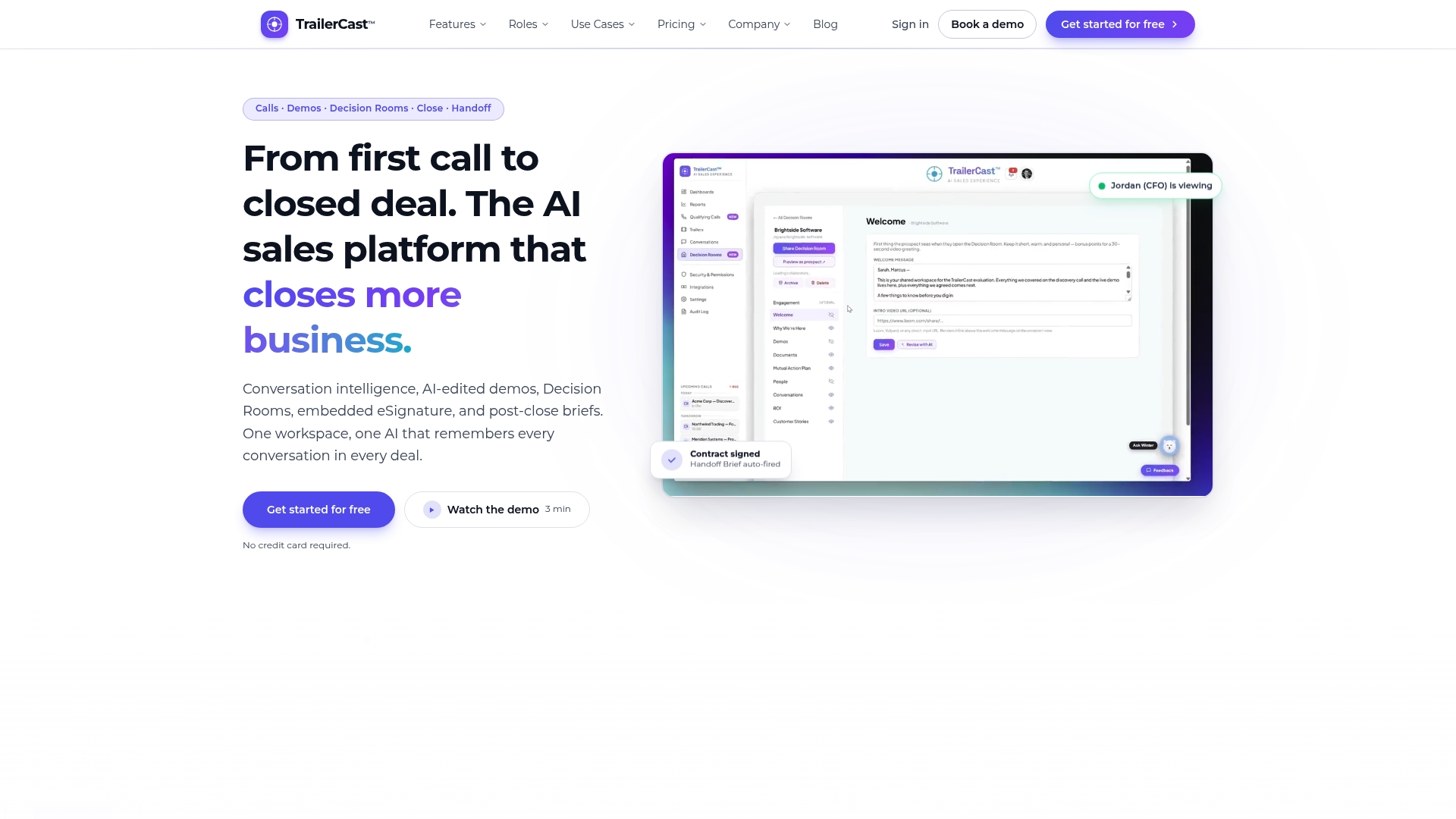
If you want the broader picture first, the full feature tour walks through each stage of a deal.
Common mistakes that make summaries useless
Summarizing everything. A recap that runs as long as the call has no reader. Aim for something scannable in a minute.
Skipping the “so what.” A list of topics isn’t a summary. Say what was decided and what it means for the deal.
Burying the next step. Put it near the top, with an owner and date.
Trusting the AI blindly. Read it. Fix names, figures, and commitments. A wrong pricing number in a recap sent to a CFO is worse than no recap.
Writing only for yourself. Ask what a stakeholder who missed the call needs in order to say yes. If your summary can’t answer that, add a forwardable version. For demos, a short recap video often travels further than an email, and a tracked async follow-up tells you whether anyone watched it.

Ignoring the manager’s use case. Good summaries also make coaching faster. Managers can review the highlights in minutes instead of listening to hours of audio, which we cover in our piece on 10-minute call reviews.
A simple workflow you can start this week
- Before the call: Set the notetaker to join automatically. Open with the recording notice.
- During the call: Stay present. Jot only the two or three moments you want to find later.
- Within the hour: Read the AI summary. Correct names, numbers, and commitments. Tag the missing stakeholder.
- Same day: Send the buyer-facing recap with next steps, owners, and dates.
- Into the CRM: Push the internal version so your manager and SE see the same picture.
- Before the next call: Reread the running brief so you open with their last concern, not a generic agenda.
For multi-stakeholder deals, tie this to a plan for reaching everyone who matters. Our playbook for multi-stakeholder B2B calls goes deeper, and the demo checklist covers what to do before, during, and after the demo itself.
FAQ
What’s the quickest way to summarize a sales call?
Record and transcribe it with an AI notetaker, then use a fixed template: attendees, purpose, pain, objections, commitments, and next steps. Read the draft, fix errors, and send it the same day. The review step takes a few minutes and protects you from mistakes.
Can ChatGPT or a general chatbot summarize my sales calls?
It can summarize a transcript you paste in, but it doesn’t join your calls, schedule itself, or keep context across a deal. Without speaker labels it may confuse what the prospect said with what you said. A purpose-built notetaker handles those gaps for you.
Do I have to tell prospects I’m recording?
Yes, as a habit. Federal law sets a one-party consent minimum, but states can be stricter, and some require everyone’s agreement. A short notice at the start of each call covers you across states. For your company’s policy, ask legal counsel.
What should I put in sales call notes?
Attendees and their roles, the purpose of the call, key points, the buyer’s pain and priorities, decision criteria, objections, commitments, and next steps with an owner and due date. Keep the same sections every time so notes are easy to scan later.
How soon should I send a call summary?
The same day, and within the hour if you can manage it. A prompt recap keeps momentum and gives the buyer something to forward while the call is still fresh.
Sources
- How to write a meeting summary with templates and examples
- Sales Call Recap template
- Build a Speaker-Aware Meeting Intelligence Pipeline, OpenAI Cookbook
- Introduction to the Reporter’s Recording Guide, Reporters Committee for Freedom of the Press
- Complying with the Telemarketing Sales Rule, Federal Trade Commission