10 Minute Call Reviews: Manager First Sales Coaching From Calls With AI

The fastest path to better calls is not choosing between live coaching and post-call review. It is running both: a light-touch rule for when to jump in during a call, plus a tight post-call workflow built on recordings and AI-assisted triage, with a manager making the final call on what matters. Record every call, review the ones that count within 24 hours, and coach to one or two specific behaviors at a time. Do that consistently and you’ll see sharper discovery questions, cleaner next steps, and faster-ramping reps within a few weeks.
TL;DR:
- Tracking call recordings, reviewing high-priority calls within 24 hours, and coaching on one or two behaviors significantly improves rep performance in weeks.
- Whisper coaching should be brief, targeted, and agreed upon beforehand to maintain credibility and avoid negative impact on prospect perception.
- AI tools excel at triage and pattern detection but should supplement, not replace, manager judgment due to their inability to interpret subtle deal meaning.
- Coaching is most effective when tailored to a rep’s experience level, with frequent, detailed feedback for new hires and targeted, infrequent review for veterans.
- Building a unified AI-powered workspace for call recording, analysis, and coaching enables scalable, consistent improvement and better deal pipeline management.
Table of Contents
- Coaching Techniques for Sales Calls While They’re Happening
- Building a Post-Call Coaching Workflow That Actually Gets Used
- Where AI Fits Into Sales Coaching Techniques (and Where It Doesn’t)
- Coaching Frameworks and Metrics That Make Improvement Measurable
- How Managers Should Open a Coaching Conversation
- What to Look for in a Conversation Intelligence Tool
- A 30/60/90-Day Plan to Start Coaching From Calls
- How an Integrated AI Sales Platform Fits This Playbook
- Coaching a Rookie Differently Than a Ten-Year Veteran
- The Real Obstacles That Kill Coaching Programs
- What Good Coaching Language Actually Sounds Like
- Connecting Call Coaching to the Rest of Sales Enablement
- Measuring Whether Coaching Is Actually Working
- What Sales Leaders Get Wrong About AI Coaching Tools
- Run Every Step of This Playbook Inside One Workspace
- Sources
- FAQ
Coaching Techniques for Sales Calls While They’re Happening
Live coaching works when it’s rare, targeted, and invisible to the prospect. Most managers either intervene too much, which kills a rep’s credibility mid-pitch, or never intervene at all, which wastes the one chance to redirect a call before it goes sideways.
The decision to jump in should hinge on three things: how much the deal matters, how experienced the rep is, and whether the prospect knows that a manager is on the line. A junior rep on a first discovery call with a mid-size account needs a different level of oversight than a senior AE closing a renewal. Set the rule before the call starts, not during it.
Whisper coaching (a private chat message or muted-line prompt only the rep sees) works best for course corrections, not full rewrites. Keep every prompt under 20 words:
- “Ask about their current tool budget before pricing.”
- “Slow down. Let the silence sit.”
- “That’s the buying signal. Ask for the next meeting now.”
- “Pull back. You’re talking over them.”
Ride-alongs need setup before the call, not commentary during it. Tell the rep in advance what you’re watching for, agree on a signal for “I need to jump in,” and stay off mute unless that signal appears. A manager who barges in unannounced doesn’t look like backup. They look like a hint that the rep can’t be trusted alone.
The rule that protects credibility: never correct a rep in front of a prospect. If something needs fixing live, it goes through a whisper channel or a scheduled pause (“let me grab my colleague for a second”), never a visible interruption. Reps who get publicly corrected on a call stop taking risks on the next one, and risk taking is exactly what you’re trying to coach into them.
Building a Post-Call Coaching Workflow That Actually Gets Used
Most coaching programs fail not because managers lack insight but because review never happens consistently. The fix is a workflow short enough to survive a busy week.
- Triage every call, review a fraction of them. Not every call deserves 20 minutes. Flag calls by deal stage, deal size, or a rep’s current focus area, and let AI flag ones with unusual talk ratios or repeated objections worth a closer look.
- Review with structure, not a full replay. Skip to timestamps. Check talk-to-listen ratio, count discovery questions, and tag where objections came up and how they were handled. A 45-minute call can be reviewed in under 10 minutes this way.
- Deliver feedback with permission and specifics. Start with “got five minutes to go over Tuesday’s call?” not a cold walk-in. Point to one exact moment on the timestamp, name the behavior you want repeated or changed, and set a single goal for the next call.
- Reinforce with a small rep, not a lecture. A two-minute role-play on the exact objection that came up, or a short call clip added to a team playlist, does more than a written summary ever will.
This matches what Salesforce’s own guidance on sales call strategy recommends: record calls, close with a clear next step, and ground feedback in what actually happened, not memory. That guidance also points to a real gap. Only about 32% of reps report getting excellent coaching on their calls, which means most teams are still running on gut feel instead of a repeatable review habit.
Pro Tip: Cap every feedback conversation at one behavior goal. Reps can absorb “ask more open questions in the first five minutes” far better than a list of six things to fix at once.
Where AI Fits Into Sales Coaching Techniques (and Where It Doesn’t)
AI is a triage tool, not a coach. It’s excellent at surfacing what to look at and terrible at deciding what it means.

Conversation intelligence platforms are genuinely good at a narrow set of tasks: flagging talk-time imbalance, counting filler words, catching a repeated objection the rep never fully addressed, and producing a searchable transcript so nobody has to relisten to a 40-minute call to find one exchange. University sales programs adopting these tools found that faster automated feedback let students run more role-plays and improve their questioning and listening skills more quickly than manual review allowed.
Where AI falls short is judgment. It can’t tell you whether a prospect’s hesitation was a real objection or just thinking out loud. It doesn’t know that the CFO who went quiet has a history of going quiet before saying yes. A study on AI-assisted role-play found the technology scales consistent feedback on delivery and structure well, but it works best as an addition to instructor judgment, not a replacement for it.
Practical use cases that hold up:
- Automated call summaries and action items, so reps stop losing 15 minutes per call to note-taking.
- Short clips built from the exact moment a behavior showed up, for team playlists and peer learning.
- Scaled role-play practice, where AI gives immediate feedback on pacing and clarity between manager sessions.
- Pattern detection across a rep’s last ten calls, flagging a recurring objection nobody’s coached them on yet.
A guardrail worth repeating: treat every AI flag as a signal, not a verdict. Spot-check a sample of what the tool surfaces before trusting it at scale, and never let a metric replace a manager listening to the actual exchange.
Coaching Frameworks and Metrics That Make Improvement Measurable
Structure beats intuition when it comes to proving coaching works. Two frameworks come up constantly in sales enablement, and both hold up in practice.
The 70/30 guideline treats coaching conversations as mostly listening: the rep should talk through what happened and what they’d do differently, with the manager filling in maybe 30% of the airtime with direction. Managers who dominate the conversation get compliance, not adoption.
The 30-60-90 ramp gives new reps checkpoints instead of a vague expectation to “get better.” At 30 days, the goal is competent discovery calls with clear qualification questions. At 60, it’s handling objections without a script. At 90, it’s running a full call independently with only spot-check review.
A coach scorecard works best when it mixes hard numbers with judgment calls:
- Talk-to-listen ratio (a rep dominating a discovery call at 70% talk time is a red flag)
- Discovery questions asked per call, tracked against a target
- Objection response rate: how often an objection got addressed versus deflected
- Next-step clarity: did the call end with a specific, dated action
Active listening tactics tend to cluster in the middle of a call, while discovery questions load at the beginning and end, and calls where one side dominates the talk time consistently correlate with worse outcomes. That’s a strong argument for coaching to call phase, not just whole-call averages. A rep might have a fine overall talk ratio and still be talking over the prospect during the exact ten minutes that mattered.
How Managers Should Open a Coaching Conversation
The words a manager uses in the first 30 seconds of a feedback conversation decide whether the rep actually changes anything or just nods and moves on.
Start by asking, not telling. “Got a few minutes to go over Thursday’s call with Acme?” beats walking in with a verdict already formed. Research on the sales coaching process found that reps are more receptive to feedback when they feel the manager adapted the conversation to them personally, not delivered a generic script pulled from a coaching checklist.
That adaptation looks different depending on experience. A new rep needs the “why” behind a suggestion spelled out. A five-year veteran needs the manager to acknowledge what already worked before suggesting a change; skip that step and they’ll tune out the rest.
Three traps kill coachability fast:
- Feedback that’s all opinion and no evidence (“that felt weak”) instead of a specific timestamped moment.
- Correcting a rep in front of teammates or, worse, in front of the prospect.
- Piling on more than one behavior change per session.
A workable script: “Got five minutes on Tuesday’s call? At the 12-minute mark, when they raised the budget concern, you moved straight to a discount. Next time, try asking one more question about what’s driving the budget conversation before you offer anything. Let’s check that on your next call.”
Pro Tip: Tie every coaching goal back to something the rep already said they want, whether that’s hitting quota, getting promoted, or just not dreading their next call with a tough prospect. Feedback lands twice as hard when it’s framed as their goal, not yours.
What to Look for in a Conversation Intelligence Tool
Buying a tool for call coaching is a features decision, not a brand decision. A handful of capabilities separate a tool that actually saves coaching time from one that just generates more data nobody reviews.
Non-negotiable basics:
- Accurate transcription with speaker separation, so you know who said what without guessing.
- Timestamping tied to specific moments, so feedback can point to an exact second instead of “somewhere in the middle.”
- Clip export, so a five-minute exchange can be pulled out and shared without sending the full 40-minute recording.
- Talk-to-listen and question-count metrics generated automatically, not hand-tallied.
Integration checks:
- Calendar sync with Zoom, Meet, or Teams so recording happens without a rep remembering to hit a button.
- CRM connection so call insights land on the right deal record automatically.
- Single sign-on if you’re rolling this out past a small pilot team.
Operational features that separate a coaching tool from a call recorder:
- Coach scorecards that combine the objective metrics above with a manager’s qualitative notes.
- Shareable playlists for team-wide learning from a single strong (or weak) call.
- Role-play support that lets reps practice against recorded objections, not just live partners.
- Security controls around who can access recordings, especially for calls touching sensitive pricing or legal terms.
Before buying anything, pilot on one call type, discovery calls tend to work best, and measure the actual time a manager spends on review before and after. If a tool doesn’t cut review time or improve the specificity of feedback within a month, it’s not the right fit regardless of what the feature list promises.
A 30/60/90-Day Plan to Start Coaching From Calls
Rolling out call-based coaching works better as a staged rollout than a company-wide mandate on day one.
- Days 1 to 30: pilot and baseline. Pick one team or call type, get recording permissions and disclosure language sorted with legal, and set a baseline for talk ratio, discovery questions per call, and next-step clarity before you change anything. Review a handful of calls manually to calibrate what “good” looks like for your product and market.
- Days 31 to 60: build the cadence. Move to a fixed weekly review rhythm, start building team playlists from strong and weak examples, and introduce short role-plays targeting the specific objections showing up most. Check whether the baseline metrics have moved at all, even slightly.
- Days 61 to 90: scale and prove it. Expand to additional teams or call types, refine the scorecard based on what actually predicted improvement in the pilot, and bring call evidence, not just win rates, into the next quarterly business review.
- Ongoing: governance. Set clear recording and retention policies, get explicit consent language into your call platform, and decide who can access recordings touching sensitive commercial terms before scaling past the pilot team.
Training combined with manager coaching consistently outperforms training alone; one research synthesis found reps improved 43% from training by itself but 67% when manager coaching reinforced that same training. That gap is the entire argument for building the cadence in phase two rather than treating a single kickoff session as coaching.
How an Integrated AI Sales Platform Fits This Playbook
Every step in this workflow, recording, triage, timestamped review, reinforcement, and handoff, maps to specific product capabilities rather than manual effort stitched across five tools.
An AI notetaker that joins the call automatically handles the recording and transcription step, producing speaker-separated summaries, talk-time analysis, and action items without a rep touching a note-taking app. From there, short AI-edited clips pulled from the exact moments that mattered, demo trailers built for sharing, work well for team playlists and peer learning since they isolate the behavior worth studying instead of forcing a 40-minute rewatch.
That evolving record of every call in a deal, sometimes called a Deal Brief, gives a manager the same context across a rep’s entire pipeline instead of one isolated call. And when a deal closes, a handoff brief carrying deal history, stakeholder context, and flagged risks moves automatically to whoever picks up the account next, closing the loop that most coaching programs never touch.
Capabilities that support this directly:
- Speaker-by-speaker transcripts and structured summaries for fast triage
- Auto-generated clips for reinforcement and playlist building
- A searchable call library so pattern detection across many calls doesn’t require manual relistening
- Deal-level context that spans every call, not just the most recent one
Coaching a Rookie Differently Than a Ten-Year Veteran
A single coaching template applied across a whole team wastes the manager’s time and the rep’s patience. What a new hire needs from call review looks almost nothing like what a tenured closer needs.
New reps, generally the first six months, need frequent, granular review. Every call is a chance to build a fundamental habit, so feedback should stay close to mechanics: how a question was phrased, whether they paused after asking it, whether they let silence do its job instead of filling it with more pitch. Weekly review cadences make sense here because habits form fast when reinforced fast.

Mid-tenure reps, six months to two years, need fewer corrections and more pattern work. Review shifts from “how did you ask that” to “why does this keep happening across your last five calls.” This is where AI-flagged repeat objections earn their keep, since a manager reviewing calls one at a time might miss a pattern that’s obvious across ten.
Veteran reps need the least frequent but the most targeted intervention. Reviewing every call for a ten-year closer insults their experience and burns manager time better spent elsewhere. Instead, sample-check calls tied to specific goals, moving into a new vertical, handling a new competitor’s objection, and let the rep self-report where they want a second opinion.
The mistake most managers make is applying the new-rep cadence to everyone, which burns goodwill with senior reps, or applying the veteran cadence to everyone, which leaves new hires guessing at fundamentals for months. Match review frequency to tenure, not to convenience.
The Real Obstacles That Kill Coaching Programs
Most call coaching initiatives don’t fail because the framework is wrong. They fail because of a handful of predictable, fixable obstacles.
Manager time is the biggest one. A sales manager already carrying forecast calls, pipeline reviews, and their own accounts has little room left for structured call review. The fix isn’t finding more hours. It’s cutting review time per call through triage and timestamped tools, so 10 minutes replaces 40.
Rep defensiveness shows up especially with tenured reps who see call review as micromanagement rather than support. Framing coaching around a rep’s own stated goals, not a compliance checklist, tends to defuse this faster than any policy memo.
Inconsistent cadence is the quiet killer. A manager reviews calls diligently for two weeks, then a busy quarter hits and the habit disappears. Building review into an existing recurring meeting, like a weekly one-on-one, protects the cadence better than a standalone commitment that competes for calendar space.
Low manager coaching skill is the one most programs ignore entirely. Research shows that increasing coaching frequency without first building manager skill can actually hurt sales-goal attainment rather than help it. More coaching from an unskilled coach isn’t neutral. It’s counterproductive. Train the managers before scaling the mandate.
Privacy and consent friction slows rollouts when legal and reps aren’t looped in early. Settle recording disclosure language and retention policy before the pilot starts, not after a prospect asks who else heard the call.
What Good Coaching Language Actually Sounds Like
The gap between coaching that lands and coaching that gets ignored usually comes down to specific phrasing, not intent.
A manager opening with “you need to ask better questions” gives a rep nothing to act on. Compare that to: “At minute 8, when they mentioned budget approval taking three signatures, you moved on. Next call, when you hear something like that, ask who those three signers are and what each one cares about.” One is a vague judgment. The other is a rep-usable instruction tied to an exact moment.
During a live call, the same precision matters even more since there’s no time for nuance. A whisper prompt like “ask about timeline” beats a vague “dig deeper” because the rep can act on it in the next five seconds without breaking their flow with the prospect.
For post-call feedback, a few language patterns consistently outperform generic praise or criticism:
- “What made you decide to ask that at that point?” (This surfaces the rep’s own reasoning, which is more durable than a manager’s correction.)
- “If you had that moment back, what would you try instead?” (This builds self-coaching instead of dependency on the manager.)
- “That question at minute 15 opened the whole conversation up. Do that earlier next time.” (Specific praise reinforces exactly what to repeat.)
The common thread: every example ties language to a moment in the call, not a general impression. Vague feedback, whether critical or complimentary, rarely changes what a rep does on the next call.
Connecting Call Coaching to the Rest of Sales Enablement
Coaching from calls works best as one layer of a larger enablement system, not a standalone initiative running parallel to everything else.
Onboarding programs benefit most directly. New-hire training that includes real call examples, both strong and weak, teaches faster than generic scripts because reps see actual language that worked against actual objections. Pulling clips from top performers’ calls into onboarding curriculum turns abstract training into concrete modeling.
Playbooks and battlecards should get refreshed based on what call data actually shows, not just what product marketing assumes reps need. If call reviews keep surfacing the same competitor objection with no consistent response, that’s a battlecard gap, not just a coaching gap.
Content and messaging teams benefit from the same feedback loop. If discovery calls consistently show prospects confused about a specific feature, that’s a signal for marketing and product content, not just something to coach around individually. A structured discovery call framework built around specific qualifying questions gives reps and enablement teams a shared standard to coach toward instead of leaving question quality to individual style.
Quarterly business reviews and pipeline forecasting also get sharper when they’re grounded in actual call evidence, specific objections trending upward, a competitor showing up more often, rather than a manager’s general sense of how the quarter felt. Enablement teams that treat call data as a continuous input to training design, not a one-time coaching exercise, tend to close the gap between what training teaches and what reps actually do on a live call.
Measuring Whether Coaching Is Actually Working
Coaching programs die quietly when nobody can prove they’re worth the time invested. Tracking improvement doesn’t require a complicated dashboard, just consistent measurement against the baseline set before the program started.
Start with the same call-level metrics used in the scorecard: talk-to-listen ratio, discovery questions per call, objection response rate, and next-step clarity. Track these monthly per rep, and watch for movement rather than absolute scores, since a rep improving from a rough baseline matters more than hitting an arbitrary target on day one.
Ramp time is the clearest business-facing proof point. If new reps historically took four months to hit full quota and a coached cohort hits it in three, that’s a number finance and leadership both understand. Win rate and average deal cycle length matter too, though they move slower and get influenced by more variables than call quality alone, so treat them as a secondary signal rather than the sole proof of coaching’s impact.
For a fair comparison, track a coached cohort against a baseline group where possible, even an informal one, since overall market conditions shift regardless of coaching quality and can otherwise mask or inflate real improvement.
The simplest ROI framing for a QBR: pull two or three call clips showing a specific behavior before coaching and after, alongside the metric shift, and let the evidence make the case instead of a slide full of adjectives. A quick post-call summary pulled straight from the call record gives you that evidence without reconstructing it from memory weeks later.
What Sales Leaders Get Wrong About AI Coaching Tools
The most common mistake I see in how teams talk about AI coaching tools is treating them as either a replacement for managers or a gimmick not worth the budget. Both are wrong, and the research backs neither extreme. AI’s real value is speed: faster feedback loops, more role-play repetitions, quicker pattern detection across dozens of calls a manager would never have time to relisten to manually.
But the research is just as clear that coaching frequency without manager skill can actively hurt performance, not just fail to help. That means the AI conversation shouldn’t start with “which tool has the best transcription.” It should start with whether managers know what good coaching sounds like in the first place. Buy the tool second. Train the coaching skill first.
If there’s one prediction worth making, it’s that the teams who win with AI-assisted coaching over the next few years won’t be the ones with the most sophisticated tool. They’ll be the ones who validate every AI-flagged pattern against a human ear before acting on it. Start with a 30-day pilot on one call type, measure the baseline honestly, and let the data argue for expansion instead of assuming it upfront.
— Daniel
Run Every Step of This Playbook Inside One Workspace
Most teams try to build this workflow by stitching together a call recorder, a separate clip tool, a deal room, and a handoff process that lives in someone’s memory. Some platforms replace that stack with one workspace where a single AI follows the deal from the first call to the signed contract, so the coaching context a manager needs, past calls, flagged objections, stakeholder history, doesn’t get lost between tools.
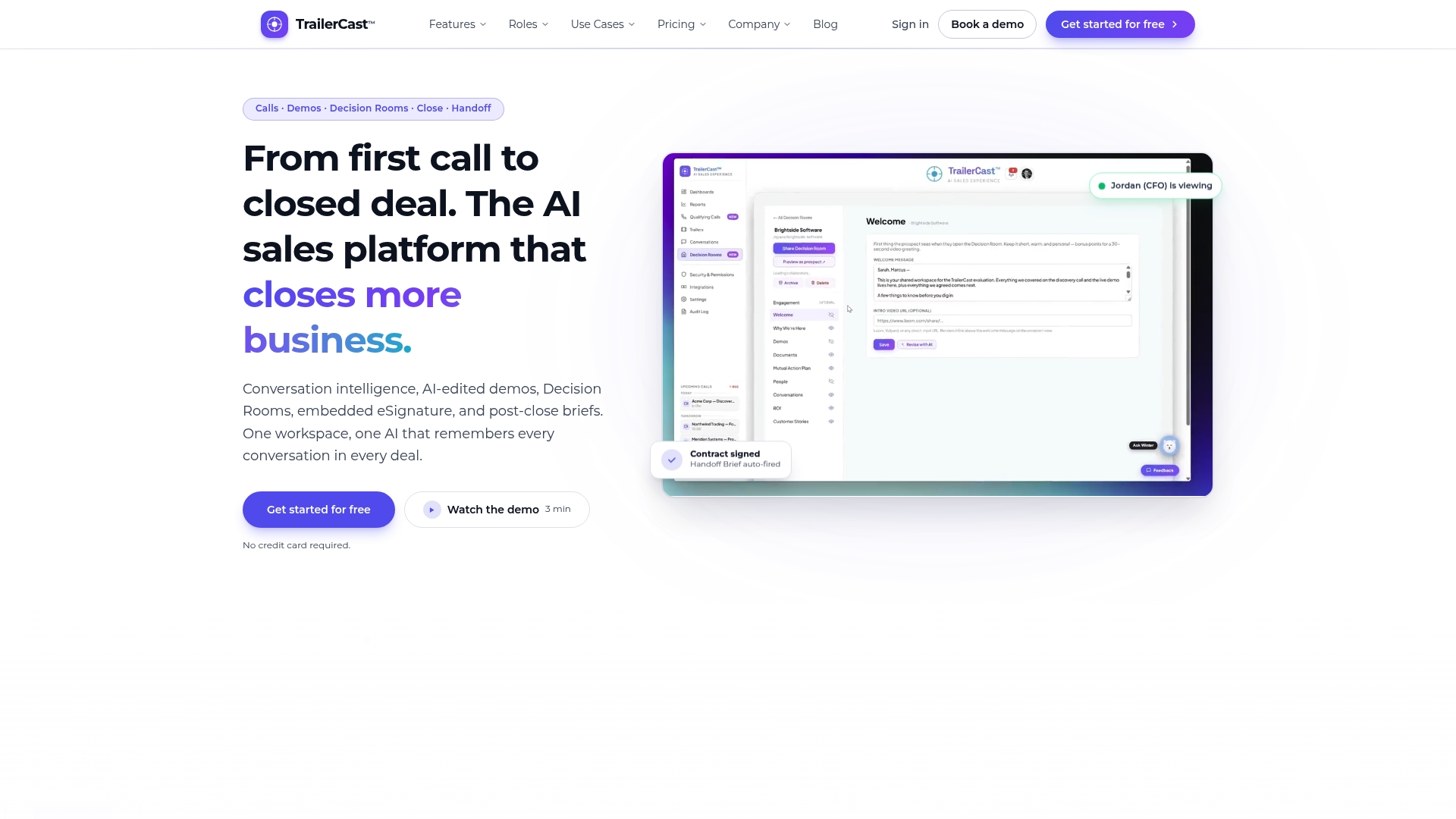
The AI notetaker joins Zoom, Meet, or Teams automatically, produces speaker-separated transcripts and talk-time analysis, and builds an evolving record across every call in a deal, not just the most recent one. When a call is worth sharing for coaching or peer learning, the platform can cut it into a short trailer instead of forcing anyone to rewatch a full recording. Every plan includes every feature. One plan, every feature, starts at $59 per seat per month billed annually, with a free trial and no credit card required. If you’re ready to see how a pilot would look on your own calls, start with the product page and run it against one call type for the first 30 days.
Sources
- Sales Students Benefit From Artificial Intelligence Tools - Naveen Jindal School of Management | The University of Texas at Dallas
- AI-assisted role-play study (Georgia Southern University, 2026)
- Study on active listening tactics and call-position effects (Cal State scholarworks)
- Effective Sales Call Strategies (Salesforce Trailhead)
FAQ
How much does sales coaching typically cost?
Cost depends heavily on whether you’re paying for outside coaching consultants, a training platform, or a conversation intelligence tool that supports internal manager coaching. Trailercast’s own platform runs one flat tier at $59 per seat per month billed annually, covering every feature with no gated add-ons.
What is the 30-60-90 rule in sales?
It’s a ramp framework that sets checkpoints for new reps: competent discovery calls by day 30, independent objection handling by day 60, and running full calls with only spot-check review by day 90. It gives managers a concrete timeline instead of a vague sense of when a rep should be “ready.”
What is the 70/30 rule in coaching?
The goal is getting the rep to reason through their own call instead of just absorbing a manager’s opinion.
What are the 5 C’s of coaching?
Definitions of this framework vary across sources and industries, and there’s no single version consistently backed by sales-specific research. Rather than force a definition that doesn’t hold up, focus on the elements this article covers directly: clear behavior goals, consistent cadence, and specific, timestamped feedback.