Sales Data Fragmentation: What It Is and How to Fix It

Sales data fragmentation is what happens when the facts about a deal live in five or six places and none of them holds the whole story. The call is in one recording, the pricing question is in an email thread, the stakeholder map is in a rep’s head, the forecast category is in a spreadsheet, and the CRM stage is whatever someone remembered to update. The fix is not another dashboard. It is deciding where each fact lives, shrinking the number of places, and giving every deal one record that follows it from first call to handoff. Below: where fragmentation comes from, how to spot it, what it costs you in forecasts and champion handoffs, and a practical plan to clean it up.
TL;DR
- Sales data fragmentation means deal information is scattered across disconnected tools, files and people, so no single record is reliable.
- It is structural: tools get added one at a time to solve one problem, and none of them shares a data model.
- You feel it as forecast arguments, deals that die in meetings you weren’t in, and handoffs where the customer repeats everything.
- Fix it in order: name a system of record per object, agree on definitions, cut the tool count, then close the gap between calls.
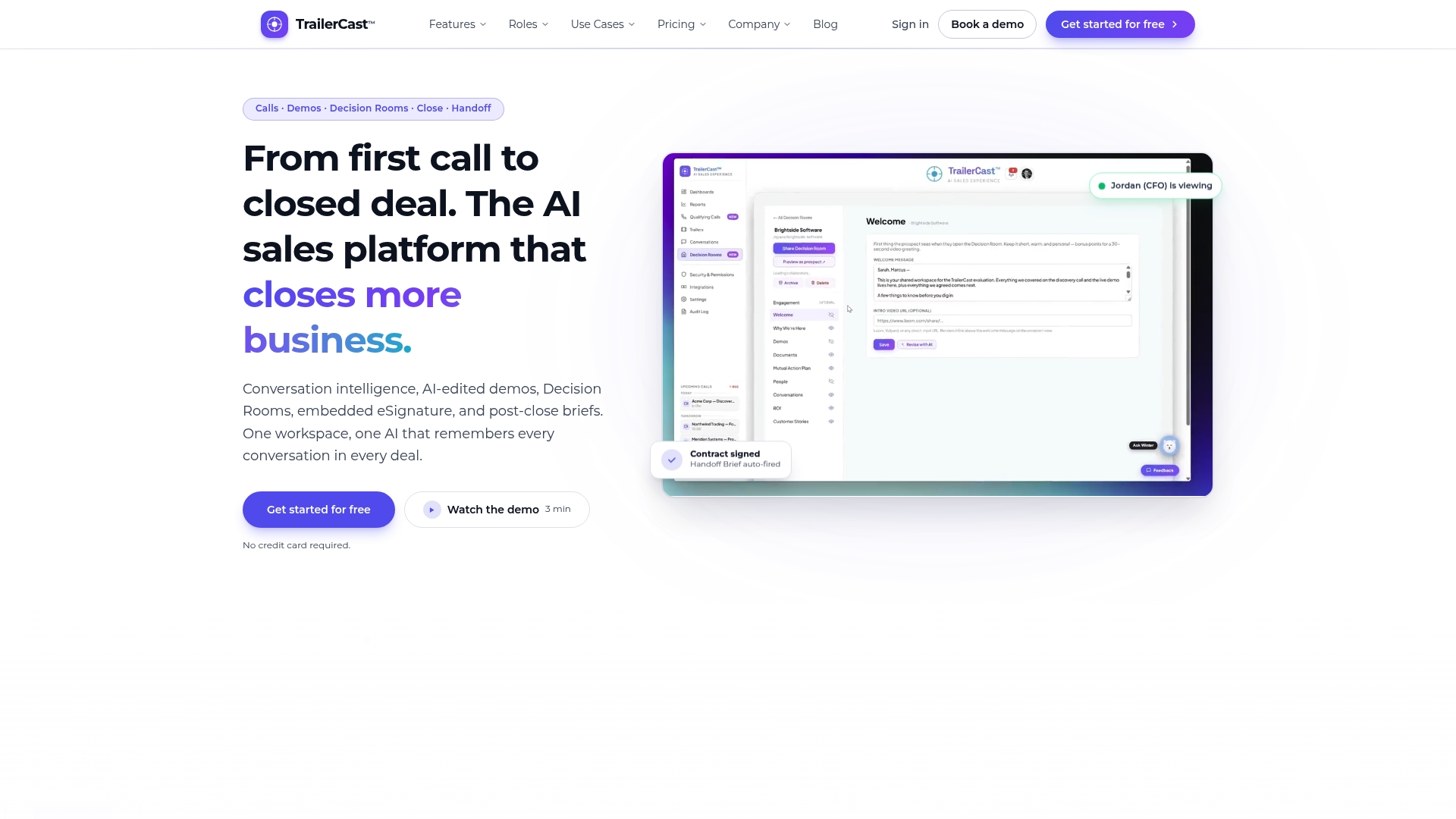
- We built TrailerCast to keep calls, demos, deal rooms, signature and handoff in one workspace, so the deal stays coherent between conversations.
Table of Contents
- What sales data fragmentation actually means
- Why it happens: tools arrive one at a time
- How to tell if your team has it
- What it costs you: forecasts, visibility and the space between calls
- A practical plan to reduce fragmentation
- The shortcut: fewer places, one memory
- Our view: the problem is the space between conversations
- See it on one plan
- What good looks like after you fix it
- FAQ
- Sources
What sales data fragmentation actually means
Fragmented sales data is customer and deal information spread across disconnected tools, spreadsheets and departments, never forming one reliable record. Act! describes it as information sitting in inboxes, spreadsheets, calendars, marketing platforms, accounting systems, handwritten notes and individual memory, which slows sales cycles, makes follow-up inconsistent and lets expansion and renewal opportunities slip.
If you work in SaaS sales or sales engineering, you already know the feeling. You are prepping for a second call and you need to remember what the CISO asked in week one, which integration the champion cares about, and whether legal has seen the security questionnaire. The answers exist. They are just in four tools and two people’s notes.
What counts as sales data
It is wider than CRM fields. A sales data warehouse guide from Default lists the usual set: CRM records such as leads, accounts, opportunities, stages and owners; marketing campaigns and attribution; product usage; website visits; firmographic enrichment; intent signals; billing data such as ARR, renewals and invoices; and sales activity including calls, meetings, emails and sequences.
For a seller or solutions consultant, the most valuable slice is the one that is hardest to store: what was actually said and shown. Discovery answers, demo reactions, objections and the buying group’s concerns rarely survive as clean CRM fields. They live in recordings, notes and chat messages, which is exactly where fragmentation hurts most.
Why it happens: tools arrive one at a time
Nobody designs a fragmented stack. It accumulates. HG Insights explains that CRM, marketing automation, intent providers, BI tools and sales engagement platforms were each adopted to solve a specific problem and were rarely designed to share a common data model. Each collects data in its own schema, manual syncs and CSV exports become the connective tissue, and every system ends up holding a partial version of the truth.
That gives you a predictable pattern in a SaaS sales org:
- A call recorder gets added to coach reps.
- A video or demo tool gets added because buyers want something to forward.
- A shared folder or portal appears for proposals and security documents.
- An eSignature app handles the contract.
- Customer success builds its own handoff doc, usually from scratch.
Each purchase was reasonable. Together they create five places where the same deal is described five different ways.
Even one CRM can be fragmented
Fragmentation is not only a tool-count problem. Fullcast points out that inside a single CRM, “lead” can mean a form fill to marketing, a sales-accepted contact to SDRs and almost nothing to customer success, while “pipeline” can mean every open opportunity to marketing, Stage 2 and above to sales, and weighted current-quarter deals to finance. Those are definitional gaps, not typing errors. You can sync every field perfectly and still argue about the numbers.
How to tell if your team has it
You do not need an audit to recognize the symptoms. Check how many of these sound familiar:
- Forecast calls start with a debate about whether the numbers are right. A RevOps diagnostic from Caugia names this data distrust as the clearest symptom.
- The same deal has different stages or probabilities in different tools. One system says negotiation, another says verbal commit, the CRM says something else.
- You re-listen to recordings to find one answer. If the information is technically captured but nobody can find it in under two minutes, it is functionally lost.
- Your champion re-sells from memory. After a good demo they walk into a meeting with the CFO, who wasn’t there, holding a PDF and their own recollection.
- Handoffs restart discovery. Customer success asks the buyer questions they already answered in the sales cycle.
- Reps keep private notes because the official record isn’t worth updating.
Three or more means the problem is structural and will not be fixed by reminding reps to log activity.
What it costs you: forecasts, visibility and the space between calls
Forecasts that drift
The clearest hard number comes from the InsightSquared and RevOps Squared 2021 State of Sales Forecasting study of nearly 400 B2B enterprise organizations. It found that 68% of companies miss forecasts by more than 10%, that 80% use two or more forecasting platforms, and that CRM data quality (44%) and manual processes (43%) were among the top causes of poor accuracy. The study is from 2021, so treat it as evidence of the pattern rather than today’s benchmark, but the causes it names are the same ones fragmentation produces.
The mechanics are simple. Every tool sees one slice of the deal: CRM fields, a recording, an email thread. A forecast built on one slice is a guess about the rest. If you want a plain explanation of the metric itself, this page on sales forecast accuracy covers how it is measured, and our own guide to forecast rollup methods shows how to choose a rollup once the inputs are trustworthy.

Deals that die where you can’t see them
The more expensive loss is not a number on a report. It is the internal meeting you were never invited to. Your champion loved the demo. Then they go back to a CFO who cares about payback, a CISO who needs answers to a security questionnaire, and an IT lead who wants to know about SSO. The materials they carry are a recording nobody will rewatch and a deck written for someone else.
That is the gap we focus on at TrailerCast. The calls were never the problem. The space between them was. When the context of those conversations sits in disconnected systems, the champion becomes the only integration layer between your product and the buying group, and champions are not reliable integration layers.
Handoffs that start from zero
Post-close is where fragmentation shows up for the customer. They told you their goals, their stakeholders, their timeline and their concerns. If those details live in call recordings and rep notes, customer success inherits a contract and a thin summary. Our customer handoff template lays out what a good transfer should carry across so the buyer does not repeat themselves.
A practical plan to reduce fragmentation
There is no point buying a new tool before you know what you have. Aris GTM lays out a 30-60-90 day plan for the product-led side of go-to-market, and its sequencing is a good model for sales teams too: inventory first, rules second, automation third.

Days 1 to 30: inventory and ownership
List every tool that touches a deal, who owns it, what it costs and when the contract renews. Then, for each object (account, contact, opportunity, call, document, contract, handoff), name one system of record. Write it down. If two tools both claim to own the opportunity stage, you have found your first conflict. Pause new tool purchases while you do this, because every addition makes the map harder to draw. Our look at the real cost of tool sprawl can help you put numbers on the inventory.
Days 31 to 60: agree on definitions and identity
Get sales, marketing and customer success in a room and settle what a lead, a qualified opportunity and pipeline mean. Fullcast’s examples above show why: without shared definitions, perfectly integrated systems still disagree. Then fix how records are matched. Aris GTM names conflicting dedupe rules, missing user-to-account stitching and inconsistent event naming as recurring failure points. For a sales team, the practical version is one way of identifying a contact and one way of tying that contact to an account and deal.
Days 61 to 90: close the loop
Only now do you automate. Make sure activity and outcome data write back to the system of record rather than staying in the tool that produced it. Build one view of each deal that a rep, a sales engineer and a manager would all recognize. Then measure: do forecast reviews still open with an argument about the data?
The shortcut: fewer places, one memory
The plan above reduces fragmentation by governing your tools. There is a second lever that is often faster: reduce the number of tools that need governing.
The five jobs that most commonly split a deal across systems are conversation intelligence, demo content, buyer-facing deal rooms, eSignature and post-close handoff. If those five live in one workspace, there is nothing to sync between them and one record of what happened.
Here is what that looks like at each stage of a deal, using what TrailerCast does:
| Deal stage | What gets fragmented | What stays together in one workspace |
|---|---|---|
| Calls | Notes, recordings, action items | An AI notetaker joins Zoom, Meet and Teams, transcribes speaker by speaker, and builds an evolving Deal Brief across every call in the opportunity |
| Demos | Raw recordings, one generic follow-up | AI-edited trailers that pick the 8 to 15 minutes that mattered, personalized per prospect or stakeholder |
| Decision rooms | Attachments, links, separate portals | Buyer-facing deal rooms with engagement analytics |
| Close | Contract in a separate app | Embedded eSignature |
| Handoff | A hurried summary email | An AI-generated handoff brief |
If you want to see how any one stage works in detail, start with AI call notetaking for discovery calls, deal room analytics or the AI sales handoff brief.
Why it helps sales engineers in particular
If you run demos, fragmentation costs you twice. First, you rebuild context before every follow-up. Second, the best moments of your demo are trapped in a recording. A trailer built from the most relevant minutes, with a CFO version that talks pricing and a CISO version that talks security, gives your champion something worth forwarding to the people who weren’t on the call. For the finance buyer specifically, see our guide to CFO-ready demos.
Our view: the problem is the space between conversations
I built TrailerCast after watching the same thing happen deal after deal. A great call, a great demo, and then silence while the champion carried our story into rooms we couldn’t enter.
Most advice on sales data fragmentation treats it as a hygiene problem: enforce CRM discipline, add an integration, buy a dashboard. Those help. But they all assume the data is already captured somewhere and only needs to be moved. In a real deal, the most important context is never typed in by anyone. It is said on calls, shown in demos and asked by people who aren’t on them.
That is why we put conversation intelligence, demo trailers, decision rooms, eSignature and handoff into a single workspace with one AI that follows the whole opportunity. It remembers every call, demo and message, so the deal stays coherent even when you are not in the room. Fewer tools means fewer places for the truth to split, and no one has to do the stitching by hand.
If you take one thing from this article, take this: don’t ask your reps to be better integrators. Give the deal a home.
Daniel
See it on one plan
TrailerCast is one plan with every feature, from $59 per month per seat, so you are not choosing between tiers to get calls, trailers, deal rooms, eSignature and handoff together. Teams that want to replace a patchwork of call recorders, video tools, portals and signature apps can see how it fits on the TrailerCast plan page.
If you would like the wider picture first, our overview of sales automation tools for B2B teams walks through what each category does, and sales engagement analytics explains which signals are worth tracking once your data sits in one place.
What good looks like after you fix it
You will know the work is paying off by behavior, not by a dashboard:
- Forecast reviews open with the deal, not with an argument about whose number is right.
- A new rep or a sales engineer joining a deal late can read one brief and be useful on the next call.
- Champions forward something specific to each stakeholder instead of re-selling from memory.
- Customer success starts from what the buyer already said.
- Adding a tool requires naming which object it owns and which tool it replaces.
A caution on measuring: set your own baseline first. Look at how far your last few forecasts landed from actual closed revenue and how often stage values disagree between systems. Then compare after a quarter. Your own numbers are the benchmark that matters, not the industry studies.
FAQ
What does it mean when sales data is fragmented?
It means the information about your customers and deals is spread across separate tools, files and people, with no single record you can trust. Typical locations include the CRM, call recordings, email, spreadsheets, shared drives and individual notes. The result is conflicting versions of the same deal and time lost reconciling them.
What is sales data?
Sales data is everything you record about prospects, deals and customers: contact and account details, pipeline stages, calls and meetings, emails, usage, billing and outcomes. Zendesk’s sales analytics guide groups the metrics into rep metrics such as stage conversion, deal metrics such as win rate and sales cycle, and business metrics such as MRR and acquisition cost.
Is fragmentation a tool problem or a process problem?
Both. Tools added one at a time create separate data models, and teams that define terms like lead or pipeline differently disagree even when the data syncs. Start with definitions and a named system of record per object, then reduce the number of tools that hold deal context.
Where should a small SaaS sales team start?
Inventory every tool that touches a deal and write down which one owns each kind of record. Freeze new purchases while you do it. Then look at where context is lost between calls, such as demos, security questions and handoffs, because that is where fragmentation costs deals.
Sources
- Act!: Why Fragmented Customer Data Slows SMB Sales Growth
- Default: Sales Data Warehouse Guide
- HG Insights: The Hidden Cost of Fragmented Market, Account and Technology Data
- Fullcast: One CRM, Three Teams, and Zero Agreement on the Data
- Caugia: Revenue Operations for B2B SaaS
- InsightSquared: 2021 State of Sales Forecasting
- PlusVibe: What is Sales Forecast Accuracy?
- Aris GTM: Tool Sprawl and Data Fragmentation
- Zendesk: What makes good sales data?