Ask 12 Questions to Qualify: 30 Minute Discovery Call Framework With AI and Metrics

Use a 30-minute, five-phase discovery call framework, opening, situation, problem, impact, and future state, that ends with a locked next step. Each phase has a job: qualify or disqualify the deal, not just fill 30 minutes with pleasant conversation. Reps who run this structure convert discovery to proposal faster because every question either builds urgency or closes off a dead end early, before it wastes three more meetings.
TL;DR:
- Running a structured five-phase discovery call maximizes qualification and reduces wasted meetings by focusing on urgency and decision-making early.
- Using the appropriate qualification framework, such as BANT for small deals or MEDDIC for enterprise, enhances targeting depending on deal size and complexity.
- Asking targeted questions across situation, problem, impact, and future state categories helps uncover genuine pain and quantifies costs effectively.
- Consistently evaluating deal viability with clear criteria like urgency, budget, decision process, champion presence, and timeline prevents chasing unqualified prospects.
- Employing AI tools for call transcription and context retention accelerates rep training, improves qualification accuracy, and ensures better deal handoff.
Table of Contents
- The 30-Minute Discovery Call Structure, Minute by Minute
- Which Question Framework Should You Use, SPIN, BANT, MEDDIC, or SPICED?
- Discovery Call Questions Organized by Situation, Problem, Impact, and Vision
- How Do You Know When to Qualify or Disqualify a Deal?
- Scripts for Opening, Transitioning, and Closing the Call
- The Mistakes That Kill Discovery Calls, and How to Fix Them Live
- How Do You Train Reps and Measure Discovery Call Quality?
- Personalization Strategies Based on Buyer Persona or Industry
- How Should You Handle Objections and Pushback During Discovery?
- Tailoring Discovery Calls for Inbound vs Outbound Leads
- A Coach’s Shortcut for Ramping Reps Faster
- Run Every Discovery Call Inside One Workspace With TrailerCast
- Where to Go Deeper on Discovery Call Frameworks
- Sources
The 30-Minute Discovery Call Structure, Minute by Minute
Most reps wing it after the first two minutes. That’s the problem. A phased agenda breaks the call into predictable chunks so you always know what you’re supposed to be learning right now, not just what you’re supposed to be saying.
Here’s the breakdown that works across most B2B deal types:
- 0 to 3 minutes: opener, agenda, and permission. State who you are, confirm the time box, and ask permission to steer. “I’ve got three things I want to cover, then leave time for your questions. Sound good?” This sets mutual control instead of you interrogating them.
- 3 to 10 minutes: situation and context. Get the lay of the land. What tools do they run today? Who’s involved? What triggered this call now, not six months ago?
- 10 to 18 minutes: problem and implication. This is where deals get won or lost. Surface the actual pain, then push on what it costs them in time, money, or risk if nothing changes.
- 18 to 24 minutes: future state and need-payoff. Ask what winning looks like. Get them describing the outcome in their own words, not yours.
- 24 to 30 minutes: qualification recap and next-step close. Summarize what you heard, confirm you got it right, and lock a specific calendar date for the next conversation.
The decision rule is simple: if by minute 18 you haven’t found a real problem with a cost attached, you’re not qualifying, you’re chatting. Disqualify gracefully and move on. High performers deviate from this agenda 40 to 60 percent of the time, which sounds contradictory until you realize the agenda’s job is to steer, not straitjacket the conversation.
Pro Tip: Write your three anchor questions (current state, desired state, the biggest blocker) on a sticky note. If the call gets cut short or hijacked by a stakeholder detour, you can still walk away with minimum viable qualification.
Which Question Framework Should You Use, SPIN, BANT, MEDDIC, or SPICED?
None of these frameworks were built to replace each other. They were built for different deal shapes, and picking the wrong one for your deal size is why so many reps sound like they’re reading a script.
- BANT (Budget, Authority, Need, Timeline) fits short, transactional deals with one or two decision makers and a compressed sales cycle. It’s fast and blunt, which is exactly what a low-ACV deal needs.
- SPIN (Situation, Problem, Implication, Need-payoff) is the backbone of consultative selling and maps almost exactly onto the 30-minute structure above. It’s teachable to new reps because the four question types build on each other logically.
- MEDDIC (Metrics, Economic buyer, Decision criteria, Decision process, Identify pain, Champion) earns its complexity in enterprise deals with multiple stakeholders and a procurement layer. Skip it for a $5,000 deal; it’ll feel like overkill and slow you down.
- SPICED (Situation, Pain, Impact, Critical event, Decision) is a newer variant that adds a hard deadline trigger, useful when urgency is the thing you’re most unsure about.
A rough heuristic: deals under $10,000 ACV with a single buyer lean BANT. Mid-market deals with two to four stakeholders and a six to eight week cycle lean SPIN. Enterprise deals with five or more stakeholders and a multi-month cycle need MEDDIC’s rigor to track who actually signs.
You don’t have to pick one and marry it. Most experienced reps blend SPIN’s question sequencing with MEDDIC’s qualification fields, asking implication questions in SPIN’s style while quietly logging the economic buyer and decision process in the background.
Discovery Call Questions Organized by Situation, Problem, Impact, and Vision
A ready bank beats improvising every time, especially for reps still building their instincts. Group your questions into four buckets and pull from each depending on where the conversation naturally goes.
Situation questions (context-setting, low risk):
- “Walk me through how you’re handling this today.”
- “Who else touches this process besides you?”
- “What prompted you to look into this now?”
- “How long has this been the setup?”
- “What’s already in your stack that this would need to work alongside?”
Problem questions (surfacing pain):
- “What’s not working about the current approach?”
- “Where does this break down most often?”
- “What have you already tried to fix it?”
- “What happens when this goes wrong?”
- “Who feels this pain the most on your team?”
Impact questions (quantifying the cost):
- “What does that delay cost you, in hours or dollars?”
- “How does this affect the rest of the team when it happens?”
- “If this stays broken another two quarters, what’s the downstream effect?”
- “Has this ever cost you a customer or a deal?”
- “What’s the risk to you personally if this doesn’t get solved?”
Vision questions (future state, need-payoff):
- “If this were solved, what would change day to day?”
- “What does success look like six months from now?”
- “Who would notice first if this got fixed?”
- “What would you be able to do that you can’t do today?”
- “How would you measure whether this worked?”
Vendors with roots in SPIN methodology argue the implication questions carry the most weight, and that tracks. They’re what turn a mild inconvenience into a business case with a dollar figure attached.
On volume: Gong’s call analysis puts the sweet spot at 11 to 14 targeted questions per call. Fewer than that and you miss qualification data. More than that and it stops feeling like a conversation and starts feeling like an interrogation. Sequence matters too, start broad with situation questions, then narrow into problem and impact once you sense where the real friction lives. Open-ended phrasing keeps buyers talking; save yes/no questions for confirming facts, not exploring pain.
How Do You Know When to Qualify or Disqualify a Deal?
Qualification isn’t a gut feeling, it’s a checklist. Score these five dimensions during or immediately after the call, and be honest even when the deal feels exciting.
- Urgency: Is there a specific trigger event or deadline, or is this “nice to have someday”?
- Budget shape: Do they have money allocated, or would this require a net-new budget request?
- Decision process: Do you know who signs, and how many approvals stand between here and a contract?
- Champion presence: Is there someone on the call who will fight for this internally when you’re not in the room?
- Timeline: Can they name a target go-live date, even a rough one?
Red flags worth walking away from: no budget conversation possible before next quarter, no named decision maker willing to get on a second call, and success criteria that don’t match what your product actually does. Forcing a deal that fails two or more of these usually just delays the inevitable “no” by sixty days. A structured sales qualification process built around explicit criteria like these catches this earlier than instinct does.
A minimal five-field scorecard you can drop straight into your CRM:
Aggregate this across your team and you get real pipeline hygiene instead of a forecast built on optimism.
Scripts for Opening, Transitioning, and Closing the Call
The words you use in the first ten seconds and the last thirty seconds matter more than anything in between. Steal these.
- Opener: “Thanks for making time. I want to spend the next 25 minutes understanding where you’re at and whether this is even worth pursuing together, then we’ll figure out next steps if it makes sense on both sides.”
- Transition from situation to problem: “You mentioned [X tool]. What’s the part of that workflow that frustrates your team the most?”
- Transition from problem to impact: “If that kept happening for another two quarters, what would that actually cost you?”
- Transition to close: “Based on what you’ve shared, here’s what I’m hearing. Does that match your read?”
- Next-step close: “I’d like to bring in our solutions engineer for a working session focused on [specific pain]. Does Thursday at 2 PM work, and who else should be there?”
Notice the last script does three things at once, it names a date, a specific stakeholder, and a concrete deliverable. HubSpot’s guidance recommends sending the recap within 24 hours so the commitment doesn’t go cold while it sits in someone’s inbox.
The Mistakes That Kill Discovery Calls, and How to Fix Them Live
The same five mistakes show up on losing calls again and again.
- Skipping the agenda. Fix: pause, say “let me make sure we cover what matters to you,” and re-anchor.
- Asking too many closed questions. Fix: rephrase the next question as “tell me about…” instead of “do you…”.
- Jumping straight to features before impact is clear. Fix: ask one implication question before pitching anything.
- Letting the call end without a next step. Fix: never hang up before naming a date, out loud, on the call.
- Talking more than you’re listening. Fix: count your own talk time mentally; if you’ve talked for over 40% of the call, stop and ask a question.
Pro Tip: If a call is drifting, don’t apologize for redirecting it. Just say “can I pause us for a second?” and ask your single highest-leverage impact question. Buyers respect control more than they respect politeness.
How Do You Train Reps and Measure Discovery Call Quality?
Good discovery isn’t a talent, it’s a coached skill. Run weekly role-plays where reps practice the impact and vision questions out loud, not just read them off a script.
Track three numbers consistently: questions asked per call, talk-time ratio, and qualified-to-proposal conversion rate. Reps below the 11-question floor almost always have lower conversion, and that pattern shows up fast once you’re actually measuring it instead of guessing.
This is where AI call intelligence earns its keep. An AI notetaker that transcribes every call and flags qualification signals automatically shortens the feedback loop from “weeks until a manager listens to a recording” to “same day.” Tools built around this workflow, TrailerCast’s discovery-call notetaker among them, also carry deal context forward so a rep ramping up on a repeatable sales process isn’t starting from a blank page every time a deal changes hands.

Personalization Strategies Based on Buyer Persona or Industry
A CFO and a VP of Engineering hear the same product pitch completely differently, and your discovery questions should reflect that before the call even starts. Research the persona, not just the company: a finance buyer wants cost avoidance and ROI timelines, while a technical buyer wants integration friction and security posture.
Industry context changes your language too. Ask a healthcare buyer about compliance exposure; ask a logistics buyer about downtime cost per hour. Generic questions signal you didn’t prepare, and buyers notice within the first ninety seconds.
Build a short pre-call brief for each persona type you sell to, three situation questions, two problem questions, and one impact question tuned to that role’s actual incentives. A sales engineer selling to a security-conscious buyer needs a different opener than one selling to an operations lead chasing efficiency gains. The framework stays the same; the vocabulary and emphasis shift.
This is also where stakeholder-specific follow-up matters. If your champion needs to resell the conversation internally to a CFO who wasn’t on the call, a generic recap email undersells what happened. Persona-specific materials, even a short trailer that speaks the economic buyer’s language, travel better through a buying committee than a one-size-fits-all PDF.

How Should You Handle Objections and Pushback During Discovery?
Objections during discovery are usually a sign you skipped ahead too fast, not a sign the deal is dead. If someone pushes back with “we already have a tool for this,” don’t argue the feature set. Ask what’s not working about the current tool instead, that’s an impact question in disguise, and it reopens the conversation without confrontation.
Price objections at the discovery stage almost never mean the price is wrong. They usually mean you haven’t built enough urgency yet. Acknowledge it plainly, “that’s fair, we haven’t even gotten to pricing yet, let’s finish understanding the problem first,” and redirect back to impact.
The hardest moments are when a stakeholder gets defensive about the current process, often because they built it. Don’t corner them. Ask what’s working well before asking what isn’t, and let them save face while still surfacing the real gap.
Silence is your friend here. When you ask a tough implication question and get an uncomfortable pause, resist the urge to fill it. The best answers usually come after five seconds of quiet that feels a lot longer than it is.
Tailoring Discovery Calls for Inbound vs Outbound Leads
Inbound leads already raised their hand, so treat the first three minutes differently. Skip the heavy qualifying-your-time preamble and get straight to “what made you book this call today?” They’ve self-selected some urgency; your job is to find out how much.
Outbound leads need more situation-building because they didn’t come looking for you. Spend more time in minutes three through ten establishing why this is worth their attention at all, since you interrupted their day rather than answering a need they’d already articulated.
Inbound calls tend to run shorter on the situation phase and longer on impact, since the prospect often already knows their pain and just needs help sizing it. Outbound calls run the opposite, more time earning the right to ask impact questions because trust hasn’t been established yet.
One thing stays constant across both channels: the next-step close. Whether the lead came from a demo request or a cold outbound sequence, the call still needs to end with a calendared date, a named stakeholder, and a specific deliverable. Channel changes the runway into the pitch; it doesn’t change how you land the plane.
A Coach’s Shortcut for Ramping Reps Faster
The framework above boils down to one habit: ask fewer questions than you think you need, but make each one count toward urgency or disqualification. Two shortcuts I use when coaching reps: first, have them role-play only the problem-to-impact transition, that’s where most calls stall, and drilling just that ten-minute segment fixes more calls than a full mock discovery ever does. Second, cap their question count at 12 on purpose, it forces prioritization instead of a scattershot list. Try running one role-play this week with a rep who’s stuck, and watch what changes when they’re forced to pick their best questions instead of asking all of them.
— Daniel
Run Every Discovery Call Inside One Workspace With TrailerCast
Here’s the actual bottleneck in most discovery processes: the call itself usually goes fine, it’s what happens after that falls apart. Your champion walks away from a great conversation, then has to resell it from memory to a CFO who wasn’t there. TrailerCast fixes that gap instead of just recording it.
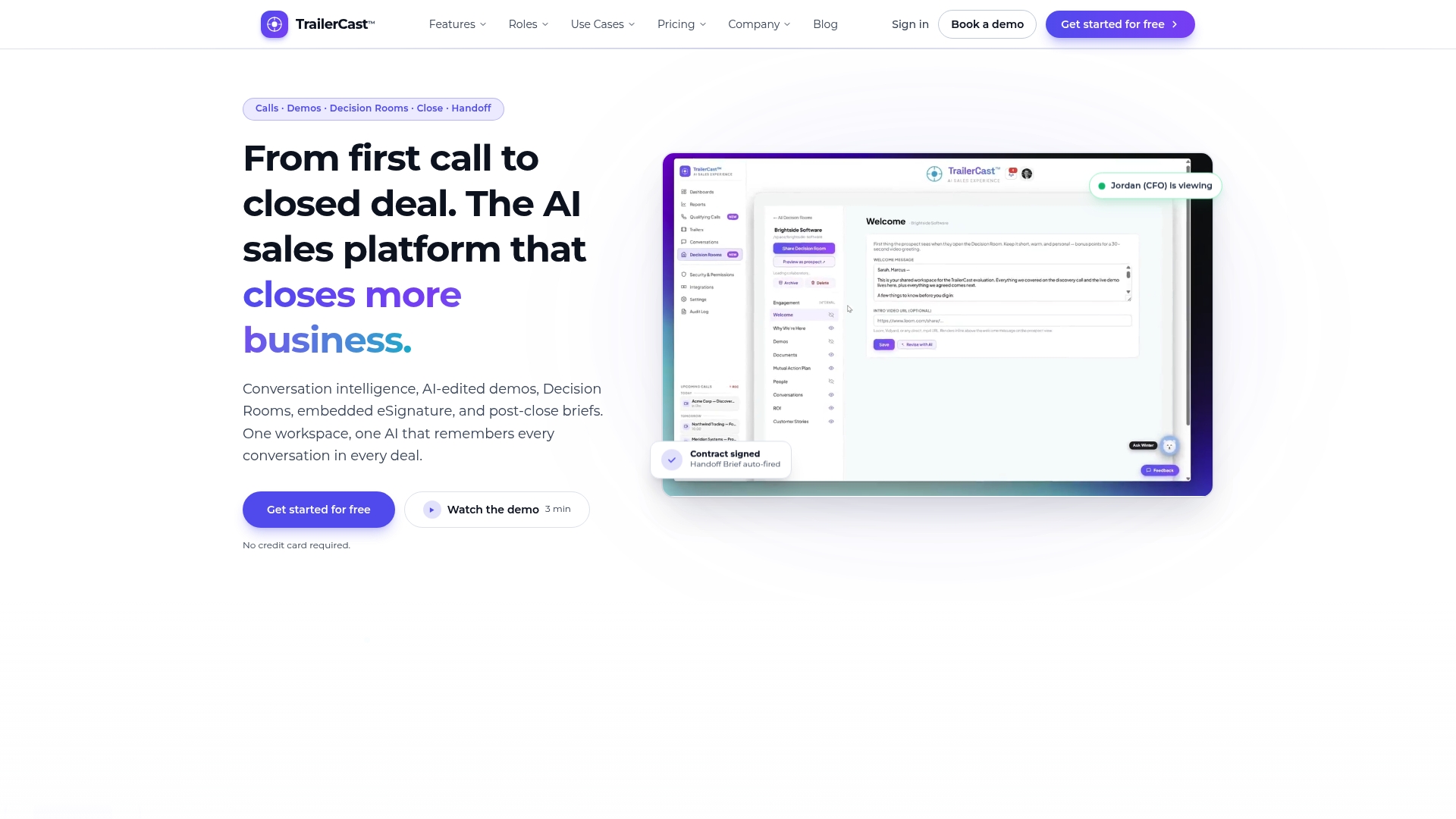
The AI notetaker joins your call, transcribes it speaker by speaker, and produces a qualification verdict and action items automatically, no manual scorecard entry required. From that same recording, TrailerCast can cut a branded demo trailer built for the stakeholder who missed the call, a CFO-focused cut that talks cost, a technical cut that talks integration. Everything lives in a Decision Room your buying committee can revisit without another meeting, and once the deal closes, an AI handoff brief carries all that context straight to your customer success team. Pricing is transparent at $79 per seat per month, no gating between tiers, and there’s a free trial with no credit card required. If discovery calls are where your deals should qualify but context is where they actually die, start with TrailerCast’s discovery call workflow and see what a coherent deal record actually looks like.
Where to Go Deeper on Discovery Call Frameworks
A few resources worth bookmarking if you want to build out your own playbook further:
- Winning by Design’s discovery call anatomy, the clearest breakdown of the phased agenda structure.
- Salesforce’s discovery call guide, useful for question wording and open/closed ratios.
- HubSpot’s discovery call templates, strong on stage-based structure and follow-up timing.