Buyer-Seller Chat Etiquette for B2B SaaS Sales Teams

Good buyer-seller chat etiquette in B2B SaaS comes down to five habits: be specific, be brief, respect the buyer’s time, never make the champion re-sell for you, and stay inside the rules for commercial messages. Marketplace etiquette is about not ghosting a stranger over a used couch. B2B etiquette is about something harder: keeping a multi-stakeholder deal moving through messages that people forward, skim and screenshot.
This guide is written for SaaS sales reps, sales engineers and solutions consultants. It covers what to put in a message, how to personalize it, when to follow up, which habits quietly kill trust, and which US rules apply.
TL;DR
- Anchor every message on one business issue, one believable outcome and one easy next step. Cut the rest.
- Write for the person who will forward it. Your champion’s CFO and CISO read your message without the call context.
- Follow up with something new each time (an answer, an asset, a clarified agenda), never with “just checking in.”
- Be honest about AI. Disclosed AI-written outreach can cost you trust early on, so keep a human voice on the relationship.
- US commercial email falls under CAN-SPAM, and texting needs consent under the TCPA. Know both before you automate.
Table of Contents
- Why B2B chat etiquette is not marketplace etiquette
- The core rules of a good message
- Personalizing by person, stage and history
- Follow-up: how often without being pushy
- Habits that damage trust
- Perspective
- Rules that apply to US sellers
- A short checklist before you hit send
- Where tooling helps (and where it doesn’t)
- Try it on your next deal
- FAQ
- Sources
Why B2B chat etiquette is not marketplace etiquette
Search for this topic and you mostly find rules for resale apps and online marketplaces: don’t share your address, answer within a day, tell other buyers when an item sold. Those rules exist because the stakes are one transaction between two strangers.
Your situation is different. You have a buying committee, a six-to-nine-month relationship if you’re lucky, and a champion who is putting their own reputation on the line every time they forward your message. Your chat etiquette is part of what they are vouching for.
The channels multiply the problem. McKinsey’s research on hybrid B2B sales found that buyers now use 10 or more channels to engage with suppliers across the purchase journey, double the number from five years earlier. Email, LinkedIn, a shared chat, a text from the AE, a Slack Connect channel, a portal comment. Every one of them is a place where tone can slip and facts can drift.
So etiquette here has two jobs. It is politeness, and it is consistency.
The core rules of a good message
One issue, one outcome, one next step
The messages that get answered are the ones a busy executive can process in ten seconds. Pick:
- One business issue the buyer has already told you about (not one you assume).
- One believable outcome tied to that issue, in their words.
- One low-friction next step they can say yes to with a single reply.
Compare two versions of the same follow-up after a demo.
Version A: “Thanks again for your time! As discussed, our platform offers a wide range of capabilities including call recording, deal rooms, eSignature and more. Let me know if you have any questions or would like to set up another call!”
Version B: “Priya, you said new-hire ramp is where forecast misses start. The two-minute clip below is the part of the demo showing how managers see which calls a rep hasn’t had coaching on. Would Thursday at 2 work for 15 minutes with your VP of Enablement?”
Version B has a named person, a problem the buyer raised, an asset sized to their attention and a specific ask. It also doesn’t pitch features. A useful value proposition describes a change in the buyer’s work, not a polished product description.
Do your homework before you ask
Nothing signals disrespect faster than asking a question the buyer’s website, press page or last call already answered. Use public information, previous call notes and the CRM record, and ask only what you cannot find. Frame the question to show you did the work: “I saw you moved to a regional team structure last quarter. Is routing still the bottleneck?” beats “Can you tell me about your org?”
The same goes for meetings. Customer-interaction etiquette guides such as Gainsight’s guide recommend proposing an agenda and inviting the other side to add or edit it. That works in chat too: “Here’s what I’d like to cover on Thursday. What would you add or cut?”
Match their cadence and register
If the buyer writes three lines with no greeting, a four-paragraph reply with a formal sign-off reads as tone-deaf. If they write long, thoughtful notes, a one-word “Sounds good!” can read as dismissive. Mirror length, formality and speed within reason. Don’t mirror anything that is rude, and never mirror emoji from a CFO who hasn’t used one.
Make every message forwardable
The champion leaves your demo and walks back to people who weren’t there. Assume every message will be forwarded, so each one should stand alone:
- Open with the context in one line (“Following Tuesday’s security review with Marcus”).
- Put the ask or answer in the first two sentences.
- Avoid inside jokes, private nicknames and anything you wouldn’t want the CFO to read.
- Link to the exact clip, page or document, not to a general folder.
This is also why we like sending a shared space the whole committee can open instead of a long thread that nobody outside the original three can follow.
Personalizing by person, stage and history
Personalization is not mentioning someone’s alma mater. It is knowing what this person cares about at this stage, given everything said so far.
| Who | What they want from your message | What to send |
|---|---|---|
| Champion | Ammunition and cover | A short summary they can paste into an internal note, plus the answer to the last objection |
| Economic buyer (CFO, VP) | Cost, risk, time to value | Pricing structure, a plain-language business case, no jargon |
| Security or IT | Specific, verifiable answers | Direct responses to their questionnaire items, with the right owner named |
| End users | Whether it makes their day easier | A short walkthrough of their own workflow |
The reason this matters is a gap the industry keeps measuring: buyers say they are more likely to buy when sellers understand their goals, yet far fewer say sellers actually do. The way to close that gap is not more adjectives. It is remembering what each stakeholder said and showing it back to them.
That is a memory problem, and it is where most teams fail. By the fourth call in a deal, nobody remembers who raised the data-residency concern in week two. A running record helps; we cover what an AI deal brief gets right and wrong separately. Whatever you use, review it before you hit send.
Keep the story consistent across channels
Buyers notice when the AE says one thing, the SE says another and the website says a third. Inconsistencies between what sellers share and what the supplier’s own materials say are a recognized cause of stalled deals. Before you reply on pricing, packaging or roadmap, check the current public page, and if you must go beyond it, say so explicitly.
Follow-up: how often without being pushy
There is no magic number. There is a principle: every follow-up must give the buyer something they didn’t have yesterday.
A workable pattern for an active opportunity:
- Same day or next business day after a call: a short recap with decisions and owners, so nothing depends on memory.
- Two to three business days later, if no reply: one useful asset tied to their stated priority (a clip, a one-pager, a customer example in their segment).
- About a week after that: a direct, low-pressure question. “Should I close the loop on this for now, or is there a better time to revisit?”
- After that: pause, or move to a slower, value-led cadence.
What to retire: “just checking in,” “bumping this to the top of your inbox,” and “circling back.” They add noise and ask the buyer to do the work of figuring out why you wrote.
Speed matters most at the start. Fast, human acknowledgment of an inbound request sets the tone for the whole relationship, and slow handling of new leads is one of the most common leaks in a pipeline. Our piece on three essentials for AI pipeline analysis goes into how RevOps can spot those gaps.
When the buyer goes quiet
Silence is rarely rejection. It is usually an internal meeting you aren’t in. Don’t send a guilt message. Instead:
- Offer your champion a two-line summary they can drop into the internal thread.
- Ask whether someone else should be included.
- Give an easy exit: “If priorities shifted, tell me and I’ll stop.”
And when they say no or not now, believe them. Professional standards for vendors point the same way: the Contact Center AI Association’s code of conduct asks its members to lead with education over pitching and prohibits unsolicited pitching or aggressive pursuit after someone has said they aren’t interested. It is a trade body’s code for one industry, but it describes a baseline any seller can adopt.
Habits that damage trust
Feature dumps. A message listing everything you do tells the buyer you haven’t listened.

Flattery. “Love what your team is doing!” with nothing behind it is easy to spot and easy to delete.
Pressure disguised as help. “Just wanted to make sure you saw our end-of-quarter pricing” lands as a deadline. Buyers know your calendar.
Copy-paste personalization. A merge field in the wrong place does more damage than no personalization.
Moving the conversation to a private channel without asking. If the thread has six stakeholders, don’t answer the CFO’s question by text with only the champion.
Hiding the AI. This one is newer, and the research is worth knowing. A 2025 study in the Marketing Review found that disclosed AI sales communication reduced affective trust (how kind and pleasant the seller seems) and cognitive trust in the seller’s integrity during the exploration phase. The authors suggest a hybrid model in which AI handles content foundations for consistency while human sellers supply trust signals, social fit and personal investment.
That is a practical rule: let AI draft, summarize and organize, and let a person own the relationship. Don’t let a bot say something to a buyer that you wouldn’t say yourself. If you want a broader view on keeping the human edge, this piece on soft skills in an AI world makes the case well.
Perspective
I built TrailerCast because the calls were never the problem. The space between the calls was.
Here is what we see over and over. A champion loves the demo. Then they walk back to a CFO who wasn’t there, a CISO who needs an answer that lives in a recording nobody will rewatch, and a PDF they are expected to re-sell from memory. The deal dies in an internal meeting you weren’t part of. Etiquette in that gap is not about saying “please” and “thank you.” It is about making it easy for the people who weren’t on the call to understand what was said.
That is why we designed TrailerCast around the whole deal rather than a single channel. Our AI notetaker is designed to capture what each stakeholder said, so the next message you send reflects it. Our demo trailers are built so the CFO gets the pricing conversation and the CISO gets the security one, instead of everyone getting the same forty-minute recording. And our Decision Rooms are meant to give the buying committee one place to look, so your message, your clip and your answer are never scattered across five inboxes.
Good etiquette is memory plus respect for the buyer’s time. We think software should carry the memory, so you can spend your attention on the respect.
Daniel
Rules that apply to US sellers
Etiquette is optional. These rules aren’t. The following is general information, not legal advice, so check your own program with counsel.
The FTC’s CAN-SPAM compliance guide states that the law covers commercial email, including B2B email. In practice, that means accurate header information, honest subject lines, identification of the message as an ad where applicable, a valid physical postal address and a clear way to opt out. Each separate non-compliant email can carry penalties of up to $53,088, according to the same guide. Honor opt-outs promptly and keep your sequencing tools in sync, because a rep’s manual follow-up shouldn’t contradict an unsubscribe.
Text messages
Texting buyers is tempting because it works, and it is where US law gets stricter. Under the FCC’s 2016 declaratory ruling on the TCPA, non-emergency autodialed or prerecorded texts to wireless numbers require prior express consent, and marketing texts require prior express written consent. If a buyer gave you their mobile for scheduling, don’t assume that covers promotional follow-ups. Ask first, in writing, and keep the record.
Recording and transcribing calls
AI notetakers join meetings, so tell people. State at the start of the call that it is being recorded and transcribed, and give participants a chance to object. Recording consent rules differ by state, so when you’re talking to buyers in several states, the safest practice is to announce it every time and honor any objection.
A short checklist before you hit send
- Does it open with context a stranger would understand?
- Is there exactly one ask?
- Does it use something the buyer actually told you?
- Would you be comfortable if the CFO read it?
- Does it contradict anything on our website or in earlier messages?
- Is a human clearly behind it?
- If it is promotional email or text, are the legal basics covered?
Teams that run this checklist for a month usually find the same two or three recurring slips. Fix those and the whole thread improves.
Where tooling helps (and where it doesn’t)
Tooling cannot fix a rude message. It can fix the conditions that produce them: forgotten context, scattered threads, inconsistent claims and late follow-ups.
If you want to see how this fits together, our AI sales calls playbook walks through multi-stakeholder deals from the first conversation on. For the very first conversation, the AI call notetaker for discovery calls is built to turn the call into structured notes and action items so your recap goes out within hours.
Try it on your next deal
TrailerCast is one workspace for calls, demo trailers, buyer-facing Decision Rooms, eSignature and post-close handoff, with one AI following the whole opportunity. There is one plan with every feature, from $59 per month per seat. If your messages keep losing context between calls, see the plan and what’s included.
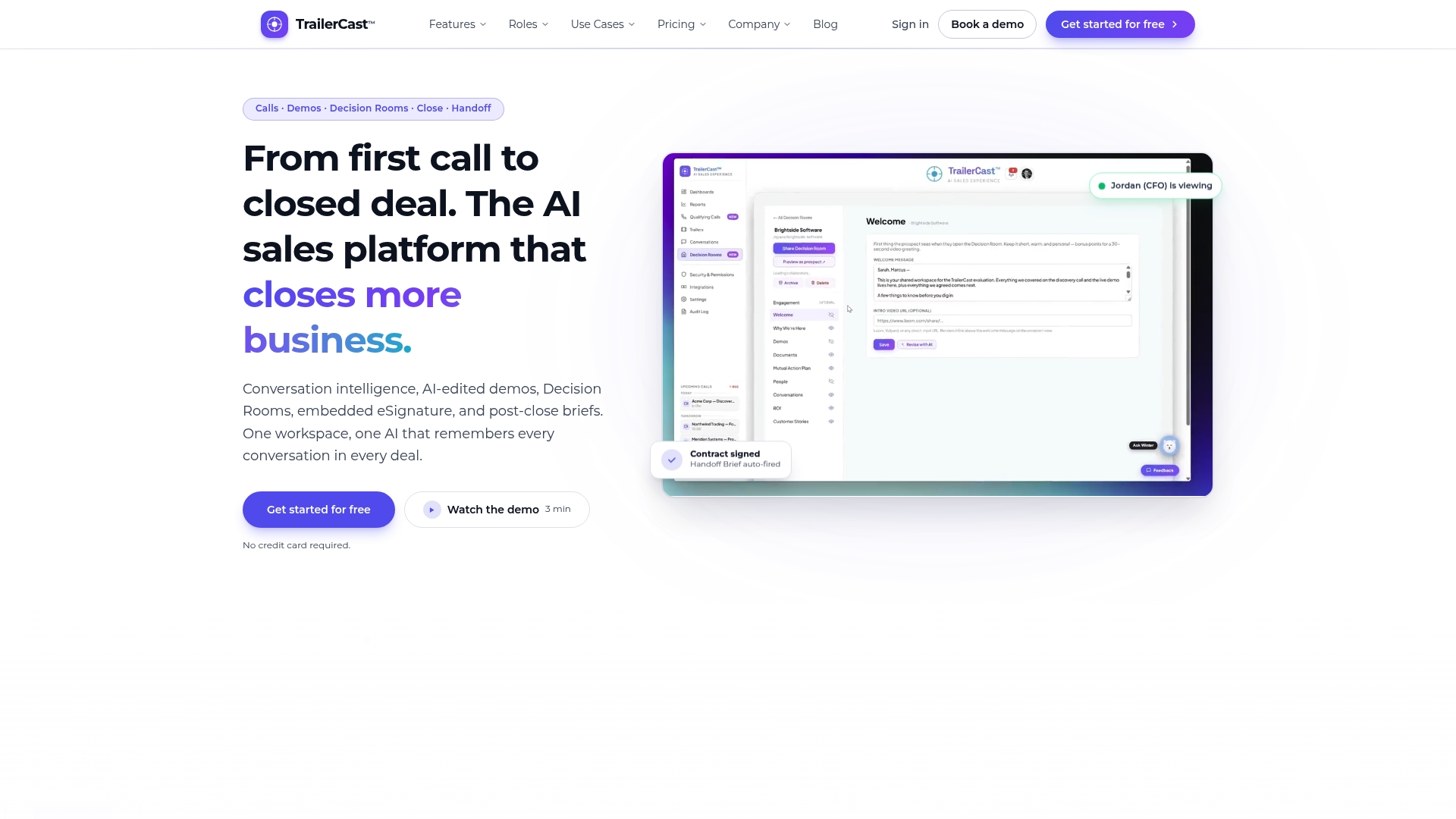
You can also start at the TrailerCast home page to see how the five stages connect.
FAQ
How fast should I reply to a buyer’s message?
Reply the same business day whenever you can, even if the reply is only “Got it, full answer by Thursday.” Buyers read speed as a sign of how you will treat them after they sign. If you can’t answer fully, acknowledge and set a time.
Is it okay to message a buyer on LinkedIn or text instead of email?
Yes, if they have used that channel with you first or invited it. Keep the thread in one place where possible so the rest of the committee can follow. For texts, remember that marketing messages to wireless numbers require prior express written consent under the TCPA.
How many follow-ups are too many?
The count matters less than whether each one adds something: an answer, an asset or a clearer next step. Three or four value-adding touches over a few weeks is reasonable. Once a buyer says they aren’t interested, stop and respect it.
Should I tell buyers when AI helped write or summarize a message?
Be honest if asked, and be transparent about recording and transcription. Research on disclosed AI sales communication shows it can lower early trust, so keep a real person visible on the relationship and use AI for drafting, summaries and consistency behind the scenes.
Sources
- The future of B2B sales is hybrid, McKinsey
- CAN-SPAM Act: A Compliance Guide for Business, FTC
- FCC declaratory ruling on the TCPA, August 2016
- Code of Conduct, Contact Center AI Association
- Marketing Review study on AI sales communication and trust
- The Guide to Etiquette in Customer Interactions, Gainsight