Guided Selling Software for B2B SaaS Teams

Guided selling software uses AI to recommend the next-best action, personalize buyer journeys, and shorten multi-stakeholder B2B deals. The fastest path to proving value: run a pilot focused on one use case, either demo personalization or deal continuity, before committing to a full rollout.
Three reasons to start that pilot now:
- Faster close rates. AI-driven guidance surfaces the right content and next steps at each deal stage, cutting the time reps spend figuring out what to do next.
- Fewer dropped handoffs. A single AI that tracks every call, demo, and stakeholder interaction keeps context intact from discovery through contract signing.
- Centralized deal context. When your champion walks back to a CFO who wasn’t on the demo, they need more than a recording link. A deal room with a personalized trailer and a mutual action plan does the work for them.
Table of Contents
- What does guided selling software actually do?
- Why does guided selling matter for complex B2B deals?
- How do you evaluate guided-selling vendors?
- What does implementation actually look like?
- What does a conservative ROI look like for a 50-seat team?
- How does Trailercast map to these criteria?
- Key Takeaways
- The part most teams get wrong
- Run your next deal through Trailercast
- Useful sources
What does guided selling software actually do?
At its core, guided selling software translates the instincts of your best rep into a system every rep can follow. That means AI-driven next-best-action recommendations, structured cadences, conversational assistants that adapt to deal stage, and buyer-facing workspaces that keep the buying committee engaged between calls.
The functional scope covers the full B2B deal lifecycle. During discovery, conversation intelligence transcribes calls, extracts qualification signals, and builds a running deal brief. In the demo phase, AI can edit recordings into personalized trailers for specific stakeholders, so your CFO gets a pricing-focused cut and your CISO gets a security-focused one. Post-demo, a digital deal room holds the mutual action plan, ROI summary, documents, and a live thread between your team and the buying committee. At close, embedded eSignature removes the DocuSign detour. After signing, an AI-generated handoff brief fires automatically to Customer Success with deal context, stakeholder map, and risk flags.
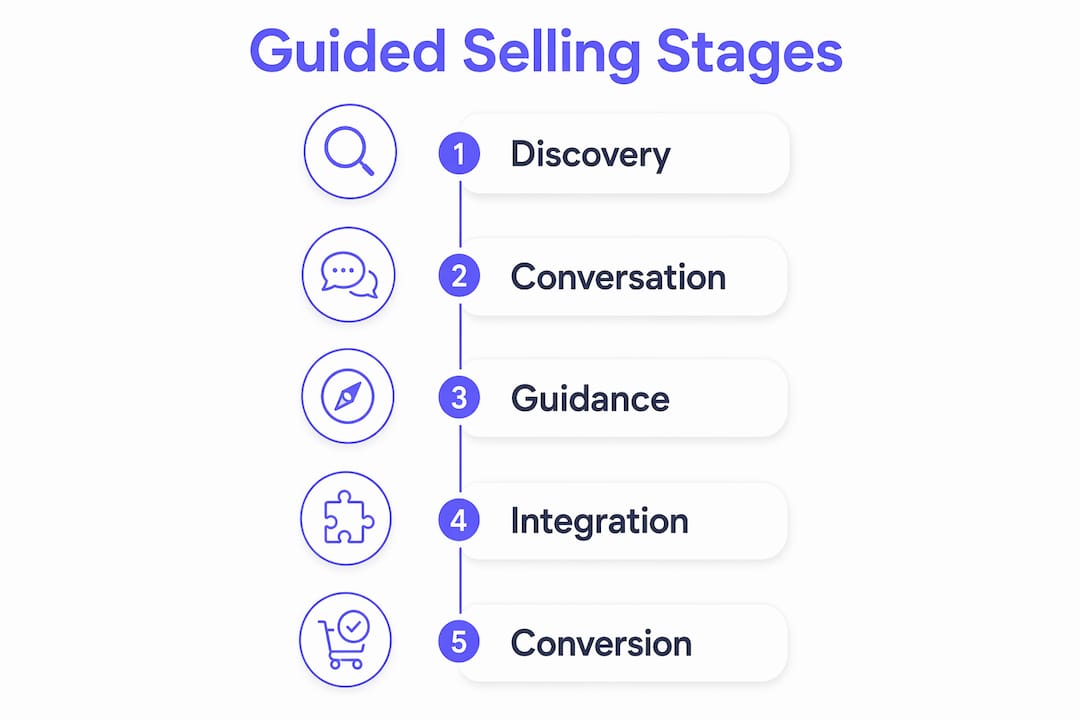
Conversational assistants can reorder and adapt question flows automatically, scaling expert guidance without custom coding. The best platforms distinguish between deterministic AI for precise product configuration and probabilistic generative AI for summarization and personalization, since each serves a different task in a complex B2B workflow.

Integration requirements are non-negotiable. Your guided selling platform needs a live CRM connection, calendar sync (Google or Microsoft), call transcript storage, and SSO/SAML for enterprise security. Without those, the AI is working from incomplete data and your deal continuity breaks the moment a rep changes.
Why does guided selling matter for complex B2B deals?
The buying process has changed faster than most sales stacks have. Average B2B buying committees now include multiple stakeholders reviewing content asynchronously, often without the seller present. That gap between conversations is where deals stall or die.
AI-driven guided selling has shown measurable impact on conversion rates across B2B applications, with the strongest results in deals that involve multiple decision-makers and longer evaluation cycles. Revenue orchestration platforms now use AI agents and structured cadences to convert strategy into execution, monitoring deals in real time and triggering next steps automatically.
The underlying shift is behavioral. Buyers want to be guided, not just informed. When your champion leaves a great demo and walks back to a room full of stakeholders who weren’t there, a static PDF isn’t guidance. A personalized trailer, a deal room with ranked content, and a live thread with your team is.
How do you evaluate guided-selling vendors?
Start with must-have capabilities, then layer in integration depth and security requirements.
Must-have capabilities (prioritized):
- Deal-context continuity across calls, demos, and stakeholder interactions
- Conversation intelligence with searchable transcripts and structured summaries
- AI-edited demo trailer personalization per stakeholder role
- Buyer-facing deal rooms with engagement analytics
- Embedded eSignature (no third-party redirect)
- Post-close handoff brief generation for Customer Success
Integration and security checklist:
- Native CRM sync (bidirectional, not just export)
- Calendar integration for auto-scheduling (Google/Microsoft)
- SSO/SAML and SCIM provisioning for enterprise
- Data residency and DPA options for compliance
Questions to ask on a vendor demo:
- How does the AI retain deal context across multiple calls and stakeholders?
- Can cadences be customized by deal stage, persona, or competitive situation?
- What does the onboarding SLA look like, and who owns implementation?
- How is data ownership handled if we cancel?
Red flags to watch for:
- Modules that don’t share data (conversation intelligence siloed from deal rooms)
- No ability to search or query transcripts across deals
- Opaque pricing with no trial option
- Pilot metrics that the vendor defines, not you
Pro Tip: Ask every vendor to show you what happens to a deal after the demo. If they can only show you the call recording, they’re solving half the problem.
Proactive deal guidance should surface custom, ranked next steps based on deal stage, stakeholder map, and historical win patterns, not just generic playbook reminders.
What does implementation actually look like?
Realistic timelines depend on catalog and CRM complexity, but most B2B SaaS teams follow a predictable arc. Simpler configurations can go live in days; complex enterprise rollouts take longer.
| Phase | Timeline | Key Activities |
|---|---|---|
| Pilot scoping | initial weeks | Define one use case, assign owner, confirm CRM admin access |
| Integrations | early phase | CRM sync, calendar, SSO, transcript storage |
| Content and templates | mid phase | Build deal room templates, upload Sales Library assets |
| Seller training | mid-late phase | Onboarding sessions, playbook walkthroughs, KPI definitions |
| Measure and iterate | pilot period | Review pilot KPIs, expand or adjust scope |
| Team rollout | following months | Expand to full team, refine cadences |
| Enterprise scale | later months | Advanced integrations, white-label, native CRM sync |
Pricing models vary by vendor. Per-seat subscriptions are the most common for B2B SaaS teams. Trailercast offers a subscription with per-seat pricing, billed monthly or annually, at $59/seat/month on an annual plan with every feature included and no gating. Enterprise add-ons (SSO/SAML, custom DPA, white-label, native CRM sync) sit on top as custom contracts. A free trial is available with no credit card required.
Implementation success checklist:
- Designated internal owner with CRM admin access
- Sample deals loaded for AI model context
- KPIs defined before day one (time-to-close, win rate, demo-to-proposal conversion)
- Onboarding best practices aligned with your CS motion, drawing on proven rollout frameworks
What does a conservative ROI look like for a 50-seat team?
Assumptions:
- 50 seats at $59/seat/month (annual billing) = $35,400/year
- Average deal size: $40,000
- Current close rate: 22%
- Pipeline per rep per quarter: 5 deals
- Total annual pipeline: 1,000 deals
Baseline vs. post-implementation:
| Metric | Baseline | With Guided Selling | Difference |
|---|---|---|---|
| Close rate | 22% | — | +3 percentage points |
| Deals closed/year | — | — | +30 deals |
| Revenue | — | — | $1,200,000 |
| Platform cost | — | $35,400 | — |
Step-by-step payback calculation:
- A 3-percentage-point close rate lift on 1,000 deals = 30 additional closed deals.
- At $40,000 average deal size, that’s $1,200,000 in incremental revenue.
- Platform cost at annual pricing: $35,400.
- Payback period: under 11 days of incremental revenue.
Even a more conservative 1-percentage-point lift (10 additional deals) produces $400,000 in incremental revenue against a $35,400 cost. The math works at almost any reasonable assumption. The risk isn’t the platform cost; it’s a failed implementation with no defined KPIs.
How does Trailercast map to these criteria?
Trailercast covers every must-have capability in a single workspace. Conversation intelligence handles call transcription, structured summaries, qualification verdicts, and a running Deal Brief across every call in the opportunity. The AI-edited demo trailer feature clips the 8–15 minutes that mattered from any recording and stitches them into a branded, stakeholder-specific trailer, so your champion has something worth forwarding to the CFO or CISO who wasn’t on the call. Buyer-facing decision rooms give the buying committee a no-login workspace with the mutual action plan, ROI summary, ranked content, and a live conversation thread. Embedded eSignature closes the deal in-app. The moment a contract signs, an AI Handoff Brief fires to Customer Success automatically.
Pricing is transparent: $59/seat/month on an annual plan, with every feature included. No gating, no module tiers. A free trial requires no credit card.
30–60 day pilot checklist for Trailercast:
- Week 1: Connect calendar, set up CRM integration, load 5–10 active deals
- Week 2: Run first discovery calls through the AI notetaker; review Deal Brief quality
- Week 3: Generate first demo trailers; share via decision rooms with one active prospect
- Week 4–6: Track per-stakeholder engagement in the decision room; measure demo-to-proposal conversion
- Day 45–60: Review time-to-close delta vs. control group; decide on full-team rollout
The single metric to watch during the pilot: demo-to-proposal conversion rate. It’s the clearest signal that your champion is successfully re-selling the deal internally.
Key Takeaways
Guided selling software pays for itself quickly when the pilot is scoped correctly, KPIs are defined upfront, and the platform centralizes deal context across every stage.
| Point | Details |
|---|---|
| Pilot scope matters | Start with one use case (demo personalization or deal continuity) and measure demo-to-proposal conversion. |
| Integration is the foundation | CRM sync, calendar, and SSO must be live before the AI can deliver accurate next-best-action guidance. |
| ROI is conservative | A 3-percentage-point close rate lift on 1,000 deals generates $1,200,000 in incremental revenue against a $35,400 annual cost. |
| Staged rollout reduces risk | Pilot for 30–60 days with defined KPIs before expanding; avoid full rollout without measurable proof points. |
| Trailercast consolidates five tools | Conversation intelligence, demo trailers, deal rooms, eSignature, and post-close handoff in one workspace at $59/seat/month on an annual plan. |
The part most teams get wrong
Most guided selling implementations fail not because the software is bad, but because the team treats it as a recording tool with extra features. They activate the call notetaker, skip the deal rooms, and wonder why close rates didn’t move.
The real value of this category is what happens between conversations. A champion who leaves your demo with a personalized CFO trailer, a live deal room, and a mutual action plan is three times more equipped to sell internally than one who leaves with a Zoom link. That’s the mechanism. The call is just the setup.
The other common mistake is skipping KPI definition. If you don’t agree on what “working” looks like before day one, you’ll spend day 60 debating whether the pilot succeeded instead of expanding it. Pick one metric, demo-to-proposal conversion is the clearest, and hold the line.
Staged pilots with defined success criteria are not a hedge. They’re how you build internal buy-in fast enough to actually change how your team sells.
Run your next deal through Trailercast
Five tools in one workspace, no credit card required. Trailercast gives B2B SaaS sales teams a single AI that follows every deal from the first discovery call through the signed contract and the CS handoff, at $59/seat/month on an annual plan. The consolidation case alone saves most teams the cost of two or three point solutions they’re already paying for.
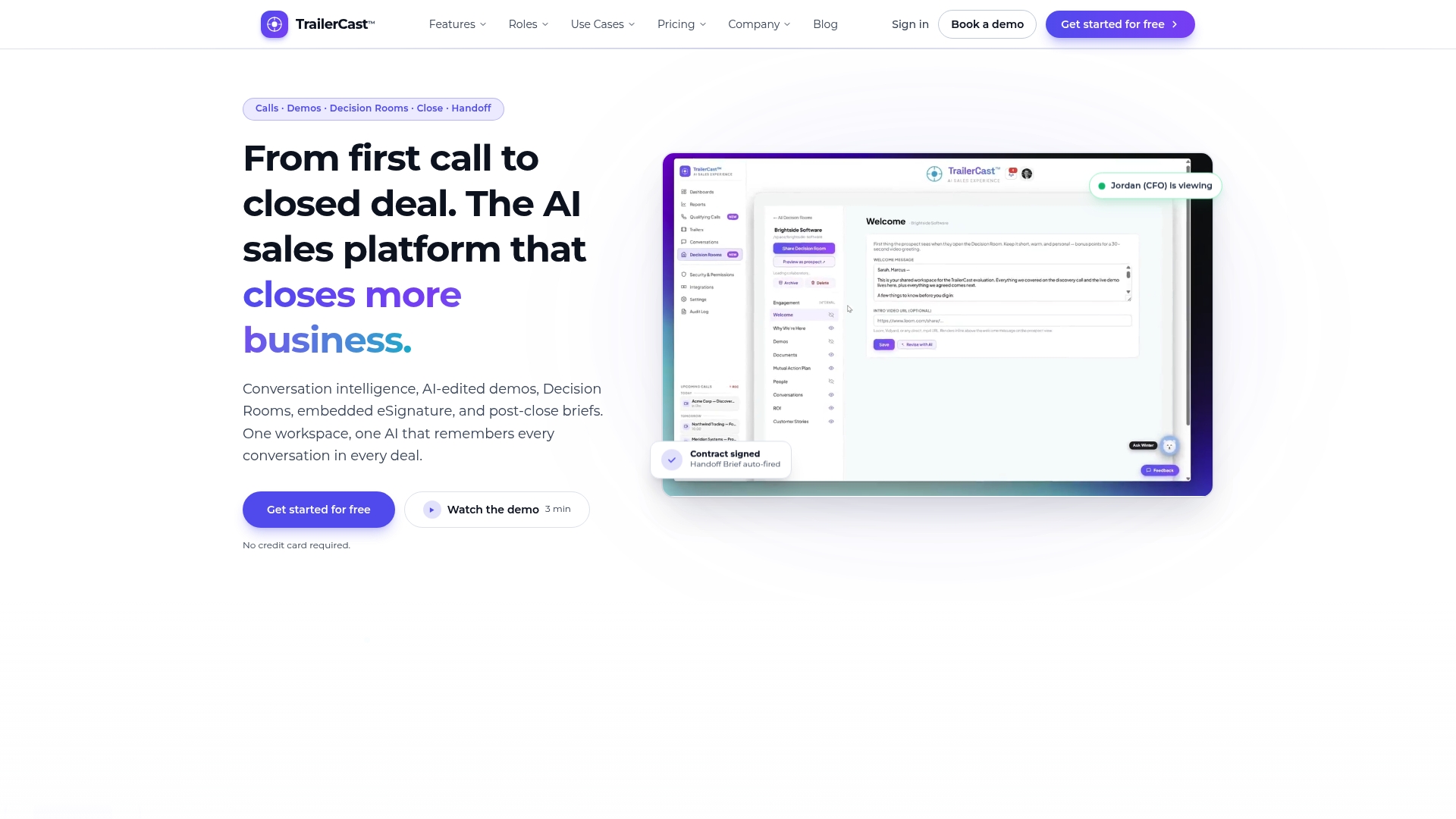
The fastest way to validate fit is a focused pilot: load five active deals, run your next three discovery calls through the AI notetaker, generate one demo trailer, and share it via a decision room. By week four, you’ll have per-stakeholder engagement data and a clear read on whether demo-to-proposal conversion is moving. Start your free trial at trailercast.io or explore the full feature set to map capabilities to your current stack before your first call.
Useful sources
- Trailercast Features — Stage-by-stage breakdown of conversation intelligence, demo trailers, decision rooms, eSignature, and post-close handoff; the primary reference for capability mapping.
- Trailercast: AI Call Notetaker for Discovery Calls — Use-case documentation for pilot scoping around discovery call transcription and Deal Brief generation.
- Trailercast: Embedded eSignature and Auto Handoff Brief — Details on closing mechanics and post-close CS handoff automation.
- Aiden: AI-Driven Guided Selling — Industry research on conversion impact from AI-driven guided selling in B2B applications.
- Clari Guide: Revenue Orchestration — Vendor documentation on AI agents, structured cadences, and deal execution automation.
- Amolino: Proactive Sales Guidance — Feature documentation on ranked next-step recommendations based on deal stage and win patterns.
- Zoovu: AI-Guided Selling Assistant — Platform documentation on conversational guided selling flows and deployment timelines.
- Compatio Guide: B2B Guided Selling Software — Technical documentation contrasting deterministic configuration AI with probabilistic generative AI for B2B workflows.
- EasyFlow: Customer Onboarding Best Practices — Practical rollout and onboarding frameworks for SaaS implementations.