Sales Champion Enablement in 48–72 Hours for Buying Group Consensus

Sales champion enablement means equipping your buyer-side advocate with a champion kit and a governed decision room so they can build consensus across the whole buying group, not just repeat your pitch to one person at a time. Buyers facing moderate to high uncertainty are 78% less likely to complete a high-quality deal, and only 1 in 5 buyers feel sellers truly understand their ROI needs. This approach is designed to close that exact gap.
TL;DR:
- Give champions a one page business case with two or three measurable outcomes, stakeholder specific materials, ready made objection answers, matched references, and shareable scripts.
- Keep discovery, ROI, security, stakeholder specific clips, an action plan, and engagement tracking together in one governed room to prevent outdated materials and expose gaps.
- Buying groups reaching consensus are 2.5 times more likely to report high quality outcomes, while 40% to 60% of qualified pipeline ends without a decision.
- Map each stakeholder’s role, influence, concern, success measure, and relationship to the champion; unopened assets after 48 hours may call for direct seller outreach.
- Equip champions within 48 to 72 hours, then review stakeholder coverage, trailer completion, objection closure, and time to consensus weekly to catch stalled deals early.
Table of Contents
- What a Champion Kit Must Contain
- Build a Governed Decision Room, Not a Shared Folder
- Map the Buying Group Before You Build Anything
- The 48 to 72 Hour Quick-Enable Playbook
- Metrics That Show Reduced Buyer Uncertainty
- How We Built This Into the Deal Lifecycle
- Packaging Artifacts So Nothing Gets Lost in Translation
- Keeping Champions Engaged for the Full Deal Cycle
- Matching Tools and Messaging to How Your Champion Actually Operates
- Using AI Signals to Get Ahead of Champion Questions
- Coordinating Internal Teams So the Message Never Drifts
- Why Champion Enablement Deserves a Real Budget Line
- TrailerCast: Built for the Champion Kit and Decision Room Approach
- FAQ
- Sources
What a Champion Kit Must Contain
Your champion is not a professional presenter. They’re a product manager or a director of ops who believes in your solution and now has to defend it in a meeting you’ll never see. A champion kit is the difference between them improvising from memory and walking in with material built for the job.
A working kit covers four things:
- A one-page business case with the problem statement, proposed outcome, and two or three quantifiable metrics the champion can point to under pressure.
- Role-specific one-pagers for each stakeholder type: a CFO page that answers cost and payback, a CISO page that answers data handling and access control, an end-user page that answers day-to-day workflow change.
- Pre-answered objections written as short, quotable lines the champion can repeat verbatim, plus two or three matched customer references relevant to the stakeholder’s industry or role.
- Shareable scripts, a few sentences the champion can paste into an email or Slack message without having to write their own pitch from scratch.
Package all of it as one forwardable link rather than a folder of attachments. Forrester’s guidance on buying groups is specific on this: champions value information that helps them build trust with colleagues, and that only works when the material is organized enough to forward without editing.
Pro Tip: Write every objection answer as a sentence your champion could say out loud in a meeting, not as a paragraph they’d have to summarize on the fly.
Build a Governed Decision Room, Not a Shared Folder
A governed evaluation environment is a single source of truth for the deal: one room, one version of every document, and visibility into who’s looking at what. Without it, your champion ends up forwarding outdated PDFs while a CFO asks questions already answered three emails ago. According to Buyerenablement, buying groups that reach consensus are 2.5 times more likely to report a high-quality deal outcome, and the gap is largely a fragmentation problem.
A governed room needs:
- A discovery section summarizing what you’ve already learned, so no stakeholder has to repeat context.
- An ROI section with the business case and the numbers that matter to finance.
- Role-specific demo trailers, short clips cut for each stakeholder rather than one generic recording.
- A compliance and security summary for legal and IT.
- A mutual action plan showing next steps and owners.
- A stakeholder ledger tracking who’s engaged and who hasn’t.
Tracked sharing matters as much as the content itself. When you can see who forwarded what to whom, you get an attribution tree instead of a guess, and you can tell whether the champion is actually multi-threading the deal or still carrying it alone.
40 to 60 percent of qualified pipeline ends in no decision due to misalignment, according to the same practitioner guide, which is the strongest argument for governance over improvisation.
Map the Buying Group Before You Build Anything
Champion kits and decision rooms only work if you know who’s actually in the room. Before you build either, map the buying group:
- List every stakeholder by role, department, and approximate influence over the final decision.
- Note each person’s primary concern, cost, risk, workflow disruption, or something else entirely.
- Write down what success looks like for that person specifically, not for the deal as a whole.
- Flag who your champion has never met, since those are the relationships most likely to stall the deal.
Once the map exists, watch for signals rather than waiting for status updates. Trailer views, document opens, comment threads, and direct questions in the decision room all tell you more than a champion’s verbal reassurance that “things are going well.” A spike in CISO document opens with no comment usually means a concern that hasn’t surfaced yet; a trailer that sits unwatched for a week usually means the champion lost momentum. Convert each signal into an action: a follow-up message, a new one-pager, or, when friction persists, a direct call from the seller rather than relying on the champion to relay bad news upward.
The 48 to 72 Hour Quick-Enable Playbook
Speed matters because champion enthusiasm fades fast once a demo ends. Here’s a tight sequence sellers and RevOps can run together.
- Hour 0 to 4 (seller): Send the champion a tracked decision room link with the discovery summary already populated.
- Hour 4 to 24 (RevOps + seller): Assemble the one-page business case and at least one role-specific one-pager for the highest-influence stakeholder identified in your map.
- Day 1 to 2 (seller): Cut or request a stakeholder-specific demo trailer and drop it into the room with a short note: “This covers exactly what [stakeholder] asked about pricing, feel free to forward.”
- Day 2 (champion, prompted by seller): Share the room with two or three named stakeholders using a prewritten line, something like “Wanted to get this in front of you before our next sync, 8 minutes covers the ROI piece.”
- Day 2 to 3 (RevOps): Check the room for gaps: does every stakeholder in the map have a role-specific asset and a clear next step assigned to them.
- Day 3 (seller): Review engagement data and follow up personally with anyone who hasn’t opened their asset.
Pro Tip: If a stakeholder hasn’t opened anything by hour 48, that’s not a scheduling problem, it’s a signal the champion needs backup reaching them directly.
Our own breakdown of this exact sequence lives in our five-asset playbook, which maps each step to a specific template.
Metrics That Show Reduced Buyer Uncertainty
Engagement data only matters if it ties back to deal quality. Track these:
- Engagement coverage: the percentage of mapped stakeholders who’ve opened something.
- Trailer view rate and completion rate by stakeholder role.
- Document open rate on the compliance and ROI sections specifically.
- Objection closure rate, how many pre-answered objections actually got referenced or resolved.
- Time-to-consensus, the days between first share and a confirmed next step from the full group.
Low engagement coverage late in a cycle is one of the clearest early warnings a deal is stalling, since moderate to high buyer uncertainty cuts the odds of a high-quality deal by 78%. Feed these metrics into forecast hygiene weekly, with a short CRO or RevOps dashboard review rather than a full deal-by-deal audit.
How We Built This Into the Deal Lifecycle
We designed TrailerCast around the exact sequence above, because we kept watching deals stall in the gap between calls rather than during them.
- AI-edited demo trailers handle the role-specific tailoring, a CFO cut and a CISO cut from the same call.
- Decision rooms serve as the governed evaluation environment, with discovery, ROI, and compliance sections built in.
- Engagement analytics surface the signals: who opened what, who’s gone quiet.
- Embedded eSignature and AI handoff briefs carry the deal through close and into customer success without a restart.
This is one implementation pattern, not the only way to run champion enablement, but it’s the one we built to match how multi-stakeholder deals actually move.
Packaging Artifacts So Nothing Gets Lost in Translation
Every asset you hand a champion needs two things: a fixed home and a tracked link. Loose attachments get buried in email threads, and a champion forwarding five separate files to five different people loses control of the narrative fast.
Keep trailers, one-pagers, and compliance summaries in the same decision room, organized by stakeholder rather than by document type. A CISO looking for the security summary shouldn’t have to scroll past pricing slides to find it. Name files plainly, “Security Summary for [Stakeholder Name]” beats “Doc_v3_final,” because a champion under time pressure forwards whatever’s easiest to identify.

Tracking matters as much as organization. A link that shows you when it was opened, by whom, and for how long turns a guess into a fact. If a trailer sent to the VP of Engineering sits unopened for four days, that’s a specific, actionable gap, not a vague sense that “things have gone quiet.” Engagement data also tells you which assets are actually working. If role-specific trailers consistently outperform generic demo recordings in completion rate, that’s a reason to build more of them and fewer static decks.
Keeping Champions Engaged for the Full Deal Cycle
Champion energy peaks right after a good demo and decays from there unless you actively maintain it. Don’t treat the kit as a one-time handoff. Check in after every stakeholder meeting the champion runs, even a short “how did the CFO conversation go” message, so you catch friction before it hardens into a stalled deal.
Give the champion small wins to report upward. A short ROI update or a new reference that matches a stakeholder’s industry gives them a reason to re-engage the group without feeling like they’re nagging colleagues. Rotate in new material every one to two weeks rather than expecting the original kit to carry the whole cycle. A compliance summary that answered questions in week one might need an addendum by week three once legal gets involved.
Corporate Visions’ research on B2B buying behavior points out that champions are imperfect conduits. Information relayed secondhand loses technical and financial nuance, which is exactly why ongoing support, not a single kickoff conversation, keeps the deal coherent.
Matching Tools and Messaging to How Your Champion Actually Operates
Not every champion persuades the same way. Some are data-driven and want the ROI number front and center; others build consensus through relationships and need a reason to start a conversation rather than a spreadsheet to forward. Watch how your champion communicates during discovery calls. If they ask for numbers first, give them the one-page business case before anything else. If they reference what colleagues think, give them a short, conversational script instead of a dense document.
Influence level matters too. A champion with direct authority over budget needs different material than one who has to convince a skeptical manager before they can even raise the deal internally. The second case calls for talking points the champion can use in a hallway conversation, not just a forwardable link.
Gartner’s research on buying-group conflict found that buying-group relevance drives consensus more reliably than persona-level personalization alone. Tailor the format to the champion’s style, but keep the substance focused on shared group outcomes rather than five different individual pitches that never add up to one story.
Using AI Signals to Get Ahead of Champion Questions
The fastest way to lose a champion’s confidence is to leave them guessing when a stakeholder asks something nobody prepared for. AI-powered tools that surface patterns across your calls and documents let you spot the question before it derails a meeting.
If engagement data shows a stakeholder spent unusual time on the pricing section without commenting, that’s worth a proactive follow-up before the next call rather than waiting for the objection to surface live. If a transcript search across prior calls turns up a recurring concern about implementation timeline, build that answer into the next one-pager instead of leaving the champion to field it cold.
This is less about predicting the future and more about not missing what’s already visible in the data you’ve collected. Our own Winter assistant reads live call transcripts inside the platform, so a question like “what did this stakeholder say about security” gets answered in seconds instead of someone rewatching a 40-minute recording.
Coordinating Internal Teams So the Message Never Drifts
Champion enablement falls apart fast when the seller says one thing, the sales engineer says another, and marketing’s one-pager contradicts both. Before any asset reaches the champion, align the internal team on one version of the business case and one set of numbers.
A short internal sync before key stakeholder meetings, five minutes, not a full deal review, keeps the seller, sales engineer, and any supporting specialist saying the same thing. Our stakeholder mapping template works as well internally as it does externally: assign one owner per stakeholder relationship so nobody duplicates outreach or sends conflicting information.
Keep a single shared source for messaging, whether that’s your decision room or a content platform. Teams managing a lot of role-specific collateral sometimes bring in a tool like Yonderly to keep that material current across reps, so nobody is forwarding a stakeholder one-pager that’s three revisions out of date.
Why Champion Enablement Deserves a Real Budget Line
Most sales organizations still treat champion support as something a rep improvises between calls. That’s backwards. The research is consistent: buyers who sit in uncertainty lose deals, and champions who get structured support outperform ones left to wing it. Treating this as a side task rather than a repeatable motion is the single biggest reason good champions go quiet right when a deal needs them most.
Test the 48 to 72 hour playbook on one live deal this week and watch what happens to stakeholder engagement before the next call.
— Daniel
TrailerCast: Built for the Champion Kit and Decision Room Approach
We built TrailerCast specifically so you don’t have to stitch together five tools to run this playbook. One workspace holds the trailers, the decision room, tracked shares, and the handoff brief, all under one plan with every feature, from $59 per seat per month.
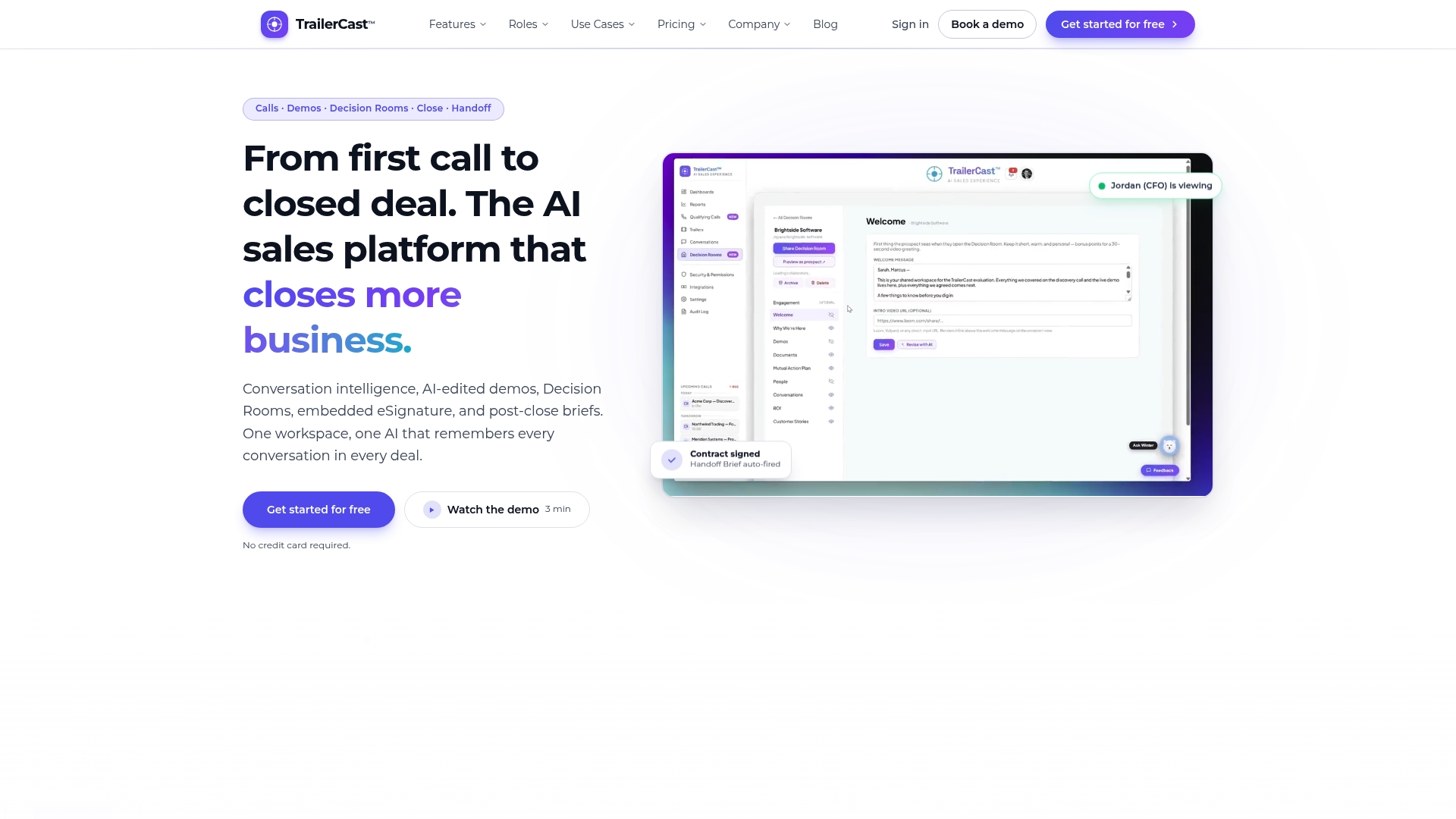
See how it fits your deal cycle on the TrailerCast homepage, or start a free trial and run the quick-enable playbook on your next opportunity.
FAQ
What Is Sales Champion Enablement?
Sales champion enablement means equipping your buyer-side advocate, the person inside the customer’s organization who wants your deal to win, with a champion kit and a governed decision room so they can brief and persuade the rest of the buying group consistently. It focuses on buying-group relevance rather than personalizing to one person at a time.
What Should Go in a Champion Kit?
A champion kit needs a one-page business case, role-specific one-pagers for key stakeholders like finance and security, pre-answered objections, and matched customer references. Forrester’s buying-group research notes that champions value material organized well enough to forward without editing.
How Long Should It Take to Enable a Champion?
A focused playbook can get a champion equipped within 48 to 72 hours: a tracked decision room on day one, role-specific assets by day two, and active engagement follow-up by day three. Speed matters because champion enthusiasm fades quickly after a demo ends.
Why Does Buyer Uncertainty Matter So Much?
Buyers facing moderate to high uncertainty are 78% less likely to complete a high-quality deal, which is why structured, consistent information across the buying group matters more than persona-level personalization alone. A governed decision room directly addresses this by keeping everyone working from the same material.
Does TrailerCast Replace a Champion Kit?
TrailerCast gives you the tools to build and track a champion kit inside a governed decision room, including role-specific demo trailers, engagement analytics, and a mutual action plan, all under one plan starting at $59 per seat per month. It’s an implementation of the approach, not a replacement for building the content itself.
Sources
- Help B2B Buyers Navigate Change Management for Complex Purchases | Gartner
- What Sales Winners Do | RAIN Group
- Buyerenablement
- Get To Know Your B2B Buying Group | Forrester