Enable Your Champion in 48 Hours: A Five Asset Playbook for Sales Reps

Validate your champion, then arm them with a five-asset kit inside 48 hours: a one-page business case, an executive briefing, an objection-preempt piece, a Mutual Action Plan, and a short product walkthrough. The immediate move is a micro-ask, send the one-pager and ask them to forward it to one stakeholder within a day. That single request tells you whether you have a real champion or just a friendly coach.
TL;DR:
- Validating a champion requires tests that confirm their influence, willingness to advocate, and personal stake, not just friendliness or casual support.
- The champion enablement kit should include a one-page business case, executive briefing, objection-preempt piece, Mutual Action Plan, and demo trailer, all designed to be easily forwarded.
- Timing is critical; assets must be sent before stakeholder meetings and updated promptly when milestones are missed to prevent deals from stalling.
- Tracking champion activity through signals like share rate, milestone completion, and objection resolution helps predict progress and identify stalled deals early.
- Using a single sales workspace consolidates all assets and tracking, reducing friction and maximizing the chances of content being forwarded to advance the deal.
Table of Contents
- How to identify and validate a real internal champion
- The enablement asset kit: formats, timing, and what “shareable” means
- Packaging and delivering leave-behinds that actually get forwarded
- Measure and track champion activity: the signals that predict progress
- Running this playbook inside one consolidated sales workspace
- What actually moves a stalled deal
- TrailerCast: one workspace for the whole champion kit
- Sources
- FAQ
How to identify and validate a real internal champion
A coach is friendly. A champion has three things a coach doesn’t: influence over the decision, willingness to fight for you internally, and a personal stake in the outcome landing well. Confusing the two is the single most common way enablement effort gets wasted, and it’s why so many deals stall in a room you were never invited into.
The MEDDPICC framework defines a champion by exactly this mix: access to the economic buyer, real influence, and skin in the game. You confirm it, you don’t assume it. Run these seven tests before you invest real enablement time in anyone:
- Ask them to get a calendar invite booked with the economic buyer.
- Have them pitch your value back to you in their own words.
- Give them a small, low-effort task and see if they complete it within a day or two.
- Ask them to map out who else needs to sign off and in what order.
- Invite them to help build the ROI case with their own numbers.
- Watch for public sponsorship, a Slack mention, a comment in a steering meeting.
- Notice whether they escalate blockers to you proactively instead of waiting to be asked.
Pair these tests with direct discovery questions: “What happens if this stalls?” and “What’s riding on this for you personally?” tend to surface real stake fast. A scorecard approach works well here: log each test result in your CRM as it happens, rather than relying on memory during a pipeline review. Micro-asks are the cheapest, fastest signal you have, so track completion rate like you’d track any other qualification metric. Our own breakdown of quick champion validation tests covers a few more ways to run this in under an hour.
The enablement asset kit: formats, timing, and what “shareable” means
Once you’ve validated a champion, the kit matters more than the pitch. A four-asset enablement kit, one-page business case, executive briefing, objection-preempt piece, and Mutual Action Plan, is widely cited as the fastest way to arm a champion to sell internally, and forwardability is the design test every asset has to pass.
- One-page business case: single PDF, delivered right after champion validation, answers “what does this mean for my boss” in one sentence.
- 8-slide executive briefing: deck format, delivered before the first multi-stakeholder meeting, built to be skimmed in three minutes by someone who wasn’t on any call.
- Objection-preempt kit: a short Loom clip or one-pager, delivered as soon as a likely objection surfaces, framed as “here’s what IT usually asks, and here’s the answer.”
- Mutual Action Plan: shared document, co-built with the champion during the second call, sets dates both sides agree to.
- ROI or business case: a simple calculator or short summary, delivered once budget conversations start.
- 2 to 3 minute demo trailer: video, delivered right after the demo call, built for a stakeholder who has five minutes and no context.
Stakeholder needs to vary the mix. A CFO wants ROI numbers, IT wants compliance detail, and end users want a short walkthrough, so build once and tailor the framing per audience rather than writing five separate documents.
Pro Tip: If a champion can’t forward an asset to their boss without adding a paragraph of context first, it isn’t finished yet.
Packaging and delivering leave-behinds that actually get forwarded
Timing matters as much as content. Hand off the exec briefing before the first committee meeting, not after. Update the Mutual Action Plan the moment a milestone slips, not at the next scheduled call. A leave-behind that arrives late is a leave-behind that gets ignored.
- Co-brand every asset with the champion’s company logo alongside yours, never yours alone.
- Keep objection clips to 90 to 120 seconds. Nobody forwards a 10-minute video.
- Use a single deal room link instead of five separate attachments scattered across e-mail threads.
- Track shares with simple UTM tags so you can see who opened what and when.
- Watch the engagement dashboard for a spike in views right before a scheduled decision meeting, that’s your signal something is moving.
A buyer-facing decision room that holds all five assets in one no-login link removes the friction of champions having to re-explain your product from memory, which is often where good deals quietly die.
Measure and track champion activity: the signals that predict progress
Champion enablement only works if you can see whether it’s working. Watch five signals every week: share or forward rate, MAP milestone completion, frequency of intro requests to the economic buyer, trailer plays per stakeholder, and objection resolution rate.
- Micro-ask completion within 48 hours is a strong early signal of real commitment.
- MAP milestones should be roughly half complete by the date both sides agreed to, if they’re lagging, that’s your coaching trigger.
- Zero trailer plays a week after sending usually means the champion never opened the link, not that stakeholders are uninterested.
- A rising objection resolution rate across calls suggests the champion is fielding questions without you in the room.
Verified champions who clear three or more MEDDPICC criteria win at meaningfully higher rates than deals led by a coach alone, which is the whole argument for spending validation time up front instead of arming the first friendly voice you find.
Build these five signals into your weekly pipeline review as columns, not footnotes, and flag any deal where two or more have gone quiet for a week.

Running this playbook inside one consolidated sales workspace
A single workspace that holds the one-page business case, exec brief, objection clips, and a co-owned MAP for every deal removes the version-control mess of scattered PDFs and Slack threads. TrailerCast’s feature set maps directly onto that need.
- Auto-edited demo trailers turn a full call into a 2 to 3 minute clip a champion can forward without re-explaining anything.
- A tracked share link shows who opened the deal room and what they watched, so you know if the CFO ever saw the ROI section.
- The Mutual Action Plan lives in the same room as the assets, so milestone slippage is visible the moment it happens.
What actually moves a stalled deal
The single most valuable thing a champion does isn’t pitching, it’s forwarding. The deal that stalls is almost always the one where nobody sent anything after the call ended. If you’re coaching a rep, ask them one question every week: “What did your champion forward this week, and to whom?” That question alone surfaces more stalled deals than any forecast call does.
— Daniel
TrailerCast: one workspace for the whole champion kit
Building this playbook by hand across five different tools, a call recorder, a video editor, a document tool, a deal room, and a CRM, is exactly the friction that gets an enablement kit sent late or not at all. TrailerCast is built to run the entire cycle in one place: the one-page business case, the exec briefing, the objection clips, and the demo trailer all live in the same Decision Room your champion forwards with a single link.
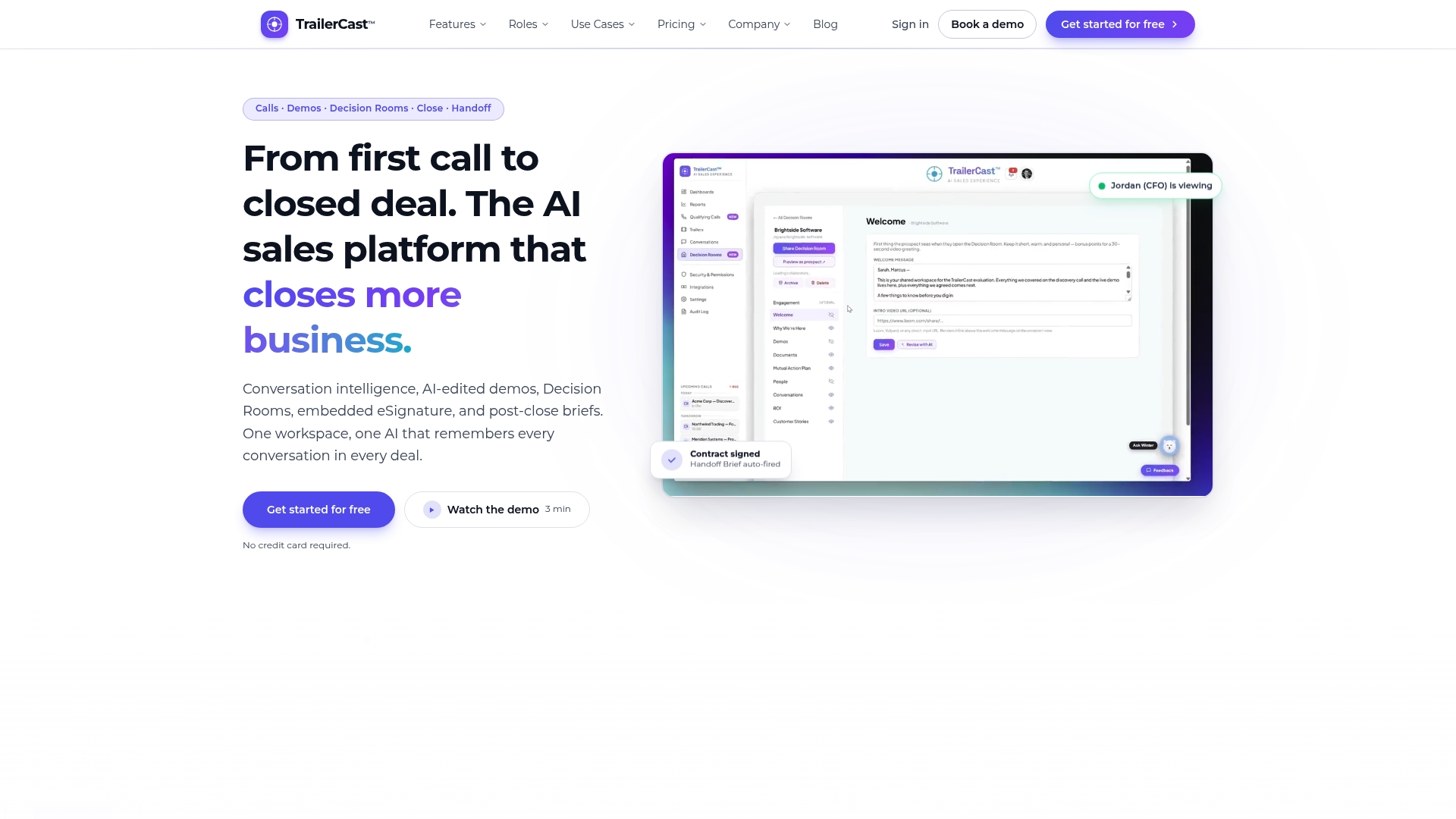
Every share gets tracked, every MAP milestone is visible, and the AI-edited trailer is pulled straight from your last call instead of built from scratch. One plan, every feature, starting at $59 per seat per month billed annually, with a free trial and no credit card required. See what a demo trailer looks like on the product page before your next champion call.
Sources
- What is champion enablement — and how do you actually arm your champion to sell internally?
- What Is a Sales Champion? 2026 Guide to Finding Them
FAQ
What are the three qualities of a true champion?
A true champion has real influence over the buying decision, willingness to advocate for you inside their own organization, and a personal stake in the outcome. Coaches often share the first quality without the other two, which is why validation tests matter before you invest enablement time.
What does it mean to champion the customer?
Championing the customer means an internal stakeholder actively advocates for a vendor’s solution within their own company, forwarding assets, answering objections, and coordinating consensus among other decision makers. It’s distinct from simply being friendly or cooperative during calls.
What does it mean to be a champion for someone?
Being a champion for someone means using your own influence and credibility to advance their interests inside a group they don’t have direct access to. In B2B sales, that means a buyer-side contact who sells your case to their CFO, IT team, or leadership without you in the room.
How do I become a champion?
Becoming an effective internal champion starts with genuinely understanding the business case well enough to explain it in your own words, then proactively forwarding materials to the right stakeholders rather than waiting to be asked. The MEDDPICC framework treats access to the economic buyer and a personal stake in the outcome as the clearest markers of that role.