B2B Sales Leaders: One Impact Journey to Make Generative AI Move Deals

Generative AI in sales works when it stops being a chatbot bolted onto your CRM and starts running the space between calls: transcribing them, turning them into content, and keeping every stakeholder informed without a rep chasing them down. The immediate move is not to buy five tools at once. Pick one impact journey. Conversation intelligence feeding into personalized follow-up is the easiest starting point. Define what success looks like in numbers, and pilot it before you scale anything.
TL;DR:
- Focusing on a single impact journey, such as conversation intelligence into personalized follow-up, increases the chances of successful AI adoption.
- Starting with low-risk use cases like transcription and qualification scoring can deliver quick improvements in coaching time and reply rates.
- Ensuring data quality, clear ownership, and integrating change management are critical to preventing pilot failure and scaling AI solutions effectively.
- Pilot duration should be six to twelve weeks with predefined exit criteria based on measurable KPIs such as pipeline velocity and forecast accuracy.
- A full deployment benefits from an integrated platform like TrailerCast, which unifies deal insights, content creation, decision rooms, and handoffs into one workspace.
Table of Contents
- What Does Generative AI Actually Do for Sales Teams?
- Which Use Cases Should You Pilot First?
- How Mature Is Your Sales AI, Really?
- How Do You Actually Roll This Out?
- What Guardrails Actually Prevent Bad Outputs?
- Which Metrics Actually Prove GenAI Is Working?
- What Does an End-to-End Deployment Actually Look Like?
- Why Do Most GenAI Sales Rollouts Stall?
- A Leader’s Checklist for Setting the Right North Star
- TrailerCast: One Workspace Instead of Five Tools
- Sources
What Does Generative AI Actually Do for Sales Teams?
Most sales leaders have heard the pitch. Fewer have seen the mechanics. Generative AI in sales does three distinct jobs, and confusing them is why so many pilots stall out.
First, it generates content: personalized emails, proposal drafts, call summaries, and even edited demo videos built from a recording nobody would otherwise rewatch, leveraging AI-driven content workflows to accelerate creation. Second, it surfaces insight: who talked the most on a call, what objections came up, which deals are stalling and why. Third, it orchestrates workflow: routing a qualified lead, nudging a rep to follow up, or auto-firing a handoff brief the moment a contract signs.
That third piece is where generative AI overlaps with predictive AI, and the distinction matters more than most vendors admit. Predictive models score leads and forecast close probability based on historical patterns. Generative models produce new material, a summary, a script, a personalized trailer, based on context. The best deployments run both together: a predictive model flags a stalling deal, and a generative layer drafts the recovery email a rep can send in thirty seconds instead of thirty minutes.
The adoption numbers back up why teams are moving fast here. A large majority of B2B commercial leaders who have implemented generative AI report being genuinely excited about its potential to lift both top-line growth and customer experience, not just efficiency metrics. That excitement tracks with what the technology actually does well right now:
- Automated call transcription and structured summaries, so no deal detail lives only in one rep’s memory.
- Personalized outreach at scale, drafted from real account context instead of a generic template.
- Content generation for proposals, follow-up emails, and objection-handling scripts.
- AI-edited demo trailers that compress an hour-long call into the eight minutes a CFO will actually watch.
- Deal-room orchestration that keeps discovery notes, ROI docs, and stakeholder activity in one place.
- Next-best-action guidance and forecasting support drawn from patterns across the full pipeline.
None of that replaces a seller’s judgment. It removes the busywork standing between a good conversation and the next step.
Which Use Cases Should You Pilot First?
Not every use case deserves your first ninety days. Some pay back almost immediately; others need infrastructure you probably don’t have yet. Here’s how to sequence them.
- Conversation intelligence and coaching. Automated transcription and qualification scoring is the lowest-risk starting point because it touches no customer-facing output. Scope it to one team, run it for four weeks, and measure how much manager coaching time it frees up.
- Personalized outreach at scale. Once you trust the transcripts, feed that context into outbound drafts. KPI: reply rate lift compared to your current template baseline.
- Demo and video personalization. Turn recorded demos into shorter, stakeholder-specific trailers a champion can forward internally. KPI: forwarding rate and time-to-next-meeting.
- Decision rooms and handoff automation. Centralize discovery notes, mutual action plans, and post-close briefs so nothing gets re-explained. KPI: sales-to-CS handoff time and early churn signals.
- Automated follow-ups and eSignature workflows. Close the loop without a tool switch. KPI: days from verbal yes to signed contract.
- Prospecting and account discovery. Highest long-term value, but it needs clean firmographic data to avoid wasted sends. Start last unless your data hygiene is already strong.
Pro Tip: Match the pilot to your bottleneck, not your budget. If deals stall in internal buyer committee meetings, start with decision rooms. If reps burn hours on note-taking, start with conversation intelligence. Chasing the flashiest use case first is how pilots die in month two.
If you run a small team with short sales cycles, start with outreach personalization. If you sell into multi-stakeholder committees with cycles longer than sixty days, start with conversation intelligence and decision rooms. The complexity of your buying committee should decide your sequence more than the size of your team does.
How Mature Is Your Sales AI, Really?
Most teams overstate where they sit on the maturity curve. There are four real stages, and skipping one usually means skipping the governance that stage requires.
- Augmented. AI assists with drafting and summarizing, but a human reviews and sends everything. A rep gets a suggested email draft and edits it before hitting send.
- Assisted. AI recommends next actions and a human approves them in bulk rather than line by line. Think approving a batch of five follow-up sequences instead of writing each one.
- Autonomous. AI executes low-stakes, low-touch actions without human sign-off, usually reserved for smaller deals or top-of-funnel qualification.
- Agentic. AI agents act across multiple steps of a workflow, coordinating tasks and even other agents, with humans stepping in only on exceptions or high-value accounts.
BCG’s framing of augmented, assisted, and autonomous agentic selling maps closely to this, and the firm’s research suggests coverage models can differ by segment: agents run more autonomously for low-touch accounts while acting as copilots for strategic, high-value deals. That’s not a compromise. It’s the correct design.
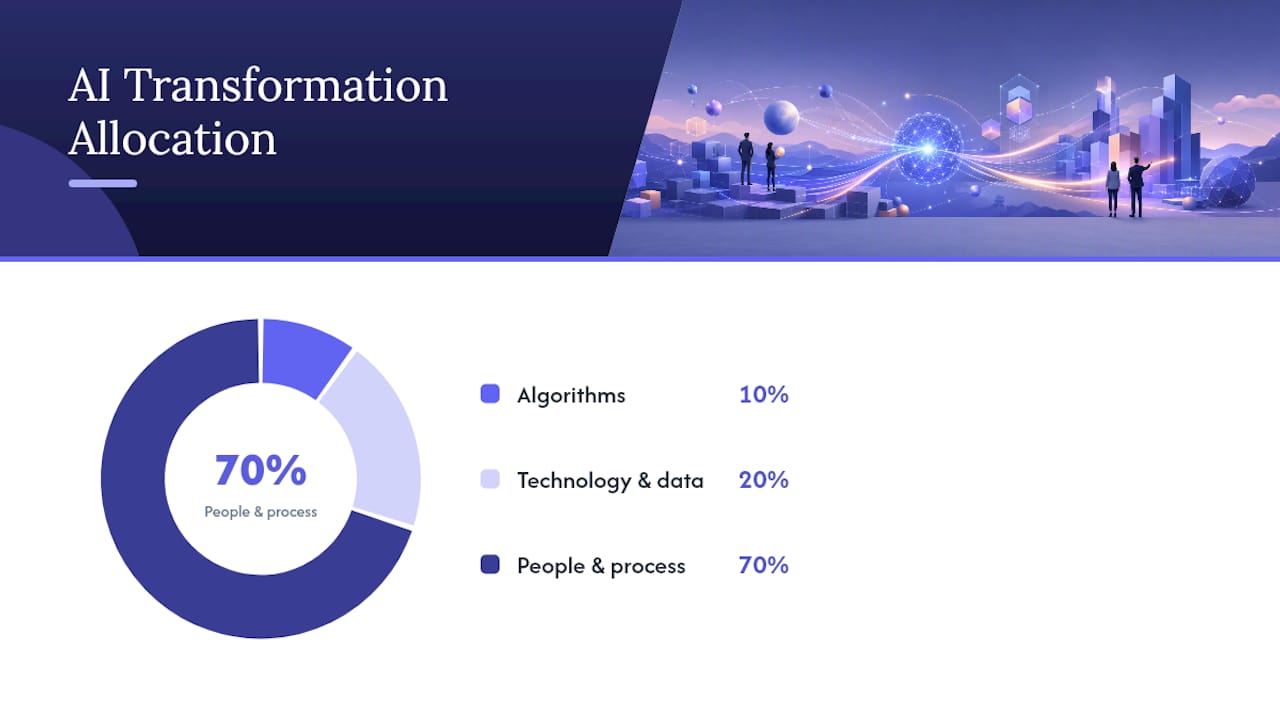
The trap is jumping straight to autonomous or agentic without the guardrails those stages demand. BCG’s often-cited allocation for a successful AI transformation is 10% algorithms, 20% technology and data, and 70% people and process, a ratio Gartner’s own sales AI framework echoes in its emphasis on workflow-first planning over tool-first planning.
How Do You Actually Roll This Out?
A pilot with no owner and no exit criteria is just a demo you paid for. Here’s the sequence that keeps generative AI in sales from becoming shelfware.
- Choose one impact journey and name an owner. Pick a single workflow (conversation intelligence into personalized follow-up is the most common starting point) and assign one person accountable for the metrics, not a committee.
- Fix your tech prerequisites before you fix anything else. That means CRM integration that actually syncs bidirectionally, a clean data spine, and monitoring in place before the first real customer touch happens. McKinsey’s research on B2B growth leaders finds they rewire the entire commercial impact journey, integrating data, decision logic, human judgment, and AI agents together rather than layering AI on top of an unchanged process.
- Put 70% of your effort into people and process. Training, incentive alignment, and change management determine whether reps actually use the tool. Coursera’s own generative AI specialization for sales professionals exists because prompting and workflow fluency are becoming baseline skills, not optional extras.
- Pilot for six to twelve weeks, then decide. Run a timeboxed pilot measuring seller time saved, conversion lift, and forecast accuracy against a CRM-grounded control cohort. Require human review on outbound templates during the pilot window, and set rollback criteria up front so a bad pilot doesn’t quietly become permanent infrastructure.
Pro Tip: Write your rollback trigger before you launch, not after results come in. “If reply rates drop below baseline for two consecutive weeks, we pause” is a decision you can only make objectively before you have a stake in the outcome.
What Guardrails Actually Prevent Bad Outputs?
Generative AI in sales fails loudest when it fails in front of a customer, a hallucinated pricing detail, a tone-deaf email, a stat that doesn’t exist. The fix isn’t more caution. It’s better plumbing.
- Audit CRM data quality before launch. Poor CRM hygiene is the leading cause of both hallucinations and bad personalization, according to Gartner’s research on common failure modes.
- Build approved templates and brand-voice guardrails into the generation layer itself, not as a post-hoc edit step.
- Require human review gates for any customer-facing output during the first several weeks of any rollout.
- Set monitoring telemetry to catch model drift. Outputs that looked fine at launch can degrade quietly over months.
- Document a clear escalation path for when an AI-generated document contains something wrong, and make sure every rep knows it.
- Treat privacy and compliance as a design constraint from day one, not a review step bolted on before launch.
None of this is glamorous work. It’s also the difference between a pilot that scales and one that gets quietly shut down after one bad email goes out.
Which Metrics Actually Prove GenAI Is Working?
Track time saved per rep, reply and meeting rates, conversion lift, pipeline velocity, forecast accuracy, and demo-to-close conversion. Any one metric alone is misleading; together they show whether AI is genuinely changing outcomes or just making activity look busier.
Structure tests as proper A/B comparisons with CRM-grounded cohorts, not before-and-after snapshots that ignore seasonality or rep turnover. Watch for selection bias: if your best reps opt into the pilot first, your results will look better than what a full rollout produces. Vendor case studies report meaningful time savings per week from combining conversation intelligence with data enrichment, but treat any single vendor’s number as a starting hypothesis, not a guarantee for your team. Give a pilot at least one full sales cycle before drawing conclusions.
What Does an End-to-End Deployment Actually Look Like?
Most of the guidance above stays theoretical until you see it applied to one deal, start to finish. Here’s a stepwise example: a discovery call gets transcribed and summarized automatically, the AI drafts a qualification verdict and action items, an edited demo trailer gets built from the follow-up call and personalized per stakeholder, a decision room centralizes the ROI doc and mutual action plan for the buying committee, the deal closes with embedded eSignature, and a handoff brief fires to customer success the moment the contract signs.
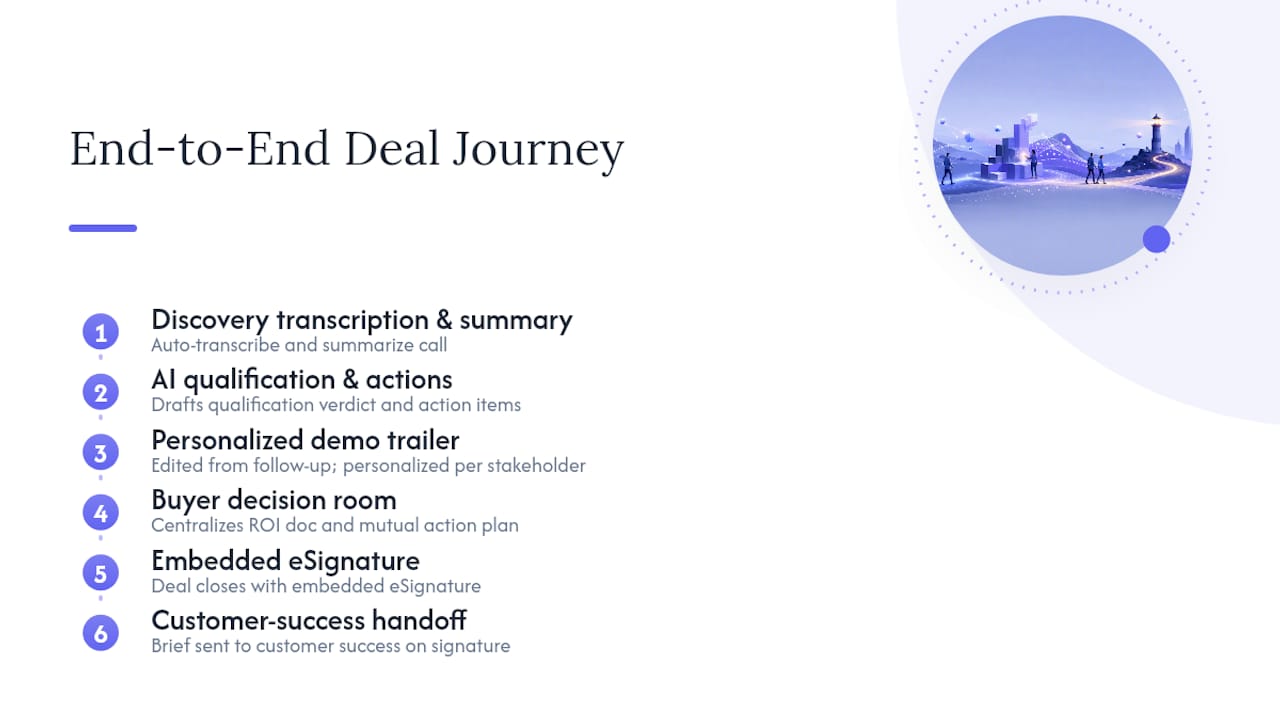
That sequence is close to how TrailerCast’s platform is built, stage by stage, and it maps closely to the impact-journey model McKinsey describes. It fits best for B2B SaaS teams selling into multi-stakeholder committees, where the cost of losing context between calls is highest.
Why Do Most GenAI Sales Rollouts Stall?
The technology rarely fails first. The process around it does.
The most common failure is treating generative AI as a bolt-on tool instead of a workflow change. A rep gets access to an AI email drafter, uses it twice, and reverts to old habits because nobody adjusted their quota structure or coaching cadence to account for the new capability. Fix this by tying AI adoption to a specific, measured behavior change, not just tool access.
The second failure is data. If your CRM fields are half-empty or your account data is stale, generative outputs will be confidently wrong, which is worse than obviously wrong. Clean the data spine before the rollout, not during it.
The third is unclear ownership. When no single person is accountable for a pilot’s success metrics, it drifts indefinitely without ever getting a real evaluation. Name an owner on day one.
The fourth is skipping change management because the tool “sells itself.” It doesn’t. Reps adopt new workflows when incentives, training, and manager coaching all point the same direction. BCG’s people-and-process emphasis exists precisely because the algorithm is rarely the hard part. Getting a sales floor to actually change how it works is.
A Leader’s Checklist for Setting the Right North Star
Before you approve a budget line for generative AI in sales, have three conversations with your leadership team: what outcome are we actually chasing (pipeline velocity, not just activity volume), what metrics will tell us honestly if it’s working, and what guardrails protect us if it isn’t. Skip any one of these and you’ll end up measuring adoption instead of impact.
Treat your first pilot as a hypothesis test, not a bet-the-quarter decision. Set exit criteria before you start, and be willing to walk away from a pilot that doesn’t clear them. That discipline is rarer than the AI itself.
— Daniel
TrailerCast: One Workspace Instead of Five Tools
If the deployment checklist above sounds like a lot of separate systems to stitch together, that’s because it usually is. Most sales stacks run conversation intelligence, video editing, deal rooms, eSignature, and handoff notes as five disconnected tools, and the gaps between them are exactly where deals go quiet. TrailerCast exists to close those gaps: one workspace where a single AI follows the deal from first call to closed contract, remembering every conversation even when you’re not in the room.
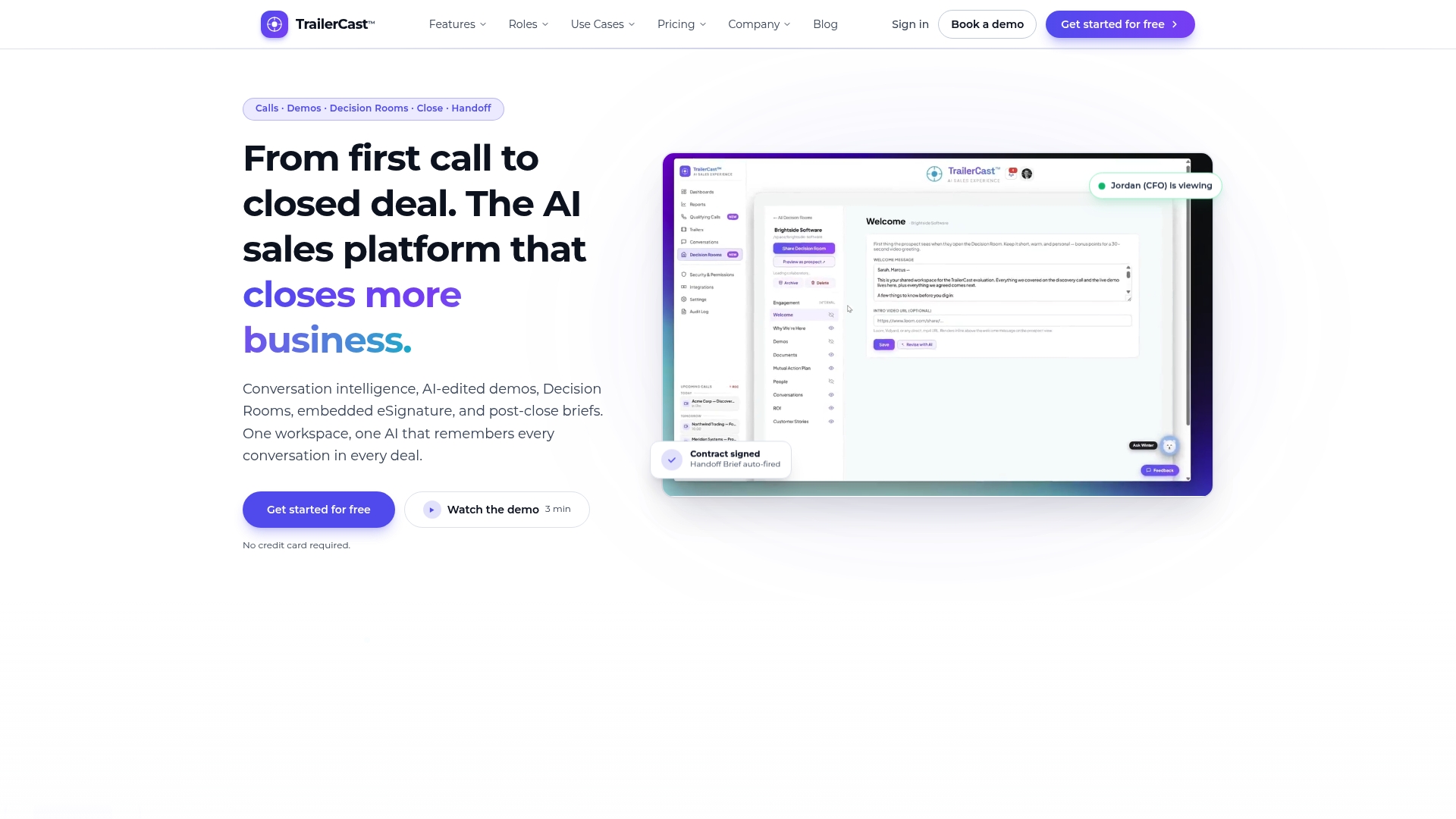
The platform covers the full sequence discussed above: an AI notetaker for discovery calls, auto-edited demo trailers personalized per stakeholder, buyer-facing decision rooms with engagement tracking, embedded eSignature, and an AI handoff brief that fires to customer success the moment a contract signs. Pricing is seat-based with monthly or annual billing, with every feature included and no tiered gating. A free trial requires no credit card. If your team sells into multi-stakeholder committees and is tired of losing context between calls, check the feature breakdown and start a trial to see how one AI brain across the full deal cycle compares to the patchwork you’re running now.
Sources
- Generative AI for Sales | IBM
- The future of B2B sales: How growth champions rewire their playbooks with AI | McKinsey
- How AI agents will transform B2B sales | BCG
- The Role of Artificial Intelligence (AI) in Sales | Gartner