Deal Management Software for B2B Sales Teams: 2026 Guide

Deal management software is a centralized platform that organizes, tracks, and advances sales opportunities through every pipeline stage with automation and real-time insights. For B2B sales teams navigating multi-stakeholder buying committees, it is the difference between a deal that moves and one that stalls in someone’s inbox. Sales organizations using dedicated deal management platforms experience a 94% increase in deals closed within six months. That number reflects what happens when you replace scattered spreadsheets and disconnected tools with one system that governs every deal from first call to signed contract.
What are the essential features of deal management software?
The best deal management tools do far more than display a pipeline. They enforce process, surface risk, and keep every stakeholder aligned without requiring a rep to manually chase updates.
The core features that separate a real deal management system from a basic CRM pipeline view include:
- Automated deal stage progression. Workflow triggers fire tasks, notifications, and approval requests the moment a deal moves from one stage to the next. Automation triggers notify stakeholders on stage changes and route approvals automatically, keeping deals moving even during busy schedules.
- AI-powered deal scoring and health monitoring. AI identifies at-risk deals and prompts next-step actions without manual data entry. Reps stop guessing which deals need attention and start acting on evidence.
- Centralized deal data. Buyer contact records, pricing approvals, proposal versions, and next-step commitments all live in one place. No more digging through email threads to find what was promised in the last call.
- Buying committee collaboration tools. Multi-stakeholder deals require shared visibility. The best platforms let you track who on the buyer side has engaged, who is still dark, and what content each person has reviewed.
- CRM and marketing integration. A deal management system that cannot pull in CRM history, marketing engagement, and service records forces reps to work with incomplete context. Full integration closes that gap.
Pro Tip: When evaluating platforms, look past the pipeline view. Ask vendors specifically how they handle pricing approvals, next-step discipline, and stakeholder tracking. Those operational controls are what actually move deals.
The feature that most teams underestimate is deal health monitoring. A rep might feel confident about a deal based on a great last call. The system, however, sees that no one from the buying committee has opened a document in three weeks. That gap between perception and reality is where deals die.

How does deal management software improve sales outcomes?
The business case for dedicated deals management software is not theoretical. Sales teams using these platforms close 94% more deals within the first six months of implementation. The mechanism is straightforward: automation removes the administrative drag that pulls reps away from selling.
“The biggest win from structured deal management is not speed. It is accuracy. Reps stop losing deals they thought they were winning because the system surfaces the truth about engagement, risk, and next steps before it is too late.”
Forecast accuracy improves because deal data is structured and current. When every deal has a defined next step, a documented stakeholder map, and a logged approval status, sales managers can read the pipeline with confidence. They are not relying on a rep’s gut feel from a call two weeks ago.
Collaboration across buying committees is where the impact compounds. A CFO who was not on the discovery call needs different information than the IT lead who was. Integrated deal management provides a 360-degree view of customers with contextualized deal data, which means your champion can share the right content with the right internal stakeholder instead of forwarding a generic deck. That precision shortens the internal approval cycle on the buyer’s side, which is the part of the deal you cannot control directly but can absolutely influence.
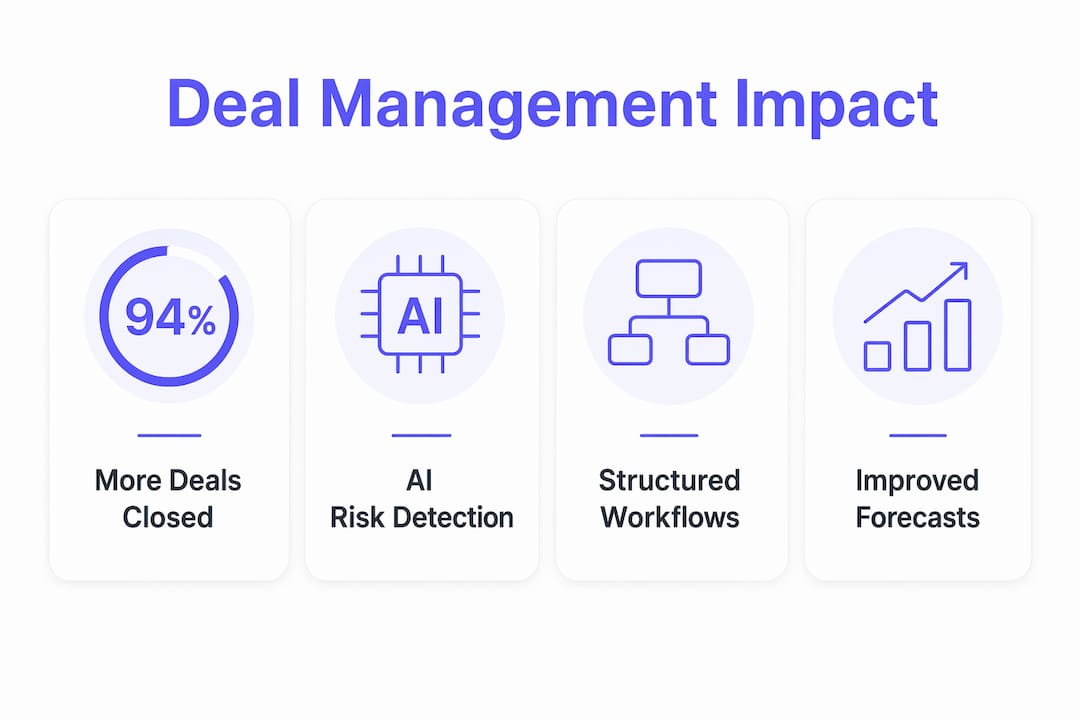
Real AI in deal management software can summarize deal history, flag risks early, and keep data accurate, significantly speeding up sales cycles. The practical effect is that reps spend less time updating records and more time having conversations that actually advance the deal.
What distinguishes deal management software from CRM and pipeline tools?
This is the question most sales teams get wrong, and the confusion costs them. CRM, pipeline management, and deal management are related but not interchangeable.
CRM is the system of record managing the full customer lifecycle. It stores contact history, account data, and relationship context. Pipeline management is the aggregate view of deal stages across your book of business. Deal management is the operational governance layer that sits on top of both.
| Function | CRM | Pipeline management | Deal management software |
|---|---|---|---|
| Primary purpose | Store customer and contact data | Track deal stage distribution | Govern individual deal execution |
| Key output | Customer history and relationship record | Forecast roll-up by stage | Next-step discipline, approvals, risk flags |
| User focus | Account managers, CS teams | Sales managers reviewing aggregate flow | Reps and managers working active deals |
| AI application | Contact enrichment, activity logging | Stage conversion analytics | Deal scoring, health monitoring, content ranking |
Structured workflows in deal management include stage definitions, pricing approvals, next-step discipline, and stakeholder tracking. These are not features you find in a standard CRM pipeline view. They are the controls that make a deal predictable rather than hopeful.
The practical confusion arises because most modern CRMs have added deal management features. Most modern CRMs integrate deal management with complete customer records to provide a 360-degree view. The distinction is whether those features are bolted on or built as the core product. A CRM with a pipeline tab is not the same as a platform designed from the ground up to govern deal execution.
Pro Tip: Before evaluating any platform, map your actual deal process on paper. Write down every approval, every stakeholder touchpoint, and every handoff. Then check whether the software enforces those steps or just displays them.
How to choose the right deal management software for your sales organization
Choosing the wrong platform is expensive, not just in licensing cost but in adoption failure. Here is a structured way to evaluate your options.
-
Map your approval and workflow needs first. Every B2B deal has pricing approvals, legal reviews, or executive sign-offs. Identify exactly where those occur in your process before you look at any software. A platform that cannot route approvals automatically will create a manual workaround that nobody follows.
-
Evaluate AI capabilities on real tasks. Ask vendors to show you how their AI handles deal summarization, risk flagging, and content recommendations. Choosing deal management software requires evaluating AI and automation capabilities that actually reduce busywork and improve data accuracy. Generic AI claims are common. Working demos on your use cases are what matter.
-
Assess your deal complexity and volume. A team running 20 enterprise deals at a time needs different controls than a team closing 200 transactional deals per month. Enterprise deals require deep stakeholder mapping and approval routing. High-volume deals need fast data entry and automated follow-up.
-
Check integration depth with your existing stack. A deal management system that does not sync bidirectionally with your CRM creates duplicate data entry. Confirm that the integration writes back to your CRM, not just reads from it.
-
Understand plan gates before you sign. Many platforms gate advanced features like AI scoring, custom workflows, or stakeholder analytics behind higher-tier plans. Map your must-have features to the plan that actually includes them, not the entry-level price you saw in the ad.
-
Run a proof-of-concept on a live deal. Take three to five active opportunities and run them through the platform for 30 days. You will learn more from that exercise than from any demo or reference call.
Pro Tip: Ask the vendor what percentage of their customers use the AI features actively after 90 days. Low adoption on AI tools usually signals that the features are too complex or too disconnected from the rep’s daily workflow.
Key Takeaways
Effective deal management software governs individual deal execution through structured workflows, AI-powered risk detection, and buying committee collaboration tools that CRM and pipeline views alone cannot provide.
| Point | Details |
|---|---|
| 94% more deals closed | Sales teams using dedicated platforms close significantly more deals within six months of adoption. |
| AI health monitoring matters | Automated risk flagging catches deals in trouble before reps realize the opportunity is slipping. |
| CRM is not deal management | CRM stores customer data; deal management enforces the operational steps that move individual deals forward. |
| Buying committee visibility | Tracking per-stakeholder engagement on the buyer side shortens internal approval cycles you cannot attend. |
| Evaluate before you commit | Map your approval workflows and run a live proof-of-concept before signing any platform contract. |
Why most sales teams adopt the wrong system first
I have watched sales teams buy a CRM, add a pipeline dashboard, and call it deal management. Six months later, the VP of Sales is still running deal reviews from a spreadsheet because the system does not enforce anything. It just records what already happened.
The mistake is treating deal management as a reporting problem. It is not. It is a process problem. The question is not “where are my deals?” It is “what is blocking each deal right now, and who needs to act?” Those are fundamentally different questions, and they require a system built to answer them.
The teams that get the most out of a deal management system are the ones that define their process before they configure the software. They know their stage exit criteria. They know which approvals require which stakeholders. They know what a healthy deal looks like at each stage. The software then enforces what they already decided, rather than becoming a blank canvas nobody fills in consistently.
Change management is the part most vendors skip in their sales pitch. Getting reps to log next steps, update stakeholder maps, and use the system consistently requires manager reinforcement, not just training. The platforms that win long-term are the ones that make compliance feel effortless because the system captures context automatically rather than demanding manual input.
The buying committee collaboration piece is where I see the biggest untapped opportunity. Most teams use their deal management system internally. The best teams extend it to the buyer side, giving champions a shared space where the deal lives, where questions get answered, and where the internal approval process becomes visible to the seller. That visibility changes everything.
— Daniel
Trailercast brings AI-powered deal governance to every stage
Trailercast is built for exactly the scenario this article describes: a B2B deal with multiple stakeholders, a champion who needs help selling internally, and a seller who cannot be in every room where the decision gets made.
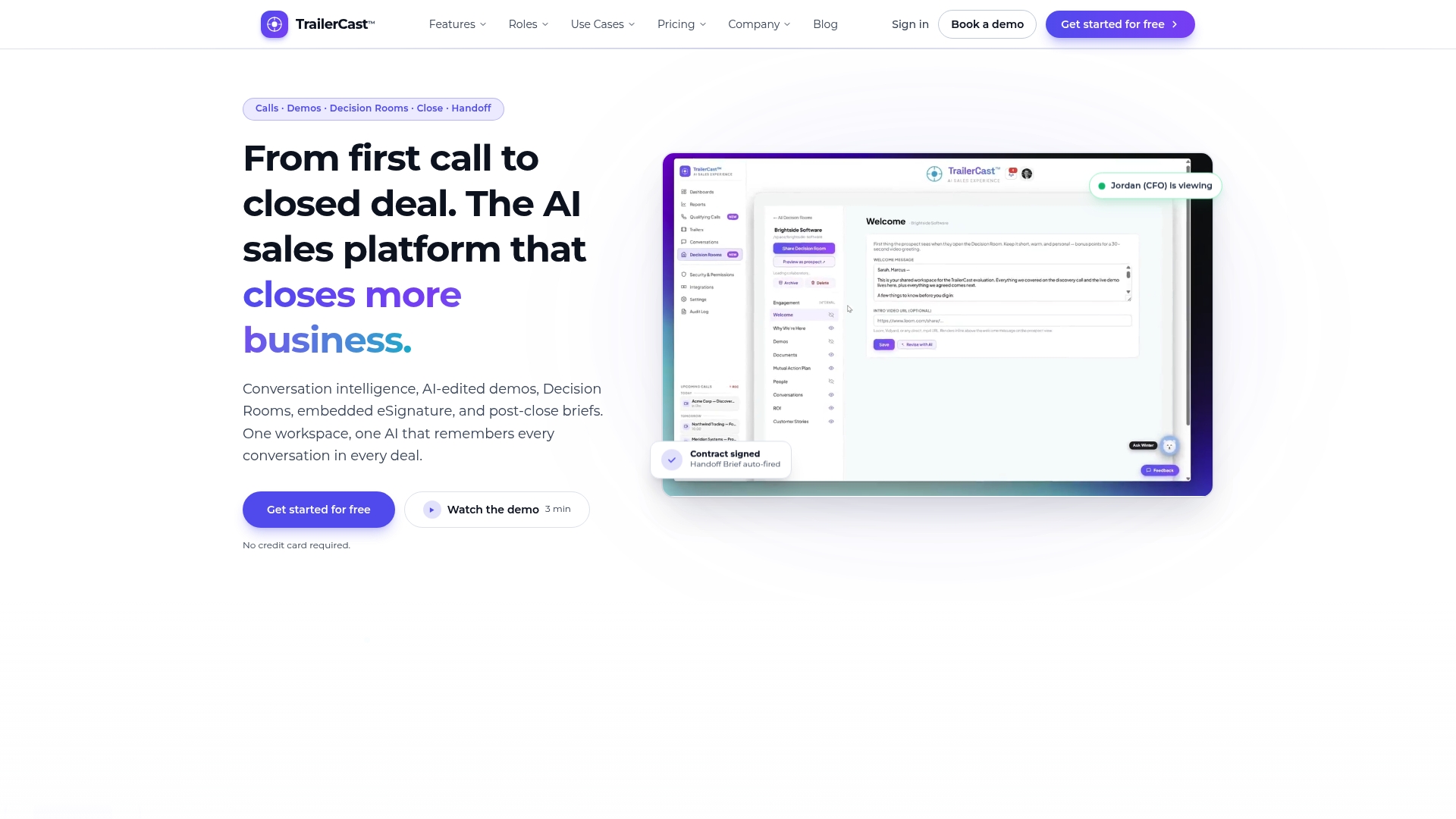
The platform covers the full deal lifecycle in one workspace. Conversation intelligence captures every call automatically. AI-edited demo trailers give your champion something worth forwarding to the CFO or CISO who missed the live session. Decision Rooms give the buying committee a shared space where the deal lives between conversations, with per-stakeholder engagement tracked in real time. Embedded eSignature and an automated handoff brief close the loop without a single tool switch. Trailercast is priced at $79 per seat per month, with every feature included and a free trial that requires no credit card. See the full platform and decide if it fits your sales motion.
FAQ
What is deal management software?
Deal management software is a platform that centralizes, tracks, and automates the progression of sales opportunities through each stage of the pipeline. It adds operational governance, including approval routing, stakeholder tracking, and AI-powered risk flagging, on top of standard CRM data storage.
How is deal management different from CRM?
CRM is the system of record for customer and contact data across the full relationship lifecycle. Deal management is the operational layer that governs how individual deals move forward, enforcing next steps, approvals, and stakeholder engagement at the deal level.
What results can sales teams expect from deal management software?
Sales organizations using dedicated deal management platforms report a 94% increase in deals closed within the first six months. The primary driver is automation that removes administrative work and surfaces deal risk before opportunities are lost.
What features should I prioritize when evaluating deal management systems?
Prioritize AI deal scoring, automated workflow triggers, buying committee tracking, and bidirectional CRM integration. Evaluating AI and automation capabilities before committing to a platform prevents adopting a system that looks good in a demo but fails in daily use.
Do I need deal management software if I already have a CRM?
Yes, if your deals involve multiple stakeholders, pricing approvals, or complex internal buying processes. A CRM records what happened. A deal management system enforces what needs to happen next, which is a different and more operationally valuable function.