CSMs: Copyable Customer Handoff Template & Scripts (2–4 Week Overlap)

Use a living account handoff template stored in your CRM or deal room, not a PDF you email once. It should capture contacts, deal history, why the customer bought, and open commitments, then trigger a joint transition meeting and a multiple-week overlap with a defined hypercare period. The next move is simple: build the template now, drop it into the account record, and get the joint call on the calendar before the ink dries on the contract.
TL;DR:
- A living account handoff template should include account details, stakeholder relationships, reasons for buying, technical setup, open promises, and a shared action plan to prevent re-asking information.
- The optimal handoff process begins weeks before signing, with internal review, joint customer meetings close to signing, shadowing periods, and clear hypercare exit criteria.
- The joint handoff meeting must be concise, focused on next steps and key priorities, with pre-meeting introductions and post-meeting action recaps to build trust.
- Systems, access, and ownership responsibilities should be verified beforehand, using acceptance scorecards and ensuring all workflows and documents are stored centrally for easy retrieval.
- Using AI-powered deal rooms to store transcripts, commitments, and engagement data reduces memory failures, making handoffs more reliable and efficient.
Table of Contents
- What Goes in a Customer Handoff Template?
- When Should Each Handoff Phase Happen?
- What Should You Say in the Handoff Meeting and Emails?
- Internal Checklist: Systems, Access, and Ownership
- How Do You Measure a Successful Handoff?
- How AI Deal Rooms Cut Handoff Friction
- Common Handoff Mistakes and How to Avoid Them
- Three Rules I’d Apply to Every Handoff
- Templates and Guides Worth Bookmarking
- Sources
What Goes in a Customer Handoff Template?
A customer handoff template only earns its place if it stops your customer success manager from re-asking questions the prospect already answered a salesperson to. That’s the real test. If the incoming owner still has to run a discovery call to figure out what the account needs, the template failed, no matter how nice it looks
Here’s what belongs in it, and where to store each piece:
- Account summary and contract basics. ARR, product mix, contract start and renewal dates, billing contact, and any negotiated terms that affect renewal conversations later.
- Relationship map. Every stakeholder’s role, who actually holds budget authority, who’s the internal champion, and each person’s preferred communication style (email versus Slack, formal versus casual).
- Why they bought. The specific business problem that closed the deal and how the customer defines success, in their own words if you captured them.
- Technical and setup notes. Integration requirements, security or compliance conditions, and any access provisioning already promised or in progress.
- Open issues and promises. Every commitment made during the sales cycle, who owns resolving it, and the deadline attached to it.
- Mutual action plan. The shared roadmap for the first 30 to 90 days, with named owners on both sides and dates, not vague milestones.
This structure lines up closely with what Teamwork’s client handoff checklist recommends for account changes: keep everything inside the existing project workspace so context never scatters across inboxes. A separate breakdown of what belongs in a sales-to-CS handoff makes the same case for including active project status and upcoming milestones, specifically to avoid forcing the new owner into an interrogation-style kickoff call.
When Should Each Handoff Phase Happen?
Handoff timing is where most teams improvise, and improvising is exactly how a customer ends up explaining their own contract to three different people. A predictable timeline fixes that.
- Start planning several weeks out. Don’t wait for the signature. Flag the account for transition once the deal reaches late-stage negotiation, so the new owner has lead time instead of a surprise assignment.
- Run the internal handoff first. Before anyone talks to the customer, the outgoing and incoming owners meet to review the template, confirm open items, and agree on who says what in the joint call.
- Hold the joint customer meeting close to signing. Rework’s account transition guidance frames this well: customer communication happens before the joint meeting, and the joint meeting itself lands about a week before or right at the moment of formal transfer, never weeks after.
- Shadow, then co-lead, then run solo. GitLab’s public handover process documents a shadowing period of roughly 2 to 4 weeks: the incoming owner observes calls silently, then co-leads them, then takes the account fully with the outgoing owner available as backup.
- Define hypercare and its exit criteria. Hypercare isn’t “keep an eye on it.” It’s a fixed window, usually a few weeks, with specific metrics that have to clear before you declare the transition closed.
What Should You Say in the Handoff Meeting and Emails?
The joint meeting is where most handoffs either build confidence or quietly erode it. Keep it to about half an hour with a tight agenda: context recap, top priorities for the next 90 days, who owns what going forward, and immediate next steps. Nobody needs a history lesson. They need to know their new point of contact already understands their account.
Before that call, the outgoing owner sends a short intro email:
- State the purpose in one line: “Introducing [new owner], your customer success manager going forward.”
- Endorse the incoming owner directly, by name, with a specific reason the customer should trust them.
- Give the new contact’s information and how to reach them.
- Name the very next step, whether that’s the joint call or a specific deliverable date.
After the meeting, send a recap with action items, named owners, and deadlines, not a generic “great chat today” note. That recap becomes the first entry in the living handoff document, so it’s searchable later instead of buried in someone’s sent folder.
Pro Tip: Open the joint call by referencing something specific from the account, like a stakeholder’s name, a promised feature, or an exact date from the mutual action plan. That ten-second detail does more to build credibility than any amount of “I’ve reviewed your account thoroughly.”
Internal Checklist: Systems, Access, and Ownership
Customer-facing polish falls apart fast if the backend is a mess. Before the incoming owner takes the account, verify:
- CRM records, shared documents, and call recordings are all linked to the account, not scattered across personal drives.
- Entitlements and technical access (admin rights, integration credentials, security clearances) are confirmed active, not just requested.
- Escalation paths are documented, and one person, not a committee, is named as the accountable transition owner.
- Knowledge-transfer assets are attached: relevant playbooks, runbooks, and any QA rubrics tied to that account’s use case.
Set explicit acceptance criteria before go-live. Enterprise transition frameworks built for managed service handoffs use a service acceptance scorecard with customer, operational, and control metrics that all have to clear a threshold before the transition is called complete. You don’t need enterprise complexity to borrow the discipline: a five-line scorecard beats a gut-feeling “seems fine.”
How Do You Measure a Successful Handoff?
Hypercare only works if you’re tracking something concrete, not just watching for complaints. Useful metrics include QA score on early customer interactions, complaint rate, first-contact resolution, response time against your SLA, and engagement or activity levels compared to the account’s pre-handoff baseline.
A short list of guardrails beats a long list of vanity metrics. Report daily during the first week of hypercare, then weekly for the remainder of the window. If you’re transitioning multiple accounts at once, track them as a cohort rather than one by one, since patterns across five accounts tell you more than any single data point.
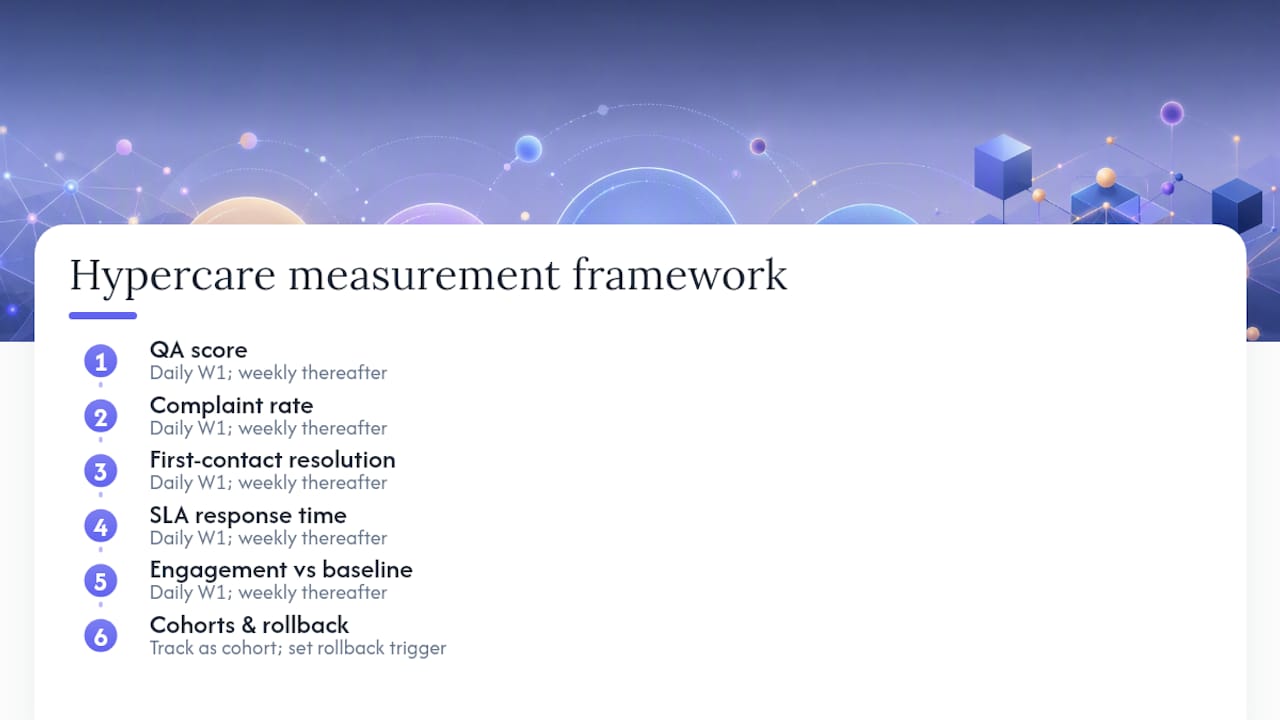
Set a rollback trigger in advance: if QA scores drop below an agreed floor or complaints spike for two consecutive reporting periods, the outgoing owner steps back in temporarily. Deciding that threshold after metrics slip is too late.
How AI Deal Rooms Cut Handoff Friction
Most handoff failures aren’t process failures. They’re memory failures: a promise made on call three that nobody wrote down, a stakeholder concern that lived only in someone’s head. A searchable deal room fixes the retrieval problem directly.
Store full transcripts, key quotes, and flagged risks inside the account’s digital workspace, not a static PDF nobody reopens. Tools that auto-generate a handoff brief from recorded calls and the mutual action plan save the incoming CSM hours of digging and catch commitments a manual summary would miss. Engagement data adds another layer: knowing which stakeholder rewatched a demo trailer or forwarded materials internally tells you exactly who to prioritize in week one, using demo trailer engagement instead of guessing.

Common Handoff Mistakes and How to Avoid Them
The same handful of mistakes shows up across almost every broken handoff, and they’re all avoidable.
Treating the handoff as a one-time email. A PDF sent once goes stale the moment a customer’s situation changes. Keep the document living in the CRM or deal room, updated as facts change, not archived after the first send.
Skipping the joint meeting. Handing an account off with a note that says “see attached” tells the customer they don’t matter enough for a proper introduction. The joint call isn’t optional. It’s the moment trust either transfers or doesn’t.
No defined overlap period. Cutting the outgoing owner loose immediately leaves the new owner exposed on any question outside the written record. A 2 to 4 week shadow period, as GitLab’s process documents, catches the gaps a template can’t anticipate.
Vague ownership. When “the team” owns the transition, nobody actually does. Name one accountable person, every time.
No exit criteria for hypercare. Without a defined end point and success threshold, hypercare either ends too early (before metrics stabilize) or never ends at all, quietly draining resources on an account that’s actually fine.
Three Rules I’d Apply to Every Handoff
Most handoff advice focuses on documentation. The bigger failure point is usually accountability drift. When ownership is fuzzy for even three days, customers notice, and they interpret the silence as being deprioritized.
Three rules hold up regardless of team size: never let the joint meeting happen without both owners present, never call hypercare complete without a metric threshold defined in advance, and never let the handoff document sit in an inbox instead of the CRM. Templates don’t fail from missing fields. They fail from nobody enforcing the process around them.
— Daniel
Templates and Guides Worth Bookmarking
For a quick, low-stakes handoff, start with Teamwork’s checklist template. For enterprise or multi-stakeholder migrations, GitLab’s documented process and the service-acceptance scorecard approach offer more rigor. For meeting structure specifically, OffBook’s guide to the sales handoff process is worth a read before your next joint call.
Sources
- Account Transition: Managing Relationship and Ownership Transfer - 2026 Guide
- Risk-Free Transition: How to Migrate to a New Outsourcing Partner
- CSM to CSE+ Account Transition Process | The GitLab Handbook
- Teamwork