Buyer Enablement Content: Map B2B Assets, Earn Shortlist Spots

Buyer enablement is the content, tools, and workflows that help a buying committee evaluate options, build internal consensus, and reach a decision without needing a seller in the room for every step. Done well, it improves your shortlist placement and gives your champion something concrete to carry into the rooms you never see. This guide maps content to buying roles, walks through asset types and templates, and covers the metrics that tell you whether any of it is actually working.
TL;DR:
- Gartner found that 69% of B2B buyers notice gaps between website content and sales explanations, so keep both sources aligned.
- Give economic buyers a business case led by numbers, technical influencers direct security or integration answers, and champions short assets they can forward easily.
- Use one trackable decision room for pricing, plans, and stakeholder materials; scattered attachments can create conflicting versions and leave champions to rebuild the case.
- Track shortlist placement, stakeholder engagement, committee sharing, and influence on wins, then retire assets that buyers do not open or forward.
- Before turning recorded calls into clips for buyers, secure consent; otherwise, the asset can create more risk than deal value.
Table of Contents
- Why buyer enablement matters now
- Buying-group roles and the stages where content matters
- Types of buyer enablement content and concrete examples
- How to plan and map buyer enablement content to jobs-to-be-done
- Production, personalization, and distribution tactics
- Measure and optimize buyer enablement
- What publishing buyer enablement content taught us
- Our take on what buyer enablement actually requires
- How TrailerCast keeps buyer enablement content organized
- FAQ
- Sources
Why buyer enablement matters now
Buyers are not waiting for your sales process to catch up with how they actually buy. By the time a rep gets a call booked, most of the committee has already formed an opinion. The 6sense 2025 Buyer Experience Report found that buyers settle on a preliminary favorite earlier in the process than they used to, and the vendor that holds that early preference may have an advantage in the deals that follow. If you are not shaping that early impression, you are competing for a spot that is already mostly decided.
That early advantage only holds if what the buyer sees matches what the buyer hears. Gartner’s 2025 sales survey found that 69% of B2B buyers notice inconsistencies between a company’s website content and what sales reps tell them directly. Every mismatch is a reason for a skeptical committee member to slow things down, and in multi-stakeholder deals, slowing down can make it harder to maintain momentum.
This is the part most sales teams get wrong: they treat the deal as a conversation between a rep and a champion, when it is really a conversation the champion has to keep having with people who were never on the call. Harvard Business Review’s analysis of changing B2B buying behavior points to the same shift. Buyers do more independent research, expect clearer explanations without a rep walking them through it, and increasingly make decisions before a seller ever gets a seat at the table.
Buyer enablement exists to close that gap. Give your champion a forwardable, role-specific case for the purchase and you shorten the internal sales cycle they are running on your behalf, often without you knowing it is happening at all.

Buying-group roles and the stages where content matters
Every multi-stakeholder deal has a cast of characters, and each one is asking a different question. Mapping your content to these roles, rather than to a generic funnel, is what separates buyer enablement from a one-pagers-for-everyone approach.
- Champion: wants proof they can defend the decision internally, needs material that makes them look prepared, not exposed.
- Economic buyer: wants a clear cost-benefit case, needs ROI framing and risk mitigation, not a feature tour.
- Influencer: wants validation their specific concern was heard, needs targeted detail (security, integration, workflow fit).
- User: wants to know the daily experience will not be worse, needs a realistic look at the product in use.
- Ratifier: wants confirmation the decision was vetted properly, needs a summary more than a deep dive.
Content needs shift as the deal moves. In awareness, buyers want framing and education, not a pitch. In consideration, they want comparative clarity: what makes you different and why that difference matters to them. In evaluation, the buying group wants proof that survives scrutiny, technical validation, security answers, references. In decision, you need a tight business case the economic buyer can approve quickly. Post-close, the buying group wants confirmation that what was promised will actually happen.
A quick signal for format choice: anything a champion needs to forward should be short and self-explanatory, since a long call is unlikely to be replayed in full. Anything an economic buyer needs should lead with numbers, not narrative. Anything a technical influencer needs should answer their specific objection directly rather than burying it in a general deck.
Types of buyer enablement content and concrete examples
Most B2B teams have plenty of content. The problem is that most of it is built for the seller’s convenience, not the buyer’s committee meeting. A useful asset inventory looks less like a resource library and more like a kit built for forwarding.
- Demo trailers: short, edited clips from an actual sales call that show the product in context, built to be forwarded without a rep present.
- One-page business cases: a single document with the problem, the proposed fix, and the expected outcome, written for someone skimming between meetings.
- ROI calculators: interactive or templated math that lets the economic buyer plug in their own numbers instead of trusting yours.
- Executive decks: a short, numbers-first summary built for someone who will never sit through a full demo.
- Decision-room bundles: a single link containing discovery notes, a mutual action plan, pricing, and documents, so the committee has one place to go instead of a scattered inbox.
- Technical validation packs: security answers, architecture notes, and integration detail aimed at the influencers who can quietly stall a deal.
- Short case studies: a focused example of a similar company solving a similar problem, kept brief enough to read in one sitting.
- Recorded clips: short excerpts tied to a specific objection or question raised on a call, sent as a direct answer rather than a generic follow-up.
The thing that makes any of these work is specificity. A CFO trailer focused on pricing and risk is more likely to get forwarded. A generic highlight reel will not. The same logic applies to decks: a version with a security-focused slide for the CISO beats a one-size-fits-all deck that tries to cover everyone and satisfies no one.
For a micro-template on any of these, start with the headline (the outcome, not the feature), follow with the single piece of evidence that matters most to that stakeholder, and close with a plain next step. Keep distribution in mind from the start: a decision room with tracked access beats an email attachment that disappears the moment it is forwarded, since you lose visibility the second content leaves your inbox. Our guidance on sending video to prospects covers the mechanics of keeping short clips watchable and trackable once they leave your hands.
Pro Tip: Build the CFO-facing version of any asset before the CFO asks for it. By the time they ask, your champion is already stalling.
How to plan and map buyer enablement content to jobs-to-be-done
Treat this like any other resourcing problem: audit what exists, prioritize what is missing, assign ownership, and ship on a schedule tied to outcomes you can actually measure.
- Audit your existing content against the roles and stages above, and mark every gap where a stakeholder would have nothing to work with.
- Score each gap using a simple rubric: likely shortlist impact, how much it helps a champion specifically, production effort required, and any compliance or legal review needed before it can ship.
- Prioritize the gaps that score high on shortlist impact and champion enablement but low on effort, since these are the fastest wins.
- Assign an owner for each asset: marketing for broad business-case content, sales engineering for technical validation packs, sales for anything tied to a specific deal.
- Define the format, the call to action, and the distribution channel before production starts, not after, so nobody builds a beautiful deck with nowhere to send it.
- Attach one success metric to each asset: shortlist appearance, time-to-share, stakeholder engagement, or influence on the next meeting being booked.
- Schedule a regular review cadence to retire assets nobody opens and double down on the ones that keep getting forwarded.
This process works because it forces a decision most teams avoid: not every piece of content deserves equal investment. A security FAQ that unblocks a CISO on every enterprise deal is worth more production effort than a polished explainer video nobody asks for. Rank by what actually moves a buying committee, not by what is easiest to produce or what a stakeholder requested loudest in the last internal meeting.
Production, personalization, and distribution tactics
Speed and specificity usually beat polish. A short, role-targeted trailer sent promptly after a call can be more useful than a beautifully produced asset that arrives after the committee has moved on.
- Fast production: short video trailers cut from real calls, modular decks built from reusable slide blocks, and editable one-pagers that a rep can adjust without waiting on design.
- Personalization patterns: a role-first trailer for each key stakeholder, a snippet-based executive summary that pulls the two or three lines that matter most, and variable fields in decks that swap in the buyer’s own numbers.
- Distribution choices: tracked share links so you can see who opens what, a decision room that keeps everything in one place, and a targeted send for high-stakes stakeholders rather than a blanket email blast.
Recording calls for later editing raises an obvious question: make sure your process for consent is clean before you start cutting clips, since a buyer-facing trailer built from a recording nobody agreed to share creates more risk than it solves. Our notes on call recording consent cover the basics worth getting right before trailers become part of your standard workflow. For technical stakeholders specifically, a standing library of security questionnaire responses saves days of back-and-forth that otherwise stalls evaluation.
Pro Tip: Send the trailer promptly after the call, while the conversation is still fresh enough for the champion to add their own context when forwarding it.
Measure and optimize buyer enablement
The right metrics tell you whether your content is actually influencing the deal, not just whether it was produced. Key metrics include shortlist placement, engagement by stakeholder, share rate among the buying committee, and the asset’s measurable influence on win rate.
Shortlist placement is the metric that matters most, since the 6sense Buyer Experience Report shows that buyers choose a preliminary favorite earlier in the process. If your content is not shaping that early impression, everything downstream gets harder.
Instrumentation makes this measurable instead of a guess: tracked share links, play rates on video assets, engagement heatmaps showing which sections of a decision room get attention, and attribution that shows which stakeholder opened what with the help of Authority Engine’s buyer-question research and visibility services. Our approach to content engagement tracking covers how to set this up without adding friction for the buyer.
Run this as a loop, not a one-time project: form a hypothesis about what a stakeholder needs, ship a test version, watch engagement, and keep the version that gets opened and forwarded. Retire the rest.
What publishing buyer enablement content taught us
The biggest pattern we have noticed is not about content quality, it is about fragmentation. A champion forced to stitch together a call recording, a PDF deck, and a separate pricing email almost always loses momentum internally, even when every individual asset is good.
Consolidating buyer-facing material into a single workspace, rather than scattering it across email threads and shared drives, keeps the message synchronized across every stakeholder who touches the deal. When a CFO and a CISO are looking at the same decision room instead of two different attachments sent a week apart, the inconsistencies that erode trust mostly disappear.

The common pitfall we see is teams building more content instead of better-organized content. A smaller set of well-targeted, trackable assets usually outperforms a sprawling library nobody can navigate.
Our take on what buyer enablement actually requires
Most advice on this topic treats buyer enablement as a content production problem: build more assets, cover more stages, fill every gap in the funnel. That misses the actual bottleneck. The constraint is rarely how much content exists. It is whether your champion can find the right piece fast enough to use it in a meeting that is happening without you.
We would prioritize differently than most frameworks suggest. Before building a technical validation pack or a polished executive deck, get the forwarding mechanism right: one trackable link, one place for the committee to go, visibility into who opened what. A mediocre asset in a well-organized decision room beats a brilliant one buried in an email chain.
The overrated piece of conventional wisdom is coverage for its own sake, a piece of content for every stage and every role. The underrated move is ruthless prioritization around whatever your champion needs to survive their next internal meeting. That is the asset that actually moves a deal, and it is usually simpler than the content calendar suggests.
— Daniel
How TrailerCast keeps buyer enablement content organized
We built TrailerCast around the same gap this guide describes: the space between calls, where deals quietly stall or move forward without a seller in the room. Instead of juggling a call recorder, a video tool, a deal room, and a signature app, we put trailers, decision rooms, tracked shares, and handoff briefs in one workspace, so every stakeholder opens the same synchronized material.
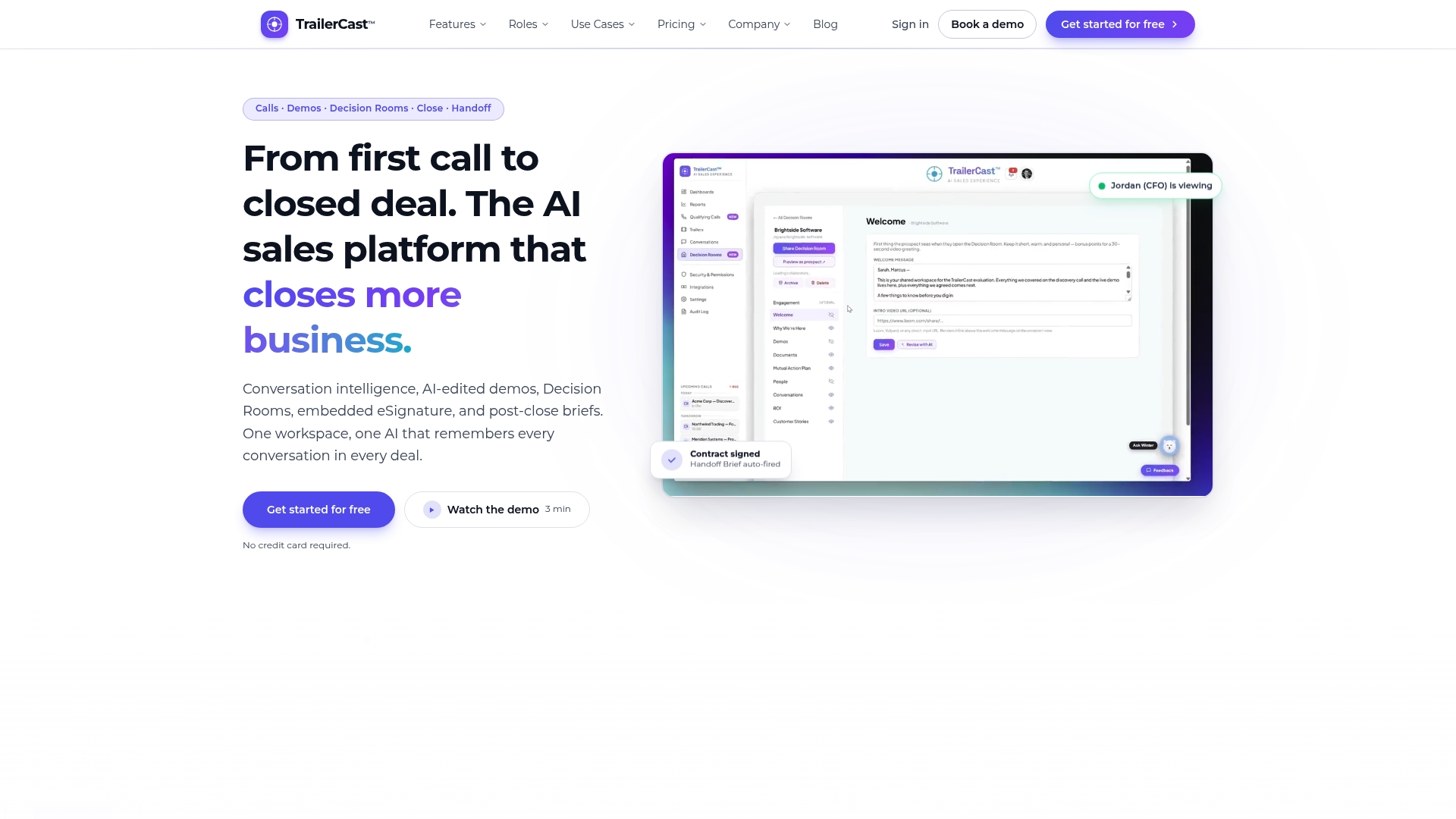
If you want to see what a role-targeted trailer and a tracked decision room look like on an actual deal, our demo trailers use case shows the mechanics in context. Every plan includes the full feature set, starting at $59 per seat per month billed annually, with a free trial and no credit card required to start.
FAQ
What is an example of buyer enablement?
A branded decision room that bundles discovery notes, a mutual action plan, pricing, and a role-specific demo trailer in one trackable link is a common example. A champion can forward that single link to a CFO or CISO instead of re-explaining the pitch from memory.
What is buyer enablement?
Buyer enablement is the content, tools, and processes that help a buying committee evaluate options and reach a decision with less reliance on repeated seller explanations. It typically includes role-specific assets, like ROI calculators and executive summaries, built to survive forwarding within a buying group.
What is the difference between sales enablement and buyer enablement?
Sales enablement equips sellers with the tools, training, and content they need to sell effectively. Buyer enablement equips the buying committee itself with material they can use to evaluate, align, and justify a decision without a seller present for every conversation.
Why does shortlist placement matter so much in buyer enablement?
Buyers often settle on an early preferred vendor well before formal evaluation ends, according to 6sense’s 2025 Buyer Experience Report, and buyers choose a preliminary favorite earlier in the process. Content that shapes that early impression tends to matter more than material produced later in the cycle.
Sources
- Gartner
- The Timeline for Influencing B2B Buyers Is Shrinking: Insights From 6sense’s 2025 Buyer Experience Report
- Hbr