Win Loss Analysis: Collect Actionable B2B Feedback in One Sprint

Win/loss analysis is the practice of asking recent buyers, both won and lost, what actually drove their decision. It gives sales, product marketing, and RevOps buyer-validated patterns instead of seller guesses. The payoff is a short list of prioritized changes to messaging, pricing, and sales behavior that lift win rates and cut no-decision outcomes.
TL;DR:
- Trigger outreach after every deal closes, contact buyers within five to 10 business days, and review themes monthly or quarterly based on deal volume.
- Choose live interviews for candid detail, surveys for low cost and reach, or a hybrid that reserves interviews for valuable or unexpected deals.
- Include both wins and losses, set selection rules before naming buyers, and segment findings by persona, deal size, or industry to expose actionable patterns.
- Store buyer reasons beside seller CRM codes, assign owners to themes, test changes, and track win rate, no decision rate, deal size, and sales cycle.
Table of Contents
- What win loss analysis is and why it matters to B2B teams
- When and how often should you run win/loss analysis?
- How to run a win/loss program, step by step
- What should you ask? Interview questions, outreach wording, and timing
- How many interviews do you need to see patterns?
- Should you run win/loss yourself or outsource it?
- How do you turn insights into action and measure ROI?
- What do successful win/loss implementations look like?
- How do you keep win/loss interviews private and compliant?
- How do you connect win/loss insights to your CRM and AI sales platform?
- Where win/loss fits in the bigger picture
- Keep buyer feedback attached to the deal
- FAQ
- Sources
What win loss analysis is and why it matters to B2B teams
Win/loss analysis collects feedback from the people who made the call: the buyers. That sounds obvious, yet most teams still rely on the reason a rep picks from a CRM dropdown. Those disposition codes get filled in quickly, often by the person with the most to lose from an honest answer, and they flatten a messy buying committee decision into one label.
The gap is wider than most leaders expect:
Buyers and sellers can disagree on the primary reasons for a deal outcome. If you steer by CRM loss codes alone, you are steering by the seller’s version of the story.
The same source reports that neutral third-party interviews often find that apparent price losses reflect a perception of low value rather than price alone. Many “lost on price” deals are really “we did not see enough value” deals, and those call for a different fix than a discount.
Once you have buyer-sourced reasons, they feed several decisions at once:
- Sales coaching: recurring execution gaps, like weak discovery or a champion left without ammunition
- Messaging: the language buyers actually used to describe what mattered
- Product roadmap: missing capabilities that blocked deals versus nice-to-haves nobody cited
- Pricing and packaging: where perceived value fell short of the number on the quote
- Competitive intelligence: how buyers compared you to the alternatives they seriously considered
Wins matter as much as losses. Why you win is as important as why you lose, because winning drivers are the ones you can repeat and scale.
When and how often should you run win/loss analysis?
Think of win/loss as a standing trigger, not an annual project. Every closed-won and closed-lost event should start an outreach, and the synthesis happens on a schedule.
- Trigger on the close event. Move an opportunity to closed-won or closed-lost and the outreach task fires.
- Reach out quickly. Contact buyers within five to 10 business days of the decision, while the evaluation is still fresh and before the buyer has moved on to the next fire.
- Synthesize on a rhythm. Collect continuously, then review themes monthly if you close many deals, or quarterly if volume is lower.
- Pilot before you scale. Start with one segment, such as a single product line or deal-size band, so you learn what works before you roll it out to everyone.
A pilot scoped to one segment can be a manageable first step. By the end of it you have real interviews, a draft taxonomy, and a first read on whether the signal is worth expanding.
How to run a win/loss program, step by step
The operational backbone is simple. Define the focus, assemble the audience, collect data, analyze, and act. Here is how we would break that into work your team can start this week.
- Set scope and learning objectives. Decide which decisions will change based on what you learn. “Why are we losing mid-market deals to a specific rival?” is a scope. “Learn about the market” is not.
- Define the sample and selection rules. Include both won and lost deals, and set rules before you pick names. If reps choose who gets contacted, you will hear from friendly accounts and miss the painful ones.
- Choose a method. Pick survey, live interview, or a hybrid, and be honest about the tradeoff.
- Design a short, specific question set. Separate decision factors (capability, price, risk) from relationship factors (trust, responsiveness).
- Transcribe, code, and build a repeatable taxonomy. Tag every answer so themes can be counted across interviews.
- Aggregate, prioritize, and assign owners. Pull out the priority actions, name an owner for each, and set a review date.
The method choice in step three deserves a closer look:
- Survey: high throughput and cheap, but shallow, and buyers rarely volunteer the uncomfortable truth in a text box
- Live interview: the richest candor and the best follow-up questions, but slower and more labor-intensive
- Hybrid: a short survey for volume, with interviews reserved for high-value or surprising deals
For step five, a taxonomy that holds up over time usually covers these buckets: product and feature, pricing, sales execution, implementation risk, champion confidence, and timing. Keep the list stable so quarter-over-quarter comparisons mean something.
Pro Tip: Write down the decision each theme would change before you start coding. If a tag cannot trigger an action, it is trivia, not insight.
That discipline protects you from the most common failure: a beautiful deck of findings that nobody owns. If you are still shaping the rest of your motion, our walkthrough on building a sales process at a Series A SaaS company shows where these triggers and owners fit.
What should you ask? Interview questions, outreach wording, and timing
Good questions are specific, decision-focused, and non-leading. You are asking about what happened, not fishing for compliments. A short set covers most of what you need:
- Walk me through how this evaluation started. What problem pushed you to look?
- Who was involved in the decision, and what did each person care about most?
- Which options did you seriously consider, and how did you narrow the list?
- What was the single biggest factor in your final decision?
- Where did our team stand out, positively or negatively, during the process?
- How did the pricing and packaging compare with the value you expected?
- What nearly changed your mind, in either direction?
- If you could change one thing about how we sold to you, what would it be?
For outreach, keep it short and honest. For a lost deal: “Thanks for considering us. We are trying to get better, and your honest view would help. Could we have a brief conversation this week? There is no sales pitch, and your feedback is not tied to any follow-up.” For a win: “Congratulations on getting started. We would like to learn what mattered most in your decision so we can serve you and future customers better.” Send within the five to 10 business day window above.
When a buyer gives vague answers, probe with “What specifically made that feel risky?” or “Can you give me an example?” If they stay evasive, move on to a concrete moment, such as the demo or the pricing conversation, and ask what they remember about it.
Pro Tip: Ask about the process before the verdict. Buyers describe what happened more candidly when they are not yet defending a conclusion.
How many interviews do you need to see patterns?
There are two thresholds to keep apart. Detection means you have enough interviews to notice that a problem exists. Saturation means new interviews stop surfacing new themes in a segment.
The number of interviews needed depends on the segment and whether you are looking to detect issues or reach saturation. See the methodology and ROI guide and the SurveyMonkey framework for guidance.
Use these as rules of thumb, not guarantees:
| Stage | Interviews | Goal |
|---|---|---|
| Small pilot | A sample of lost deals, plus a few wins | Detect the biggest issues |
| Scaling sample | A larger sample per segment | Identify recurring themes in that segment |
| Continuous program | Triggered on every close, sampled by rule | Track change over time |
Balance wins and losses so you learn what to protect, not only what to fix. Then segment by persona, deal size, and vertical. A pattern that is invisible across all deals often jumps out inside one segment, and that is the version a product or marketing owner can act on.
Should you run win/loss yourself or outsource it?
The core tradeoff is candor versus cost. Third-party interviewers tend to get more honest answers because buyers feel free to criticize someone who does not work for the vendor. DIY is cheaper and faster, and keeps the learning close to the team.
Outsource when:
- You need objective feedback that leadership will believe
- Budget allows and you want scale without hiring interviewers
- Internal politics make candid findings hard to land
Keep it internal when:
- Deal volume is low and the goal is exploratory
- You want fast learning in a pilot before committing budget
- A product marketer or RevOps lead has time to run the interviews
Either way, automate the low-effort parts: a CRM trigger that creates the outreach task at close, a short survey for volume, automated transcription, and basic coding of themes. For ideas on the tooling side, this roundup of sales team collaboration tool examples is a useful starting point for what to stitch together.
How do you turn insights into action and measure ROI?
Themes only matter when they change something. A simple loop works: score each theme by impact and effort, assign an owner, and run a short experiment before committing to a big change. Teams that adopt structured programs typically see win-rate improvements in the first year by fixing recurring process issues the interviews surface.
Track a handful of metrics:
- Win rate by segment
- No-decision rate
- Average deal size
- Closing velocity
A small win-rate lift compounds into real bookings. For illustration, a higher win rate on the same volume of qualified opportunities would produce more bookings, with the size of the increase depending on deal volume and average deal size.
What do successful win/loss implementations look like?
Programs that work show patterns that appear again and again.
The first pattern is a narrow start. Teams that begin with one segment, run a handful of interviews, and ship one visible change build credibility fast. A common early finding is that “lost on price” deals were really value-perception problems, which sends the fix to messaging and discovery instead of the discount sheet.
The second is a buyer-visible link between feedback and action. When a theme like implementation risk appears in interviews, teams that respond with a clearer onboarding story in demos see that objection stop showing up. Our own look at what B2B sales demos taught us about why deals stall points at the same kind of recurring demo and implementation risk themes you will likely hear in interviews.
The third is executive sponsorship. Programs with a sponsor who reads the quarterly synthesis and holds owners to their actions survive reorgs. Programs without one produce a report and a shrug. If your first pilot ends with one named change, one owner, and one number to watch, you have the beginning of a program that lasts.
How do you keep win/loss interviews private and compliant?
Buyers are doing you a favor, so treat what they say with care. Start with consent: tell every participant up front that the conversation is recorded or transcribed, why, who will see it, and how long you will keep it. Get a clear yes before you hit record, and honor a no without argument.
Then limit exposure:
- Share themes and anonymized quotes by default, and restrict raw recordings to a small named group
- Strip names, company identifiers, and pricing details before findings go to a wide audience
- Set a retention period and delete recordings and transcripts when it ends
- Keep interview data in access-controlled systems, not in open shared folders or chat threads
If you sell to enterprises, expect questions about how you secure this material. A practical read on what mature security programs look like is this guide to ISO 27001 for SaaS and tech companies. Have your legal or privacy team confirm requirements that apply to your buyers’ regions and industries, since consent and retention rules vary. Finally, separate feedback from selling. If a lost buyer agreed to an interview, do not use it as a back door for a pitch.
How do you connect win/loss insights to your CRM and AI sales platform?
Insights that live in a slide deck decay. The goal is to attach buyer-validated reasons to the deal record, so reps and managers see them where they work.
Start with structure. Add a small set of coded fields to the opportunity, using the same taxonomy from your coding step: primary decision driver, competitor considered, champion confidence, and risk theme. Keep the CRM’s loss reason, but treat it as the seller’s view and store the buyer’s reason alongside it, so disagreements become visible instead of hidden.

Then close the loop in both directions. Triggers push closed deals into your outreach queue. Transcripts and coded themes flow back to the opportunity, so the next rep on a similar deal sees what actually moved buyers. Conversation intelligence helps here because the same themes buyers raise in interviews often appear earlier in call transcripts, which lets you spot a pattern before the deal is lost. Post-close, a handoff brief can carry what won the deal forward to Customer Success, so the promises made are the promises kept.
Where win/loss fits in the bigger picture
I built this playbook from a simple belief: the calls were never the whole problem, the space between them was. Run a small pilot, wire the triggers into your CRM, and let a few honest buyer interviews reshape one thing in your next quarter. Continuous feedback gets far more useful when it sits next to persistent deal memory and conversation intelligence, because the same themes then show up before a deal is lost, not after.
— Daniel
Keep buyer feedback attached to the deal
We built TrailerCast so the reasons buyers give never get separated from the opportunity. Our platform brings conversation intelligence, demo trailers, decision rooms, and handoff briefs into one workspace, so what you learn about a buyer’s decision drivers stays with the deal from first call to closed deal.
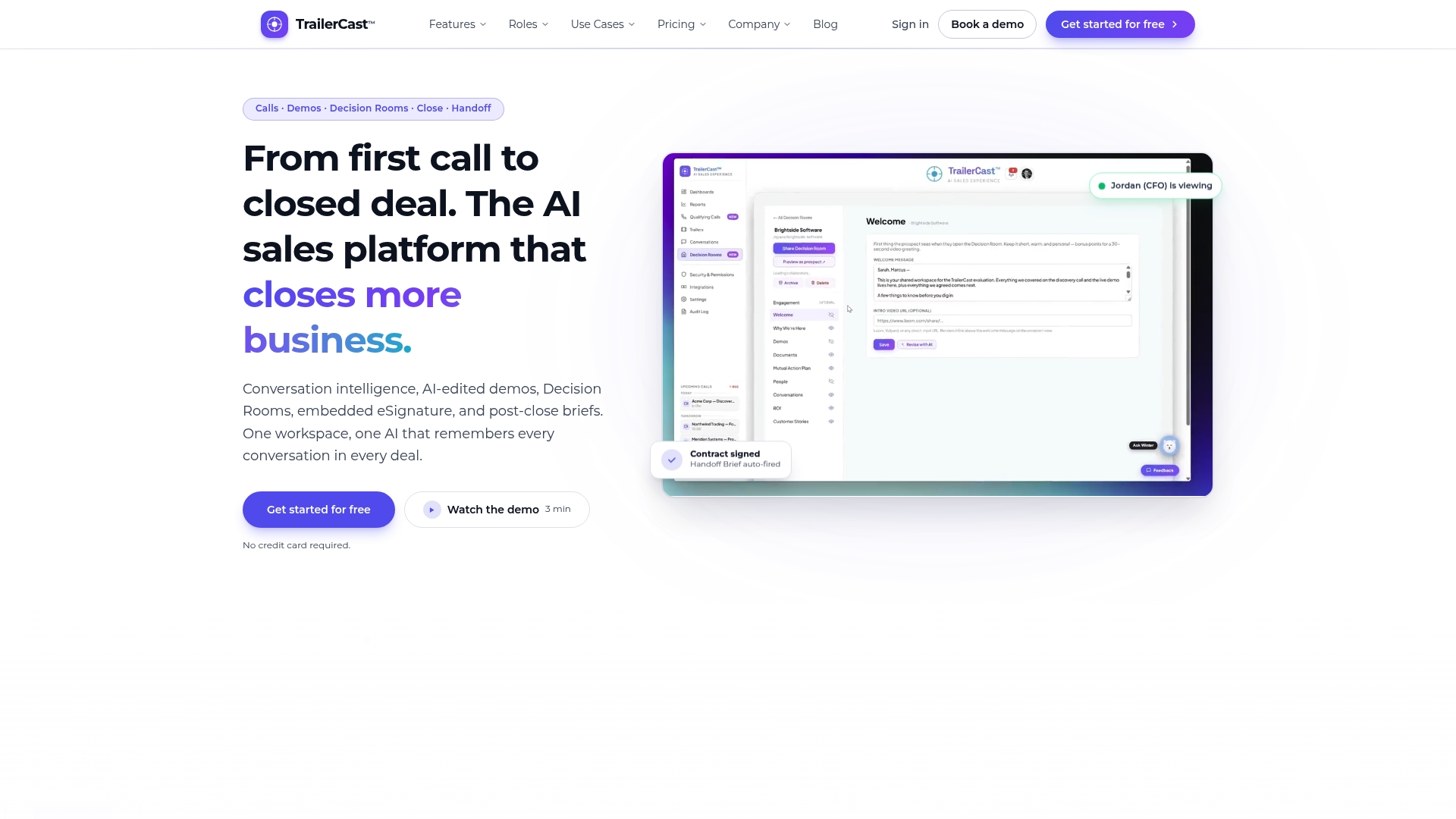
See how it works in our features overview, or start with one plan and every feature, from $59 per seat per month, on the pricing page.
FAQ
How do I interpret a win loss ratio?
A win/loss ratio tells you how many deals you close compared with how many you lose, but not why. Read it by segment, such as deal size, persona, or competitor, and pair it with buyer interviews, because disposition codes alone often disagree with what buyers say.
What does a 2.0 win loss mean?
Whether a win rate is good depends on your market, deal size, and how many opportunities end in no decision, so compare it against your own history and segments.
Who should run win/loss interviews?
Neutral interviewers tend to get more candid answers, so a third party or someone outside the deal team works best. If you keep it internal, choose a product marketer or RevOps lead rather than the rep who worked the deal.
How soon after a deal closes should I reach out?
Aim for five to 10 business days after the decision. Buyers still remember the evaluation clearly, and you reach them before the next priority takes over.
Sources
- Win/Loss Analysis: Methodology, Cost & ROI (2026)
- Win-Loss Analysis: A Step-by-Step Framework and Guide
- Win/Loss Analysis White Paper - Anova Consulting Group