Stop Losing Deals: Track Buyer Engagement by Buying Group

Track engagement across the whole buying group, not one contact, using four signal layers: identity, behavior, context, and outcomes. Connect every event to a CRM opportunity, score it against historical wins, and fire alerts that force a specific seller action. Skip the buying-group step and your dashboard will look busy right up until the deal dies in a meeting you weren’t invited to.
TL;DR:
- Tracking buyer engagement effectively requires connecting existing tools like CRM, call transcripts, and content platforms with a dedicated owner to ensure data quality and privacy compliance.
- Building a detailed stakeholder map involves analyzing meeting data, tracking content shares, and regularly reviewing viewer attribution to identify all decision-makers beyond just initial contacts.
- Prioritize high-value events such as repeated demo views, section-level proposal attention, and new stakeholder appearances, while ignoring unreliable signals like ungated email opens.
- Develop a scoring model that emphasizes recent, role-relevant actions, links alerts to specific seller tasks, and calibrates weights against historical win and loss data for trustworthiness.
- Employ an end-to-end sales workspace that consolidates all engagement signals, automation, and alerts, enabling real-time visibility and prioritization of buying-group activity to act before deals stall or fail.
Table of Contents
- What You Need Before You Start Tracking Buyer Engagement
- How Do You Map the Buying Group Behind a Deal?
- Which Events and Metrics Actually Predict a Close?
- How Do You Build a Scoring Model That Sellers Trust?
- Do Engagement Signals Actually Predict Revenue Outcomes?
- What Are the Minimum Privacy and Governance Rules?
- How Does One AI Sales Workspace Cover the Whole Playbook?
- Best Practices for Reading Engagement Data Without Fooling Yourself
- Common Pitfalls That Sink Engagement Tracking Programs
- What Do Real Deal Patterns Look Like When Tracking Works?
- Your 30/60/90 Priority Checklist
- Put the Whole Playbook in One Workspace
- Sources
- FAQ
What You Need Before You Start Tracking Buyer Engagement
You don’t need a new tech stack to start tracking buyer engagement properly. You need the right connections between the tools you already have, and one person who owns the data.
Start with integrations: your CRM (Salesforce, HubSpot), calendar and call recording transcripts, demo or content player analytics, and your proposal and eSignature tools. If content lives in a separate hosting system, that needs a feed into the same opportunity record too, or you’ll end up reconciling three spreadsheets before every forecast call.
On the people side, assign a RevOps or data steward to own event taxonomy, a sales leader to own the playbook that turns alerts into actions, and someone from legal or privacy to sign off on what you collect and why.
Minimum instrumentation checklist:
- Identity resolution that maps every contact, email domain, and viewer to one opportunity record
- Authenticated assets (demos, proposals, decision rooms) instead of open links anyone can forward anonymously
- A defined event taxonomy: view, repeat view, share, section-level attention, signature step
- Consistent tagging so the same event type reads the same way across every tool
On privacy, document your collection purpose, retention period, who has access, and how someone opts out or gets suppressed. This isn’t paperwork for its own sake. It’s what keeps your tracking usable when legal or a prospect asks how you know what you know.
How Do You Map the Buying Group Behind a Deal?
The average B2B purchase now involves roughly 13 people across departments, according to Forrester’s Buyers’ Journey research. If your CRM opportunity lists two contacts, you’re not missing data. You’re missing most of the committee.
Building an accurate stakeholder map is a discipline, not a one-time task. Here’s the sequence that works:
- Pull every name from meeting attendee lists, email threads, and proposal viewer logs, then cross-reference against your CRM contact record for that opportunity.
- Tag each stakeholder by role the moment you identify them: champion, economic buyer, technical evaluator, procurement, or influencer. A name with no role attached is just noise later.
- Watch for tracked forwards and shares. When your champion sends a proposal or a demo trailer to someone new, that forward is often the first signal a second stakeholder exists.
- Check document and trailer viewer attribution weekly, not just at the start of the deal. New names appearing mid-cycle usually mean the internal conversation has moved without you.
- Ask directly when coverage looks thin. If every engagement event traces back to one person, that’s the moment to ask your champion, “Who else on your side needs to see this before a decision gets made?”
That last rule matters more than any tool. When engagement concentrates on a single contact, Forrester’s research suggests treating it as a coverage gap, not a sign of strong interest. A deal with one enthusiastic champion and no visibility into the other twelve people in the room isn’t further along. It’s riskier.
Which Events and Metrics Actually Predict a Close?
Structure your tracking around four layers: identity (who’s involved and their role), behavioral events (what they did), context (when, on what asset, at what stage), and outcomes (did the deal move). Twilio’s framework for customer engagement instrumentation lays out this exact structure, and it holds up well for complex B2B cycles because it separates “something happened” from “something happened that matters.”
Not every event carries equal weight. Here’s how to prioritize:
High-value events worth alerting on:
- Authenticated demo or trailer plays, especially repeat views of the same asset
- Proposal section-level attention (someone spent real time on pricing or security, not just opened the document)
- Shares or forwards with attribution showing a new stakeholder in the loop
- Signature progress, including partial completion and stalls
- A new executive or role appearing in the viewer log for the first time
Weak signals to weight down or ignore:
- Ungated email opens, which are unreliable given privacy protections and shared inboxes
- A single hit on a general landing page with no follow-through
- Bulk newsletter or nurture engagement unrelated to an active opportunity
Repeated demo engagement in particular correlates strongly with higher close rates, according to Consensus’s Buyer Behavior Report, which makes it one of the first signals worth instrumenting even before you build a full scoring model.
Pro Tip: If you can only track four things this quarter, track stakeholder coverage, demo-view thresholds, proposal engagement rate by section, and win-rate compared across engagement buckets. Everything else is refinement.
How Do You Build a Scoring Model That Sellers Trust?
An engagement score is only useful if it separates activity from intent, and if it changes what a seller does next.
Follow these steps to build one:
- Weight recent and role-relevant actions higher than old, generic ones. A CFO viewing pricing yesterday outweighs a junior analyst’s page view from three weeks ago.
- Store four fields on every event: timestamp, actor, asset, and opportunity stage. Without stage context, a “high engagement” score means nothing, since a hot signal at the proposal stage reads differently than the same signal during early discovery.
- Set decay rules. Recent activity should typically outweigh older activity, but repeated old engagement from the same person is durable interest, not noise, so don’t let decay erase it entirely.
- Calibrate weights against your own historical wins and losses, not a generic template. Twilio’s engagement KPI research points to this as the step most teams skip, and it’s why so many engagement scores drift out of touch with reality within two quarters.
- Map every alert to a required seller action. A new executive viewing a demo triggers a scheduled CFO-focused brief. A stalled signature triggers a legal check-in call within 48 hours, not an automated reminder email.
- Log what the seller actually did in response to each alert. That log becomes the data set you use to prove or disprove the model six months from now.
Dashboards that don’t change seller behavior are just reporting. A RevOps playbook built around alerts tied to specific plays is what turns tracking into a genuine forecasting tool instead of a screenshot for your Monday pipeline review.
Do Engagement Signals Actually Predict Revenue Outcomes?
Test it before you trust it. Compare opportunities with high buying-group engagement against lightly engaged ones on four metrics: win rate, conversion to the next meeting, average contract value, and sales-cycle length. Twilio’s engagement measurement guide frames these four as the baseline validation set, and they’re straightforward to pull from most CRMs once events are tagged to opportunities.
Segment before drawing conclusions:
- Break results out by persona (technical buyer vs. economic buyer engagement predicts differently)
- Separate by lead source, since inbound and outbound deals often show different engagement patterns at the same win rate
- Compare by content type: a demo trailer viewed twice is not the same signal as a case study PDF opened once
Run specific cohort tests: trailer-send recipients against a control group with no trailer, demo-view-count buckets against close rate, and proposal engagement level against signed conversion. Feed whatever holds up back into your scoring weights, and retest every couple of quarters. Buyer behavior shifts, especially now that early digital research increasingly shapes decisions before a rep ever gets a call.
What Are the Minimum Privacy and Governance Rules?
Buyers are trusting you with a record of every page they viewed and every proposal they forwarded internally. Treat that trust as the baseline requirement, not an afterthought layered on after legal complains.
- Document the collection purpose, storage location, retention period, and who has access for every tracking source you add
- Set clear opt-out and suppression behavior, and honor it immediately when a stakeholder requests it
- Favor authenticated, first-party interactions (logged-in demo views, tracked proposal opens) over unreliable signals like raw email opens, which shared inboxes and privacy protections make nearly meaningless anyway
- Assign a data steward who reviews any new tracking source or alert type before it goes live, not after
- Keep an audit trail showing which alerts fired and how a rep responded, both for compliance and for your own model validation
None of this slows down implementation much. It does mean fewer surprises when a prospect asks how detailed your visibility into their internal process really is.
How Does One AI Sales Workspace Cover the Whole Playbook?
Most teams try to run this playbook across five disconnected tools: a call recorder, a video editor, a deal-room app, an eSignature tool, and a handoff doc nobody reads twice. TrailerCast was built to run it in one workspace instead, following a deal from first call to closed contract with a single AI that remembers every prior conversation.
Conversation intelligence handles stakeholder identification automatically, flagging names and roles as they surface in calls. AI-edited demo trailers create the exact high-value viewing events the scoring model prioritizes, and can be cut differently per stakeholder, so a CFO gets a pricing-focused trailer while a technical evaluator gets one built around integration detail.
The gap sellers actually lose deals in isn’t the call. It’s the silence after it, when a champion walks a trailer or a proposal back to a buying committee alone and you have no visibility into what happened next.
Decision rooms track that exact moment: who opened what, who forwarded it, who’s stalled. Signature tracking and post-close handoff briefs close the loop, so the outcome layer of the scoring model gets filled in without a separate manual step.
Best Practices for Reading Engagement Data Without Fooling Yourself
Raw event counts lie by omission. A stakeholder who opens a proposal five times in one sitting because they’re confused about pricing looks identical in most dashboards to one who’s genuinely excited and forwarding it to three colleagues. Context is what separates the two, so always read volume alongside recency, role, and what happened immediately after the event.
Look for patterns across the whole buying group before drawing a conclusion about deal health. A single champion generating heavy activity while the rest of the committee stays silent isn’t a green light. It’s usually a sign the deal hasn’t left one person’s inbox yet.
Compare engagement against your own historical baseline, not an industry benchmark you found in a blog post. What counts as “high engagement” varies enormously by deal size, sales cycle length, and buying committee size, and a threshold that works for a $15,000 annual contract will look wildly different from one that fits a six-figure enterprise deal.
Review trends weekly at the individual opportunity level, but review your scoring model itself only quarterly. Adjusting weights every time one deal surprises you introduces more noise than signal, and it makes it impossible to tell later whether a change in close rates came from better tracking or from a model you tweaked five times in eight weeks.
Finally, always pair a metric with a decision. If a KPI on your dashboard has never once changed what a seller did on a Tuesday, it’s decoration, not analytics.
Common Pitfalls That Sink Engagement Tracking Programs
The most common mistake is scoring every event as equally important. A single email open and a repeated authenticated demo view should never carry the same weight, but plenty of homegrown scoring models start out treating them that way because it’s easier to build. Fix this early by defining your event taxonomy and data quality standards before you touch scoring weights at all.
A second pitfall: tracking individuals instead of buying groups. Teams build beautiful contact-level engagement histories and still lose deals they thought were “hot,” because the score reflected one enthusiastic evaluator, not committee consensus. The fix is structural, not technical: require stakeholder-role tagging as a mandatory field before an opportunity can advance stages.
Third, teams over-trust unreliable signals. Email open rates in particular are notoriously misleading given privacy-protecting proxies and shared inboxes, yet they’re often the easiest data to pull, so they end up overweighted by default. Deprioritize them explicitly in your model rather than letting convenience decide your weighting.
Fourth: alerts with no required action. An alert that just says “engagement increased” trains sellers to ignore the tool within a month. Every alert needs a mapped play, and every play needs to get logged so you can tell later whether it worked.
Last, and quietly the most damaging: treating silence as disqualification. A quiet deal may still be active through forwarded links, shared logins, or procurement processes your tracking simply can’t see. Missing telemetry means unknown, not dead, and a quick direct check with your champion beats writing the deal off on assumption alone.

What Do Real Deal Patterns Look Like When Tracking Works?
Consider a mid-market SaaS deal that starts with one champion, a director of operations, requesting a demo. Conversation intelligence from the discovery call flags two additional names mentioned but not yet on the CRM record: a CFO and a security lead. That’s the stakeholder map starting to form before a second meeting even happens.
A trailer built for the CFO gets sent by the champion two days later. The viewer log shows three plays over the pricing section specifically, each a few days apart. Under a four-layer model, that’s a behavioral event (repeat view), tied to context (pricing-focused asset, late-stage opportunity), and it fires an alert: schedule a CFO-focused financial justification call within the week.
Compare that to a deal where the only activity for three weeks is the same champion re-opening the original proposal. No new names, no forwards, no section-level movement past the summary page. That pattern, engagement concentrated on one person with no committee expansion, is exactly the coverage gap Forrester’s buying-group research warns about. The right move isn’t a follow-up email. It’s a direct question to the champion about who else needs to weigh in.

Neither pattern requires guesswork once the events are instrumented and tied to opportunity stage. The signals were always there. The difference is whether anyone was set up to see them in time to act.
Your 30/60/90 Priority Checklist
Map the buying group in the first 30 days using meeting attendees and document viewers. By day 60, instrument three high-value events (demo views, proposal attention, shares) and one alert with a mandatory seller action. By day 90, validate against win rate and adjust. Operational alerts beat vanity dashboards because they force a decision, not a glance. Run the pilot small before you scale it.
— Daniel
Put the Whole Playbook in One Workspace
Most of what this playbook asks for, buying-group mapping, high-value event tracking, alerts tied to plays, currently lives scattered across a call recorder, a video tool, a deal room, and a signature app that don’t talk to each other. TrailerCast runs the entire deal lifecycle in one workspace instead, with one AI that follows a deal from the first call through close, so the stakeholder map, the demo trailer views, and the proposal engagement all live in the same record instead of four exports you have to reconcile by hand.
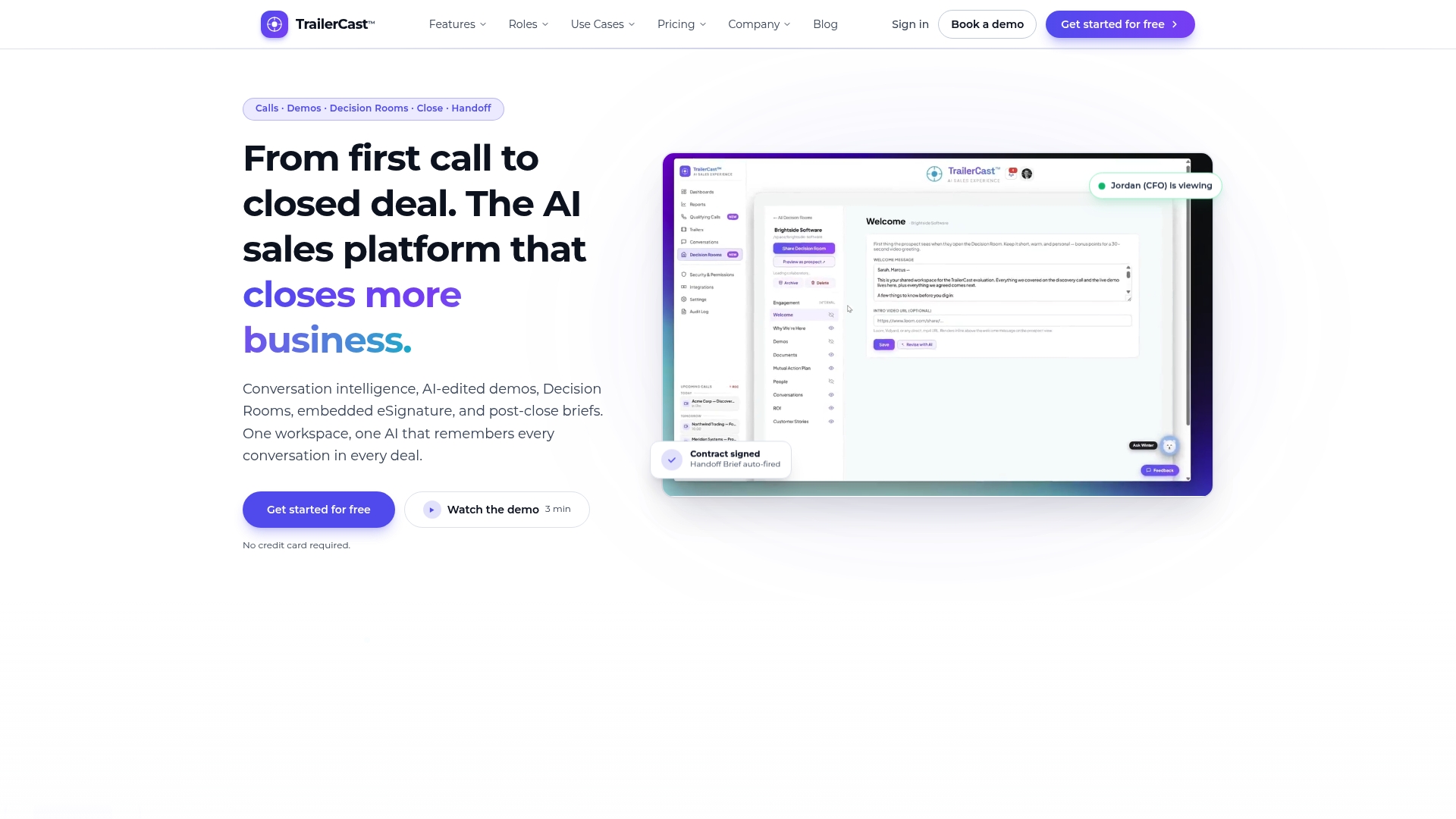
A 30-day pilot would typically start by instrumenting three things: conversation intelligence on discovery calls to build the initial stakeholder map, AI-edited demo trailers sent to at least one non-attending stakeholder per deal, and a single alert rule tied to a required seller action. That’s enough to test whether the signals hold up against your own historical close data before rolling it out further. If you want to see how the feature set maps to each stage of a deal, the platform’s feature breakdown walks through calls, demos, decision rooms, close, and handoff individually. Start a free trial to instrument your first pilot deal this week.
Sources
FAQ
What Are the Five Stages of Customer Engagement?
Most frameworks describe engagement moving through awareness, consideration, evaluation, purchase, and advocacy or retention. In a B2B deal, this maps to first contact, active research across the buying group, demo and proposal review, signature, and post-close handoff, the exact lifecycle this playbook tracks end to end.
Are Click-Through Rate and Engagement Rate the Same Thing?
No. Click-through rate measures how often people click a specific link out of everyone who saw it, while engagement rate is broader, covering views, shares, time spent, repeat visits, and other interactions with content or a deal room. In B2B sales tracking, engagement rate is the more useful metric because it captures depth of interest, not just a single click.
How Do You Track Employee Engagement Versus Buyer Engagement?
Employee engagement typically relies on surveys, pulse checks, and participation metrics inside internal tools, while buyer engagement in a sales context tracks external behavior: demo views, proposal attention, and stakeholder participation tied to a specific opportunity. The methods overlap conceptually, both measure interest and involvement, but buyer engagement tracking needs to tie directly into CRM opportunity data to be useful for revenue teams.
What Are Some Examples of Buyer Engagement Metrics?
Strong examples include stakeholder coverage (how many buying-group members have engaged), demo or trailer repeat-view counts, proposal section-level attention time, and signature completion speed. Twilio’s engagement KPI guide frames these against outcome metrics like win rate and cycle time, which is the comparison that actually proves whether a metric matters.
What Does TrailerCast Cost for Sales Teams Tracking Engagement?
TrailerCast runs one plan with every feature included, starting from $59 per seat per month on annual billing, with no feature gating between tiers. A free trial is available for teams that want to test the engagement tracking and alerting workflow before committing.