60 Dials or 3 Hours? 30 Day Sales Talk Time Coaching Plan for Managers

Sales talk time is the share of a call your rep spends speaking versus listening, and the smartest way to use it is as a coaching signal, never a quota. If you need one number to start with, borrow the old outbound rule of 60 dials or three hours of talk time a day as a loose activity floor, then layer in talk/listen ratio targets by call type.
TL;DR:
- Reps should aim for a talk/listen ratio tailored to call types, such as 60-70% customer talk on discovery calls to ensure effective information gathering.
- Measuring talk time with automated transcription tools provides more accurate data and should be paired with outcome metrics like first-time appointments and pipeline growth.
- Coaching should focus on high-value questions and active listening techniques, not just reducing talk time, to improve a rep’s ability to identify buying signals.
- Industry and role differences significantly impact ideal talk durations, with technical or complex product calls naturally requiring more rep talk without indicating poor performance.
- Using AI tools for automatic analysis and coaching clips streamlines talk-time management, but human review remains essential to interpret context and drive development.
Table of Contents
- 1. What Talk Time Means and How to Calculate It
- 2. Why Talk Time Helps and Why It Can Mislead
- 3. Talk/Listen Ratio Targets by Call Type
- 4. How to Measure and Report Talk Time Correctly
- 5. A 30-Day Coaching Playbook for Talk-Time Quality
- 6. How an AI Sales Platform Operationalizes Talk-Time Coaching
- 7. How Talk Time Expectations Shift by Industry and Role
- 8. How to Train Reps to Manage Their Own Talk Time
- 9. Measurement for Coaching, Not Punishment
- 10. TrailerCast: Instrument Talk-Time Coaching at Scale
- Sources
- FAQ
1. What Talk Time Means and How to Calculate It
Talk time sounds simple until you try to measure it consistently across a team. At its core, it is the total minutes a rep spends speaking during a call, divided by the total call length, expressed as a percentage. A few formulas make this concrete:
- Daily talk time equals the sum of speaking minutes across every call in a day.
- Rep talk percent equals rep speaking minutes divided by total call minutes, times 100.
- Customer talk percent equals customer speaking minutes divided by total call minutes, times 100.
- Talk/listen ratio expresses the same relationship as a ratio, such as 40:60 rep to customer.
The 60 dials or three hours of talk time benchmark comes out of high-volume outbound sales, where reps are dialing dozens of contacts a day and the goal is momentum, not depth. It fits inbound SDR teams and outbound cold-calling desks reasonably well. It fits almost nothing else. A field rep running two on-site demos a day will never hit three hours of raw talk time, and holding them to that number punishes the wrong behavior.
Average call durations vary just as much by context. A qualifying call might run 10 to 15 minutes. A demo often runs 20 to 30. An enterprise presentation with multiple stakeholders can stretch past 45 minutes. None of these durations is right or wrong on its own, which is exactly why raw talk time needs company from other metrics before it means anything.

2. Why Talk Time Helps and Why It Can Mislead
Talk time earns its place on a dashboard because it gives you an activity baseline. It tells you whether reps are getting enough at-bats, and it can flag a rep whose calls have gone unusually quiet, often a sign of disengagement or issues in the sales pipeline. Used this way, it is a smoke detector, not a scorecard.
The trouble starts when talk time becomes the target instead of the signal. Talk time can turn into a vanity metric when it is not tied to outcomes, and a metric chasing itself tends to produce exactly the behavior you did not want.
- It rewards volume over skill. A rep who talks for 40 minutes to fill a quota is not necessarily selling better than one who closes the same deal in 15.
- It penalizes efficiency. Your best performers often talk less because they ask sharper questions and get to the point faster.
- It encourages filler. Reps who sense they are being timed will pad calls with restatements and small talk rather than substance.
The fix is pairing talk time with outcomes: first-time appointments, show rates, next-step conversion, and revenue generated per hour of talk time. When talk time goes up, but those numbers stay flat, you have found noise, not progress.
3. Talk/Listen Ratio Targets by Call Type
Different calls call for different ratios, and treating them the same is one of the fastest ways to misread a scorecard. Discovery calls perform best when customers talk 60 to 70 percent of the time, because the whole point of discovery is pulling information out of the buyer, not delivering a monologue.
- Discovery calls: aim for customer talk of 60 to 70%, rep talk of 30 to 40%.
- Demos: aim for a balanced customer and rep talk time, since you are walking through product while still checking reactions.
- Presentations: expect nearly balanced customer talk time, given the format leans toward structured delivery.
- Closing calls: target 50 to 60% customer talk, since objections and final questions need room to surface.
Top-performing discovery calls run customer talk at 60 to 70 percent, while demos and presentations settle closer to a 45 to 55 percent range. That gap matters because it means a rep who is 65% quiet on a discovery call is doing the job right, and the same ratio on a presentation would suggest the rep lost control of the room.
A typical qualifying call has rep talk time notably less than customer talk time. A demo and a longer enterprise presentation have more balanced talk times, with slight customer talk time advantage.
When a call deviates sharply from these ranges, the coaching move depends on direction. Too much rep talk on discovery usually means the questions were closed-ended or the rep filled silence out of nerves. Too much rep talk on a demo can mean the script ran long and skipped checking for reactions.

4. How to Measure and Report Talk Time Correctly
Three methods dominate talk-time measurement, each with a different cost and accuracy tradeoff. Conversation intelligence software auto-transcribes and tags speaker segments, giving you exact percentages with no manual work. Manual timing, where a manager scrubs through a recording with a stopwatch, works for spot checks but does not scale past a handful of calls a week. CRM tagging, where reps self-report call length and outcome, is fast but unreliable since it depends on reps remembering to log it accurately.
Whichever method you pick, the formulas stay the same: rep talk percent is rep minutes over total minutes, and customer talk percent is the inverse. What changes is how much you trust the number.
A useful weekly dashboard pairs talk time with the outcomes it should predict:
- Weekly talk time trend by rep, to catch drift before it becomes a habit.
- Talk/listen ratio by call type, so discovery and demo numbers are not lumped together.
- First-time appointments per hour of talk time, to connect activity to pipeline.
- Conversion rate per talk-hour, to catch reps who talk a lot but close little.
Run a monthly audit looking for the combination that actually signals trouble: high talk time paired with low pipeline movement. That pattern, more than any single number, tells you a rep needs coaching rather than encouragement.
Pro Tip: Pull three of your lowest-converting calls each week and listen for the moment the rep talked past a buying signal instead of asking a follow-up question.
5. A 30-Day Coaching Playbook for Talk-Time Quality
Improving talk time is a coaching problem, not a compliance problem, so the playbook should run over weeks, not a single meeting.
- Week 1: Baseline every rep’s current talk/listen ratio by call type, then audit one call per rep in detail. Set individual goals tied to conversion, not to raw minutes.
- Week 2: Run micro-coaching sessions built around three high-value discovery questions per rep, reinforced with role-play. Cutting a long scripted list down to three or four core questions forces active listening and lets the buyer’s answers shape what comes next.
- Week 3: Use call clips or highlight reels in team coaching sessions to show, not just describe, what a strong discovery call sounds like. Trim scripts that push reps into long monologues.
- Week 4: Remeasure talk/listen ratios and connect any shift to conversion data. Keep what worked, drop what did not, and start the next cycle.
Pro Tip: Assign one rep each week to present their best call to the team. Peer coaching often lands better than manager feedback alone.
6. How an AI Sales Platform Operationalizes Talk-Time Coaching
Running this playbook by hand across a team of ten or more reps gets tedious fast, which is where conversation intelligence tools earn their keep. TrailerCast’s notetaker joins calls automatically, transcribes speaker by speaker, and produces talk-time analysis alongside a searchable transcript, so a manager can pull up any rep’s ratio without scrubbing a recording.
- Automatic transcription and talk-time analysis on every call, with searchable transcripts for spot audits.
- AI-edited demo trailers that turn a 45-minute call into an 8 to 15 minute clip for coaching or buyer review.
- Decision rooms that track stakeholder engagement between calls, so managers see what happens after the talk-time numbers are logged.
These artifacts feed a coaching cadence naturally: auto-summaries and action items give you the weekly review material, and handoff briefs carry context forward once a deal closes. No tool replaces the judgment of listening to a call yourself, and talk-time numbers still need a human reading them against context.
7. How Talk Time Expectations Shift by Industry and Role
Complex, regulated products tend to push rep talk time higher across the board, simply because there is more required information to convey.
Role matters as much as industry. An SDR running short qualifying calls should show a very different ratio than an enterprise account executive running a 45-minute technical presentation to five stakeholders. The SDR’s job is to ask a handful of qualifying questions and get out quickly. The account executive’s job includes walking through product depth, which naturally raises rep talk time without signaling a problem.
Sales engineers and solutions consultants sit in their own category. Their calls often run more rep-heavy by design, since they exist to explain technical detail that a generalist account executive cannot. Treating a sales engineer’s talk time like an account executive’s is a common measurement mistake that creates false alarms on scorecards.
The practical takeaway is that a single company-wide talk-time target rarely works. Set ratio expectations by role and by call type, then use trend and outcome data within those categories, not across them, to spot real problems.
8. How to Train Reps to Manage Their Own Talk Time
The most durable fix for talk-time problems is not a stricter scorecard, it is better questions. Reducing a scripted list down to three or four high-value questions forces reps to listen for the answer instead of racing to the next line on the sheet, which naturally opens more room for the customer to talk.
Practical training steps that hold up across teams:
- Role-play discovery calls where the only goal is asking a strong follow-up question, not covering a checklist.
- Record and review a rep’s own calls with them, pointing to the exact moment they talked past a buying signal.
- Teach a short pause of three to five seconds after asking a question, since letting silence sit often produces a longer, more honest answer than filling the gap yourself.
- Build a short, focused discovery call framework reps can lean on instead of an exhaustive script.
Improving core sales communication skills, including active listening and concise follow-up, tends to move talk-time ratios in the right direction as a side effect, rather than as the direct target of training. That distinction is worth keeping in mind: you are training listening and questioning skill, and the ratio improvement follows.
9. Measurement for Coaching, Not Punishment
The goal of tracking talk time is never to catch reps talking too much. It is to spot when a call’s shape does not match what usually converts. Study your most efficient closers instead of penalizing them for talking less, and pair every quantitative signal with an actual call review before you act on it.
— Daniel
10. TrailerCast: Instrument Talk-Time Coaching at Scale
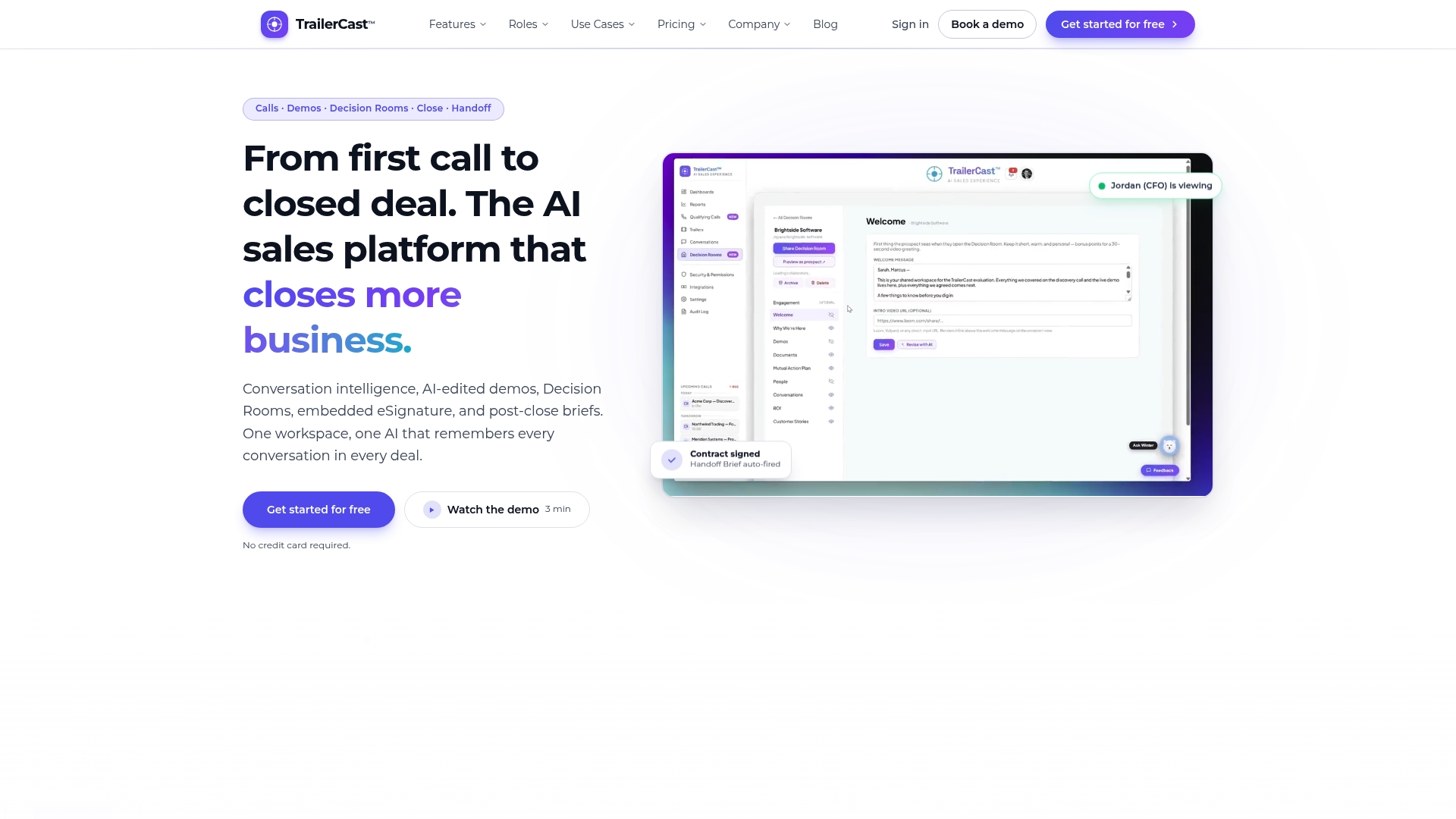
Everything in this playbook, ratio tracking, call review, coaching clips, gets easier when it lives in one place instead of scattered across a call recorder, a spreadsheet, and a folder of video links. Some AI sales platforms measure talk/listen ratios automatically, produce AI-edited trailers for coaching clips, and provide decision rooms that show deal progress after calls.
- Automatic talk-time and talk/listen ratio analysis on every recorded call.
- AI-edited trailers for fast, focused coaching review.
- Decision rooms and handoff briefs that carry deal context forward after close.
One plan includes every feature, starting from $59 per seat per month billed annually. Try the AI sales tool to see how talk-time coaching looks with the data already organized for you.
Sources
The benchmarks and critiques above draw on Salesforce’s pitch guidance, SalesGravy’s critique of talk time as a KPI, Force Management’s listening and questioning guidance, Apparate’s talk-time benchmarks, and Indeed’s sales communication skills guide. For capacity and headcount planning built around these benchmarks, see this sales capacity planning model.
- Why Talk Time is the Worst KPI for Measuring Sales Performance (Ask Jeb)
- Talk time analysis and benchmarks | Apparate
- Effective Sales Communication: 5 Key Actions | Force Management
- 18 Sales Communication Skills That Can Grow Your Career | Indeed
FAQ
What is the 3-3-3 rule in sales?
Definitions vary across sales organizations, and no single source in this research defines a standardized 3-3-3 rule, so treat any version you encounter as a team-specific convention rather than an industry standard. Ask your own manager or sales enablement team how their version is defined before applying it.
What is the 30-60-90 rule in sales?
The 30-60-90 rule most commonly refers to a phased plan for new hires, breaking the initial period into learning, applying, and independently executing phases. It is a ramp-up framework, not a talk-time metric, though the 30-day coaching playbook in this article uses similar weekly staging for talk-time improvement specifically.
Is 30-40 calls a day a lot?
Whether 30 to 40 calls a day is a lot depends heavily on role and call type: it can be light for a high-volume SDR desk built around the 60-dials or three-hour benchmark, but heavy for an account executive running long demos and presentations. Judge the number against your team’s typical call length and role, not against a universal standard.
What is the 2 2 2 rule in sales?
There is no standardized “2 2 2 rule” defined in established sales communication research, and definitions circulating online vary by source. If your organization uses this term, confirm the specific definition internally rather than assuming it matches a common industry framework.
How long should a sales call be?
Call length should match its purpose rather than a fixed number: qualifying calls often run 10 to 15 minutes, demos 20 to 30, and enterprise presentations 45 minutes or more. What matters more than duration is the talk/listen ratio for that call type, since a well-timed short call can outperform a long one that never lets the customer talk.