Three Tests to Build a Sales Champion Strategy in Under an Hour

A sales champion strategy is a repeatable process for finding the internal contact who will sell on your behalf when you’re not in the room, then proving they’ll actually do it. The payoff is real: deals with an engaged champion close at 60 to 80 percent versus 15 to 25 percent without one. Before you invest another hour in enablement, ask your favorite contact to do one small, verifiable thing like prewiring a meeting. Their answer tells you almost everything.
TL;DR:
- Building multiple internal relationships across different roles is crucial, as a single champion leaving can cause deals to stall for up to 60 days.
- Structured touch sequences, including prewiring meetings and stakeholder mapping, increase the likelihood of sustainable champion advocacy throughout the sales process.
- Providing champions with concise, tailored assets like internal decks, objection cheat sheets, and ROI statements enhances their ability to defend and promote your solution internally.
- Running a brief, 15-minute preparation call before each internal champion meeting significantly improves advocacy and reduces the chance of deal loss.
- Using automated tools to streamline asset sharing, engagement tracking, and stakeholder handoffs can multiply success rates and reduce deal cycle time in multi-stakeholder sales.
Table of Contents
- What Is a Sales Champion, and Why Does It Matter?
- How Do You Spot a Real Champion Early?
- What Should You Give a Champion to Sell for You?
- How Do You Activate a Champion Once You’ve Found One?
- Why Single-Threaded Deals Collapse (And How to Prevent It)
- How Do You Measure Champion Strength?
- What Mistakes Kill Champion Strategies Before They Start?
- How Does Tooling Make Champion Enablement Easier?
- The One Habit That Beats Every Framework
- Scale the Playbook Without Doing It All by Hand
- Where This Article’s Claims Come From
- Sources
- FAQ
What Is a Sales Champion, and Why Does It Matter?
A sales champion is someone inside the buying organization who wants your deal to close and is willing to spend their own political capital to make that happen. That’s a different animal from a “coach,” who feeds you information but won’t stick their neck out, and a “supporter,” who likes you personally but has no real influence over the decision. Confusing the three is probably the single most expensive mistake in complex B2B sales, because it leads reps to build a whole strategy around someone who was never going to fight for them.
A real champion carries three traits at once:
- Influence — decision-makers actually listen when they speak up.
- Alignment — they personally benefit from solving the problem you fix, not just professionally interested in it.
- Capability — they know how to navigate internal politics and objections without your help.
The ATD’s research on coaching styles backs up this trait combination as the baseline for anyone you’d bet a deal on. Title matters less than you’d think. A director who owns the problem often outperforms a VP who’s merely aware of it, because ownership is what drives someone to act when nobody’s watching.
How Do You Spot a Real Champion Early?
Enthusiasm is cheap. Action is expensive, which is exactly why it’s the signal that matters. Before you commit to building someone into a champion, look for behavior that costs them something: are they introducing you to other stakeholders unprompted? Replying within hours instead of days? Contributing names and org details to a stakeholder map without being asked twice?
Those signals tell you who’s worth testing. Here’s how to run the test itself:
- Ask them to prewire a meeting. Request they set up and frame an internal conversation with a stakeholder you haven’t met. A real champion does this within days.
- Ask them to reveal the real buying process. Not the official one on the website, the actual one, including who kills deals and who signs checks.
- Ask them to rehearse the internal pitch with you. Have them walk through how they’d explain your solution to their own boss, out loud, before the real meeting happens.
This is the three-test method, and it works because each ask carries social cost. Anyone can say “this looks great.” Fewer people will burn a favor with their CFO to get you five minutes on a calendar. If a contact stalls, deflects, or gives you a vague non answer on any of the three, you’re likely dealing with a coach or a supporter, not a champion, and your enablement effort needs to go elsewhere.
Pro Tip: Frame the ask as a favor to them, not to you. “I want to make sure I don’t waste your CFO’s time. Can you walk me through how you’d position this internally first?” gets a very different response than “Can you set up a meeting for me?”
What Should You Give a Champion to Sell for You?
Champions don’t fail because they lack enthusiasm. They fail because they walk into a room with nothing but a memory of your demo and get outmaneuvered by a skeptical CFO who wasn’t there. Your job is to hand them ammunition they can use without you.
Three assets do most of the work:
- A five-slide internal deck they can present or forward, built around their language, not your product pitch.
- A boss objection cheat sheet with the three questions their manager will actually ask, and one-line answers to each.
- A repeatable ROI one-liner, a single sentence with a number attached that they can say from memory in a hallway conversation.
Layer in a few micro-assets if you want to push further: a two-minute personalized demo trailer built for the specific stakeholder they’re pitching, a one-page executive brief, and ROI figures pre-filled so nobody has to build a spreadsheet from scratch. Short, forwardable video is consistently more usable than long-form decks or generic calculators, mostly because busy executives will watch two minutes but won’t open a twelve-slide PDF.
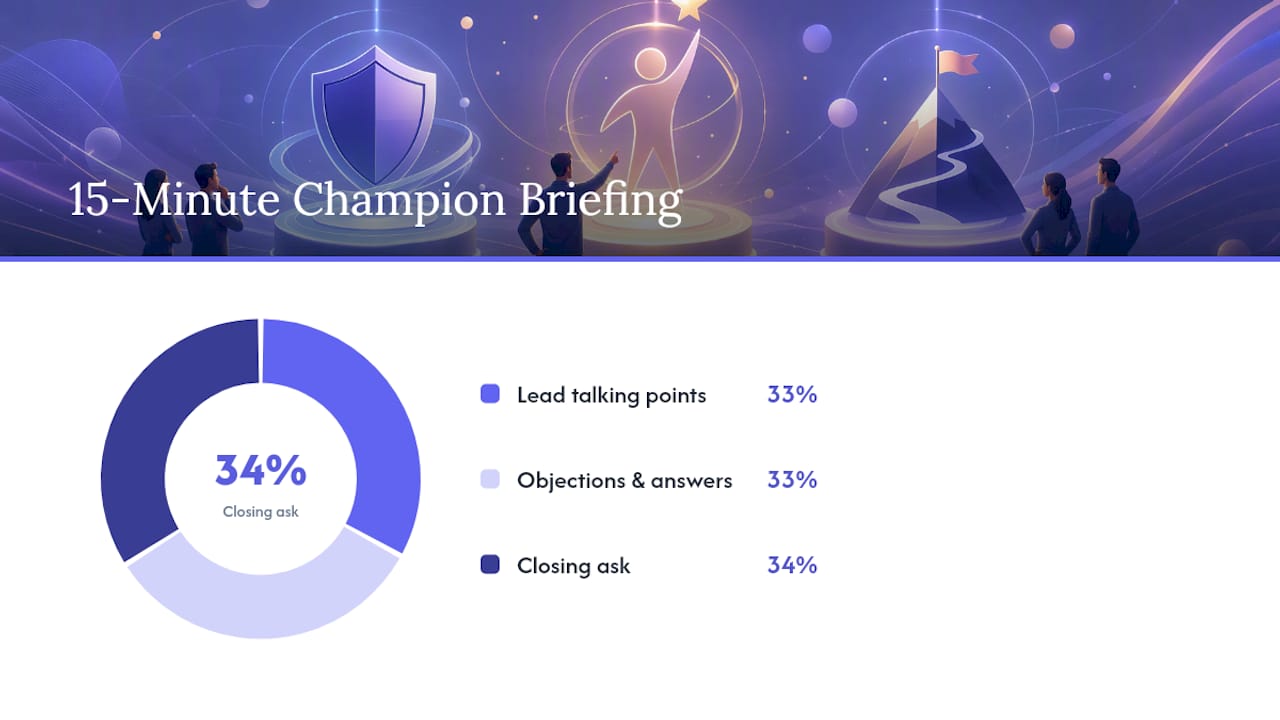
None of this works without a briefing. Run a 15-minute prep call before every internal meeting your champion has, and cover exactly three things: the two talking points they should lead with, three objections they’ll likely hear and a one-line answer to each, and the specific ask that closes the meeting, like locking a follow-up with the decision-maker. This structure measurably increases advocacy rates because it removes the guesswork that makes champions freeze up under pressure.
Pro Tip: Keep the deck to five slides on purpose. A champion who has to explain forty slides to their boss will simplify it badly or skip the meeting altogether.
How Do You Activate a Champion Once You’ve Found One?
Champion building works better as a campaign than a one-off conversation. Map out a condensed touch sequence tied to deal milestones instead of the calendar, so momentum builds around actual progress rather than arbitrary check-ins.
A workable nine-touch sequence looks like this:
- Discovery call, first signal of ownership.
- Follow-up with a personalized recap and one relevant proof point.
- Three-test round one: the prewire ask.
- Stakeholder mapping conversation.
- Enablement kit delivery, plus the 15-minute prep brief.
- Champion-led internal meeting, with you on standby, not in the room.
- Debrief call to capture objections raised.
- Executive sponsor touchpoint, brought in specifically to answer the objection that surfaced.
- Close-stage reinforcement: updated ROI one-liner and a final push cheat sheet.
Each role in this sequence carries distinct responsibilities:
- The rep builds the enablement kit, runs the prep briefs, and tracks stakeholder coverage.
- The champion carries the message internally and reports back on objections.
- The sales manager reviews scorecard data weekly and flags stalled champions.
- The executive sponsor shows up at exactly the moment a peer-to-peer conversation will land better than another rep call.
The nine-touch framing matters because it treats champion development as a system you run on every deal, not a one-time favor you hope pays off. Insert proof events, like a customer reference call or a live technical demo, right before the touches where skepticism tends to spike, usually around touch six or seven when the champion first faces internal pushback.
Why Single-Threaded Deals Collapse (And How to Prevent It)
A deal that runs through one champion is a deal running on borrowed time. Reorgs happen. People change jobs. Priorities shift overnight. When your one internal advocate leaves or gets reassigned, you’re not just losing a contact, you’re losing all the context they were carrying. A champion’s departure opens a window of roughly 30 to 60 days where deal momentum decays rapidly, and most reps don’t notice until the deal has already gone cold.
Multi-threading is the fix, and it means deliberately building relationships across four distinct roles, not just collecting extra contacts:
- A business champion who owns the problem and the budget conversation.
- A technical champion who can defend the solution to IT or security.
- A finance or executive champion who can speak to ROI in board terms.
- A user champion who represents the people who’ll actually work in the tool daily.
In practice, this means staging introductions deliberately instead of waiting for your champion to make them, tracking who’s actually opening and sharing your materials, and re-briefing every stakeholder every few weeks so nobody’s working off month-old information.
Pro Tip: If you can only build one redundant relationship, make it technical. Business champions get reorganized. Technical evaluators tend to stay put and carry institutional memory longer.
How Do You Measure Champion Strength?
Champion work is easy to feel good about and hard to prove, unless you’re tracking the right numbers. Structured champion programs report 2 to 3 times higher win rates and 30 to 40 percent shorter sales cycles compared to deals run without a deliberate champion process, which makes this one of the highest-leverage things a rep can systematize.
A simple scorecard, scored on each active deal, keeps the process honest:
| Scorecard field | What to score | Why it matters |
|---|---|---|
| Influence | Do decision-makers listen when this person talks? | Predicts whether their advocacy actually moves the deal |
| Alignment | Do they personally gain from solving this problem? | Weak alignment means weak follow-through under pressure |
| Capability | Can they navigate internal politics without you? | Determines how much enablement they’ll actually need |
| Actions taken | Introductions made, prewires completed, stakeholders recruited | The strongest predictor available, weighted above verbal support |
Actions taken should outweigh verbal enthusiasm every time you score a contact, because a champion who says the right things but never introduces you to anyone is still a coach wearing a champion’s badge.
What Mistakes Kill Champion Strategies Before They Start?
The most common failure isn’t a bad champion, it’s a rep who never actually tested for one. A few patterns show up again and again in stalled deals.
- Product dumping. Handing a friendly contact a stack of generic collateral and hoping they’ll figure out how to sell it internally themselves.
- Mistaking enthusiasm for commitment. A contact who loves your demo but goes quiet the moment you ask them to do something with actual social cost attached.
- Single-threading by default. Relying on one relationship because it’s comfortable, then getting blindsided when that person leaves.
- Ignoring vague answers about buying process. If a contact can’t or won’t tell you who actually approves budget, that’s a red flag, not a detail to sort out later.
When a champion stalls, don’t just wait it out. Pivot to a secondary contact you’ve already been multi-threading with, reframe the silence directly (“I noticed we haven’t heard back, is timing the issue or has priority shifted?”), and re-enable whoever’s still engaged with a fresh, more targeted asset instead of resending the same deck.
How Does Tooling Make Champion Enablement Easier?
Everything above works with a spreadsheet, a shared drive, and discipline. It works faster and more reliably with a workspace built for it. The gap most reps actually lose deals in isn’t the call, it’s the silence between calls, when a champion is back at their desk trying to remember what you said and re-explain it to people who weren’t there.
A centralized deal workspace addresses that gap directly by keeping every asset, conversation, and signal in one place instead of scattered across email threads and forgotten folders:
- Personalized demo trailers and exec briefs live in one spot your champion can find and forward without digging through old emails.
- Sharing gets tracked as an attribution tree, so you can see exactly who your champion forwarded materials to and who actually engaged.
- Once a deal closes, an auto-generated handoff brief carries stakeholder context and open commitments straight to customer success, so momentum doesn’t die at signature.
TrailerCast was built around this exact idea, that a single AI following a deal from first call through handoff keeps champions equipped without adding rep overhead. Structured programs already report 2 to 3 times higher win rates; tooling that removes friction from the enablement kit only compounds that advantage.
The One Habit That Beats Every Framework
If you take exactly one thing from this article, make it this: brief your champion before every single internal meeting, no exceptions, even the ones that feel too small to matter. Reps who skip the 15-minute prep call because “it’s just a quick check in” are the same reps surprised when the deal dies in a meeting they weren’t part of.
Run the three-test on your next live deal this week. Ask for the prewire. Watch what happens. The answer will tell you more about your deal’s odds than any forecast call ever will.
— Daniel
Scale the Playbook Without Doing It All by Hand
Every asset and touch described above works. It also takes real hours to build by hand, deck by deck, deal by deal. TrailerCast is built to give sales teams running multi-stakeholder deals a single workspace instead of stitching together a call recorder, a video editor, a deal room, and a signature tool separately.
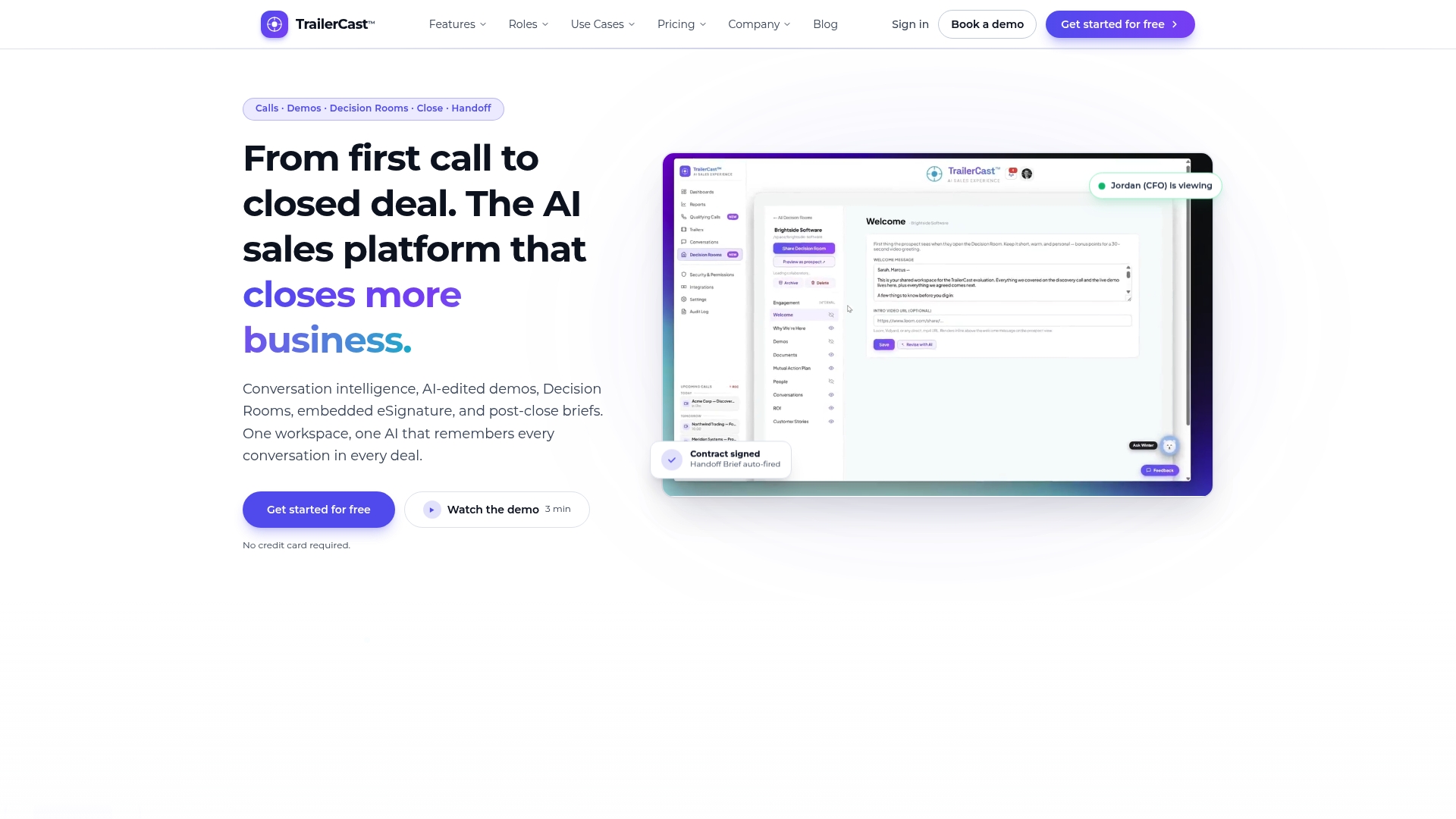
The platform automates the parts of this playbook that eat the most time: personalized demo trailers get cut automatically from your actual sales calls, sharing and engagement get tracked so you know exactly who your champion forwarded materials to, and every enablement asset lives in one branded deal room your champion can access without a login. When a deal closes, an AI-generated handoff brief carries the full stakeholder map straight to customer success automatically. It fits teams with multi-stakeholder buying committees, typically three to seven people per deal, where a single dropped thread can stall momentum for weeks. TrailerCast runs one plan with every feature included, starting from $59 per seat per month, with a free trial and no credit card required. Start a trial and run your next champion sequence inside a workspace built to carry it.
Where This Article’s Claims Come From
- Champion-based selling: Win B2B SaaS deals from inside, for win-rate and cycle-time figures.
- How to build a champion in sales, Causo Hub, for the three-test method.
- Champion Building Play, It’s Just Revenue, for enablement asset guidance and program-level results.
- What Is a Sales Champion and How to Build One, for multi-threading and the decay window.
Sources
- Champion-based selling: Win B2B SaaS deals from inside
- How to build a champion in sales (2026) | Causo Hub
- Champion Building Play: The Person Who Returns Your Emails Isn’t Your Champion — Build Real Ones or Lose
- What Is a Sales Champion and How to Build One
FAQ
What Are the Top 5 Sales Strategies for Building a Champion?
The five that matter most are testing for commitment with small verifiable asks, building a lean enablement kit, multi-threading across four stakeholder roles, running a structured touch sequence, and scoring champion strength on actions rather than words.
What Is the 30 60 90 Rule in Sales?
It’s a ramp-up framework for new reps, mapping goals across the first 30 and 60 days on the job. It’s separate from the 30 to 60 day window in champion strategy, which refers to how fast momentum decays after a champion leaves a deal.
What Are the 5 C’s of Sales?
Definitions vary by source, but the concept generally centers on qualities like credibility, competence, and clarity in the sales relationship. This article focuses on a tighter, evidence-backed set: influence, alignment, and capability as the three traits that actually predict champion behavior.
What Is the 70/30 Rule in Sales?
It commonly refers to spending most of a sales conversation listening and less time talking. It applies directly to champion identification: the diagnostic questions in the three-test method work because you’re drawing out information, not pitching.
How Much Does TrailerCast Cost?
TrailerCast offers a plan with every feature included; for current pricing and trial details, visit their official website.