SaaS Onboarding Software: A 2026 Guide for Teams

SaaS onboarding software is defined as any platform that delivers in-app guidance, interactive tours, and behavior-triggered messaging to accelerate user activation after signup. The stakes are real: 40–60% of SaaS users never return after their first session. That single number explains why onboarding has moved from a nice-to-have to a core growth function. This guide covers what these platforms actually do, how user onboarding tools differ from customer onboarding solutions, and how to build a stack that drives lasting adoption.
What are the essential features of SaaS onboarding software?
The best onboarding software shares a common set of capabilities that move new users from signup to their first meaningful action. Understanding these features helps you evaluate platforms against your actual activation goals, not just a feature checklist.
The core feature set includes:
- Interactive product tours and tooltips. Step-by-step walkthroughs guide users through key workflows without requiring them to read documentation. Contextual tooltips appear at the exact moment a user needs them, not before.
- Visual, no-code journey builders. SaaS teams can launch basic onboarding tours in under 15 minutes without filing an engineering ticket. That speed matters when you need to iterate weekly based on activation data.
- Built-in analytics and event tracking. Platforms track where users drop off, which steps they skip, and which flows convert. Session replays let you watch real user behavior rather than guess at it.
- Behavior-triggered messaging. Automated in-app messages and lifecycle emails fire based on what a user does or does not do. A user who skips a key setup step gets a nudge. A user who completes it gets a next-step prompt.
- A/B testing and personalization. SaaS onboarding features like segmentation and multivariate testing let teams run experiments on flow order, message copy, and checklist design to find what actually converts.
Pro Tip: Build your onboarding checklist around your product’s single most important activation milestone. Every step that does not lead toward that milestone is friction you added yourself.
How does user onboarding software differ from customer onboarding software?

This is the most expensive confusion in SaaS procurement. Teams buy the wrong category, deploy it, and wonder why adoption numbers do not move.
User onboarding software and customer onboarding software are two distinct categories with different platform capabilities and team workflows. Conflating them leads to costly errors. Here is how they split:
| Category | Primary focus | Who uses it | Key features |
|---|---|---|---|
| User onboarding software | In-app guidance for individual users | Product and growth teams | Tours, tooltips, checklists, behavior triggers, A/B testing |
| Customer onboarding software | Post-sale implementation projects | Customer success teams | Collaboration portals, task tracking, milestone management, CRM sync |
User onboarding software lives inside your product. It guides individual users through activation milestones, tracks their progress through in-app events, and fires messages based on behavior. The audience is a single user trying to get value from your product.
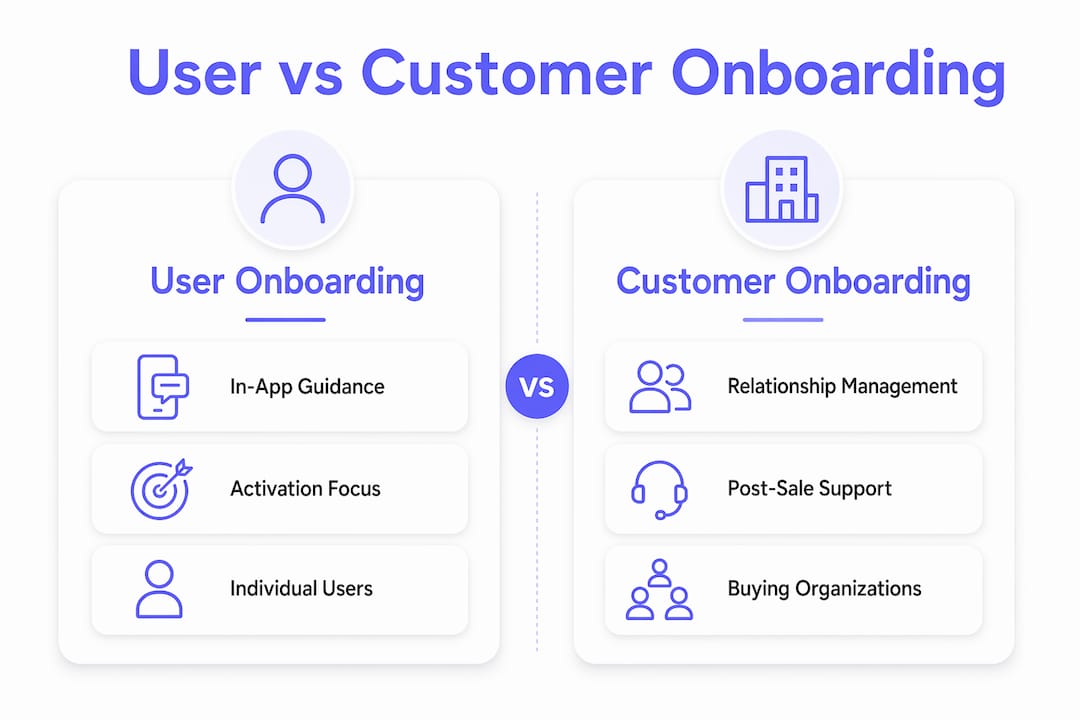
Customer onboarding software manages the relationship between your company and a buying organization after a contract signs. It coordinates tasks across your CS team and the customer’s team, tracks implementation milestones, and surfaces health signals. Post-2020 customer onboarding platforms moved away from generic project management tools toward purpose-built platforms with external collaboration portals and product usage tracking. The audience is an account, not a user.
The practical consequence: a B2C SaaS company with self-serve signups needs user onboarding software. A B2B SaaS company selling to enterprise accounts needs both. Buying only one when you need both creates a gap that shows up as churn six months later.
Pro Tip: Map your sales motion before you buy. If your deals involve a signed contract and a CS handoff, you need customer onboarding software on top of whatever in-app guidance tool you already run.
What practical approaches improve SaaS onboarding success?
The biggest mistake SaaS teams make is treating onboarding as a product feature rather than a multi-channel system. Getting the onboarding process for SaaS right requires thinking across every touchpoint a new user encounters.
Here are the approaches that consistently move activation rates:
- Start before first login. Send a pre-login email sequence that sets context, explains what the user will do in their first session, and removes any setup friction. Users who arrive knowing what to expect complete activation steps at a higher rate.
- Use product-usage signals to personalize flows. If a user completes step one but skips step two, trigger a specific message about step two. Generic tours that show every feature to every user produce low completion rates.
- Integrate lifecycle emails with in-app flows. Effective SaaS onboarding requires a combined technical and marketing approach using integrated tools to address early user disengagement. Email re-engages users who have gone quiet. In-app messages guide users who are active. Both channels need to know what the other is doing.
- Avoid feature overload in the first session. Show users the one thing that delivers immediate value. Save advanced features for later onboarding stages triggered by behavior, not by a timer.
- Build a stack, not a single tool. No single tool covers the entire onboarding lifecycle. Successful teams combine in-app guidance, analytics platforms, and lifecycle email messaging to optimize adoption. Think of these as three separate jobs that need three coordinated tools.
“The biggest misconception is that onboarding starts at first login. Effective onboarding requires a stack spanning in-app experiences, lifecycle emails, and product analytics working together from day one.”
The SaaS sales process at growth-stage companies often reveals this gap clearly. Teams invest heavily in acquisition and close, then hand new users a generic welcome tour and call it onboarding. The churn that follows is predictable.
What should you consider when selecting onboarding software?
Choosing the right platform requires evaluating more than the feature list. The implementation experience and integration fit matter as much as what the tool does on day one.
Key considerations before you sign a contract:
- Speed to launch without engineering. If every onboarding change requires a developer, your iteration speed drops to zero. Prioritize platforms where your product or growth team can publish and update flows independently.
- CRM and analytics integration. Customer onboarding software success depends heavily on customer-facing portals and deep CRM integrations tailored to mid-market and enterprise needs. Check whether the platform syncs with your CRM and your product analytics tool before you commit.
- Real-time usage signal integration. The best platforms pull live product usage data into the onboarding layer. A user who has not triggered a key event in 48 hours should receive a different message than one who has completed the full activation flow.
- Time-to-value analytics. You need to measure how long it takes a new user to reach their first activation milestone. Platforms that surface this metric make it easy to run experiments and prove impact.
- Customer-facing portals for B2B accounts. If you run a B2B motion with a CS handoff, look for platforms that offer external collaboration workspaces where your team and the customer’s team can track implementation tasks together.
Pro Tip: Run a 30-day pilot with real users before committing to an annual contract. Activation data from a live pilot tells you more than any demo.
Implementation works best as a cross-functional project. Product owns the in-app flows. Customer success owns the post-sale implementation layer. IT owns integrations and data governance. When one team runs the whole project alone, the other teams’ use cases get ignored, and the platform underperforms.
Customer success handoff is a particularly high-stakes moment. The context built during the sales cycle needs to transfer cleanly to the CS team so they can start the onboarding conversation from where the deal left off, not from scratch.
Key Takeaways
Effective SaaS onboarding software requires a multi-channel stack combining in-app guidance, behavioral analytics, and lifecycle email to move users from signup to activation without engineering dependency.
| Point | Details |
|---|---|
| User vs. customer onboarding | These are two distinct software categories. Buying the wrong one for your motion is a costly mistake. |
| Multi-channel stack | No single tool covers the full lifecycle. Combine in-app guidance, analytics, and email for full coverage. |
| Speed without engineering | Prioritize platforms where your team can launch and update flows in under 15 minutes. |
| Behavior-triggered messaging | Generic tours underperform. Trigger messages based on what users actually do inside your product. |
| Cross-functional ownership | Assign product, CS, and IT each a clear role. Solo implementations consistently miss use cases. |
The onboarding gap nobody talks about
I have watched a lot of SaaS teams spend serious money on onboarding software and still lose users in the first week. The tool was not the problem. The strategy was.
The pattern I see most often: a growth team buys a user onboarding platform, builds a beautiful product tour, and ships it. Activation numbers tick up slightly. Then they plateau. The team assumes the tool has hit its ceiling and starts evaluating replacements. What they actually hit was the limit of in-app guidance alone.
The users who churned were not confused about how to use the product. They were unconvinced it was worth the effort. That is a different problem. It requires lifecycle emails that reinforce value, a CS touchpoint that catches at-risk accounts early, and a handoff process that does not drop context between sales and success.
The other mistake I see is teams conflating user onboarding with customer onboarding. They buy a project management tool with a portal and try to use it for in-app activation. Or they buy an in-app guidance tool and try to run enterprise implementation projects through it. Neither works. The categories exist for a reason.
My honest recommendation: map your full user journey before you buy anything. Identify where users drop off, what information they need at each stage, and which team owns each touchpoint. Then buy tools that fit those specific jobs. The stack will cost more than a single platform. It will also actually work.
— Daniel
Trailercast and the space between onboarding and close
SaaS teams focused on user activation often overlook what happens in the sales cycle before a user ever logs in. The quality of the handoff from sales to customer success determines whether onboarding starts with context or starts from zero.
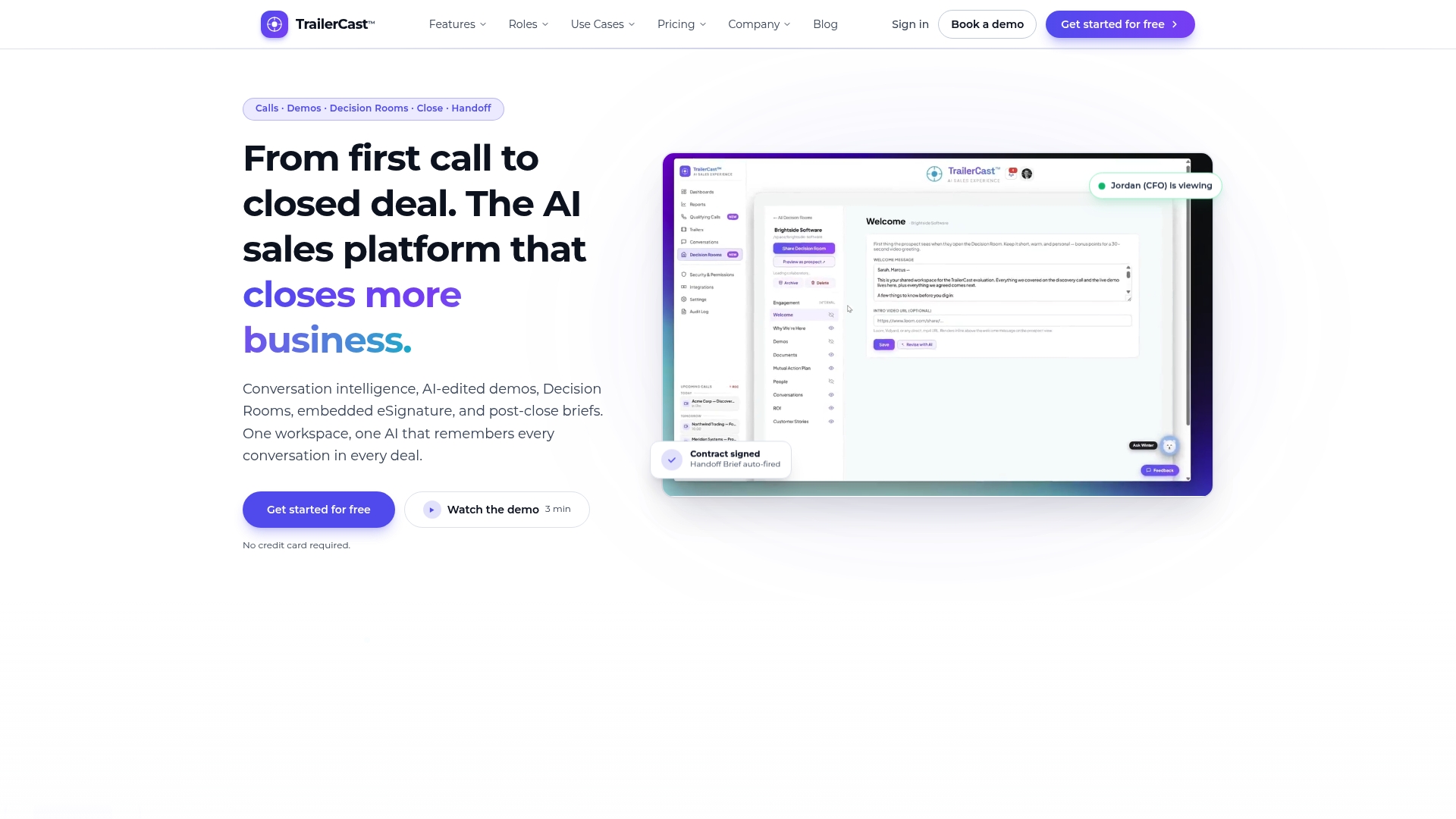
Trailercast is built for that gap. Its AI Handoff Brief fires automatically the moment a contract signs, giving your CS team the full deal context, stakeholder map, promised features, and risk flags before the kickoff call. That means your customer onboarding starts informed. Trailercast also gives sales teams AI-edited demo trailers and buyer-facing Decision Rooms that keep prospects engaged between calls, so the deal arrives at close with momentum rather than confusion. Explore the full Trailercast platform to see how it connects every stage from first call to post-close handoff.
FAQ
What is SaaS onboarding software?
SaaS onboarding software is a platform that delivers in-app guidance, interactive product tours, and behavior-triggered messaging to help new users reach their first activation milestone quickly. It reduces early churn by guiding users to product value without requiring support or documentation.
How do user onboarding and customer onboarding software differ?
User onboarding software guides individual users through in-app activation flows. Customer onboarding software manages post-sale implementation projects between your CS team and a buying organization, typically including collaboration portals and milestone tracking.
What features should I prioritize in onboarding software?
Prioritize a no-code flow builder for fast iteration, behavior-triggered messaging, built-in analytics with event tracking, and integration with your CRM and product analytics platform. A/B testing capability is a strong secondary requirement.
Why do 40–60% of SaaS users churn after the first session?
Users who churn early typically fail to reach a meaningful activation milestone in their first session. Effective in-app onboarding that guides users to a clear “aha” moment within the first session is the primary lever for reducing this rate.
Do I need both user onboarding and customer onboarding software?
If you run a B2B SaaS motion with a CS handoff after the sale, you need both. User onboarding software handles in-app activation for individual users. Customer onboarding software manages the implementation relationship with the buying organization. Running a B2B motion with only one category creates a gap that shows up as churn.