B2B Pilot vs. Proof of Concept: 2–4 Weeks for Tech, 6–12 for ROI

A proof of concept proves technical feasibility; a pilot proves operational and business fit. A PoC is short, owned by engineering or solutions, and answers one question: does it work in your environment? A pilot runs longer, belongs to ops and customer success, and shows adoption and ROI. Run a PoC when technical unknowns remain. Run a pilot when you need adoption and ROI evidence.
TL;DR:
- A PoC should last two to four weeks, test one technical hypothesis, and start security review early; skip it when references or demos settle feasibility.
- A pilot runs six to twelve weeks with real users, data, and workflows, and needs an executive sponsor plus written adoption and business targets.
- When finance questions payback or vendors are compared on return on investment, use a proof of value; a technical PoC cannot answer the economic objection.
- Running a pilot before technical feasibility is established can cost three to five times more; set price, rollout scope, and conversion terms before launch.
Table of Contents
- What a proof of concept delivers and when to skip it
- What a pilot proves in a production-like setting
- How the two compare on scope, owners, metrics and cost
- When to choose a PoC, a proof of value, or a pilot
- How to run a proof of concept, step by step
- How to run a structured pilot with conversion terms
- Outcomes and next steps after a PoC or pilot
- Why success criteria decide whether a pilot becomes revenue
- How we help you prove demos, adoption and ROI
- FAQ
- Sources
What a proof of concept delivers and when to skip it
A proof of concept is a short, technical experiment that shows a product can work in the customer’s own environment. A PoC typically lasts two to four weeks, and it answers a binary question: does it work, or not?
Solutions engineering or engineering usually owns it. They are the people who can say “yes, it integrates” with authority, and engineering gatekeepers tend to trust that answer more than any slide deck.
A good PoC leaves you with:
- A working integration or prototype in the buyer’s environment
- Test scripts that anyone on the team can rerun
- Binary pass/fail evidence against criteria agreed before work began
- A short write-up that a pilot team can pick up
Sometimes you can skip it. If you have strong references from similar customers, or a demo environment already answers the technical question, a PoC adds delay without adding evidence. The test is simple: if nobody on the buying side doubts that the technology works, move on.
What a pilot proves in a production-like setting
A pilot is an operational test with real users, real data and real workflows. Where a PoC asks “can this work?”, a pilot asks “will this work here, for these people, at a price that makes sense?” Pilots typically run six to twelve weeks, long enough for habits to form or fail to form.
Ownership shifts accordingly. Customer success, operations, product and a stakeholder sponsor all have a stake, and the sponsor matters most. When the champion walks away, a pilot without an executive behind it quietly dies.
The deliverables are different, too:
- Adoption KPIs showing who actually used the product and how often
- Performance benchmarks against the current way of working
- An operational runbook covering training, support and handoffs
- Business metrics the finance team can verify
Pilots are often paid, and they should carry conversion terms from day one. If the buyer hits the agreed targets, what happens next? Price, term and rollout scope belong in the pilot agreement, not in a negotiation that starts after the results are in. A free, open-ended pilot invites drift, because nobody has a reason to decide.
How the two compare on scope, owners, metrics and cost
Here is the practical split between the two.
- Objective and scope: A PoC is a narrow technical check. A pilot validates operations, adoption and business outcomes across a real team.
- Duration and resources: Two to four weeks with a small team for a PoC. Six to twelve weeks with users, training and support for a pilot.
- Owners: Engineering or solutions engineering for the PoC. Customer success, ops, product and an executive sponsor for the pilot.
- Success criteria: For a PoC, something like “the integration syncs records without data loss.” For a pilot, something like “70% of invited reps use the tool weekly and cycle time drops against baseline.” Those figures are examples of how to phrase criteria, not benchmarks.
- Cost: Order matters. Running a pilot before a PoC can cost three to five times more than a focused technical test, and you can end up with the same binary feasibility answer.
The pattern to remember: each step takes longer and costs more, so earn the right to take the next one with evidence from the last.
When to choose a PoC, a proof of value, or a pilot
There is a third option worth knowing. A proof of value, or PoV, tests whether the product delivers financial value, which is a different question from whether it works. The pilot then tests daily operations.
Ask yourself these questions in order:
- Is the technology new to your stack, or are there integration or security unknowns? Run a PoC.
- Do engineering gatekeepers need hands-on proof before they will sponsor the deal? Run a PoC.
- Is the main objection about money, with finance wanting numbers before approving? Run a PoV.
- Are you comparing vendors on ROI rather than on features? Run a PoV.
- Are you confident the technology works, and now need to prove people will use it? Run a pilot.
Pro Tip: Default to a PoV when the core objection is economic rather than technical. A flawless integration will not move a CFO who doubts the payback.
How to run a proof of concept, step by step
Keep it small, and keep it honest. Teams that treat a PoC as a mini-launch usually spend weeks proving things nobody asked about.
- Agree on one testable hypothesis and the pass/fail criteria before any work starts.
- Time-box the scope to two to four weeks and keep artifacts minimal.
- Define the environment, data access and security requirements up front.
- Assign a single owner and a small cross-functional team.
- Document the evidence and prepare handoff materials for a pilot or next step.
Two habits protect the outcome:
- Write down what “fail” looks like, so a negative result is a clear answer and not an argument.
- Put security review at the start, because a late security surprise is the classic way a short PoC becomes a much longer one.
How to run a structured pilot with conversion terms
A pilot without structure is a free trial that nobody finishes. Well-structured pilots convert far better, and structure comes from decisions made before launch.
- Set business metrics and adoption KPIs before starting, and get the buyer to sign off on them in writing.
- Time-box the pilot to six to twelve weeks, with milestone reviews at fixed dates.
- Negotiate conversion terms and pricing before launch, so success triggers a purchase rather than a new debate.
- Plan training, integrations and support for every pilot participant.
- Record results in a format that finance and executives can approve without a translator.
If you are measuring engagement during the pilot, our guide to sales engagement analytics covers what to track and why. For pilots built to prove attribution, the pilot approach is a useful companion. And for a lighter-weight example from outside sales, Prowl’s guide to starting a pilot shows the same principles applied to analytics automation.
Outcomes and next steps after a PoC or pilot
Moving from PoC to pilot to production should depend on evidence, not momentum. A PoC should progress only once core technical assumptions are validated, and a pilot should move to production only when value, adoption and operational readiness are confirmed. The label matters less than what you can show.
Put the contract triggers in writing: target metrics, a decision date, pricing and the rollout scope that follows a pass. That discipline pays off. Well-structured pilots convert more successfully than open-ended evaluations.
If results come back negative, you have two honest options: a short, scoped iteration with a new hypothesis, or a clean stop against termination criteria you set at the start.

Why success criteria decide whether a pilot becomes revenue
Most failed evaluations I have seen did not fail on technology. They failed because nobody wrote down what success meant, so the buyer’s team drifted, the champion lost momentum and the deal stalled in silence. Our view is simple: a pilot is a sales investment, and it deserves the same discipline as any other. Agree on the finish line, name the people who must approve the result, and settle the commercial terms before day one. When a prospect asks us for a “quick trial,” we turn it into exactly that kind of structured test.
— Daniel
How we help you prove demos, adoption and ROI
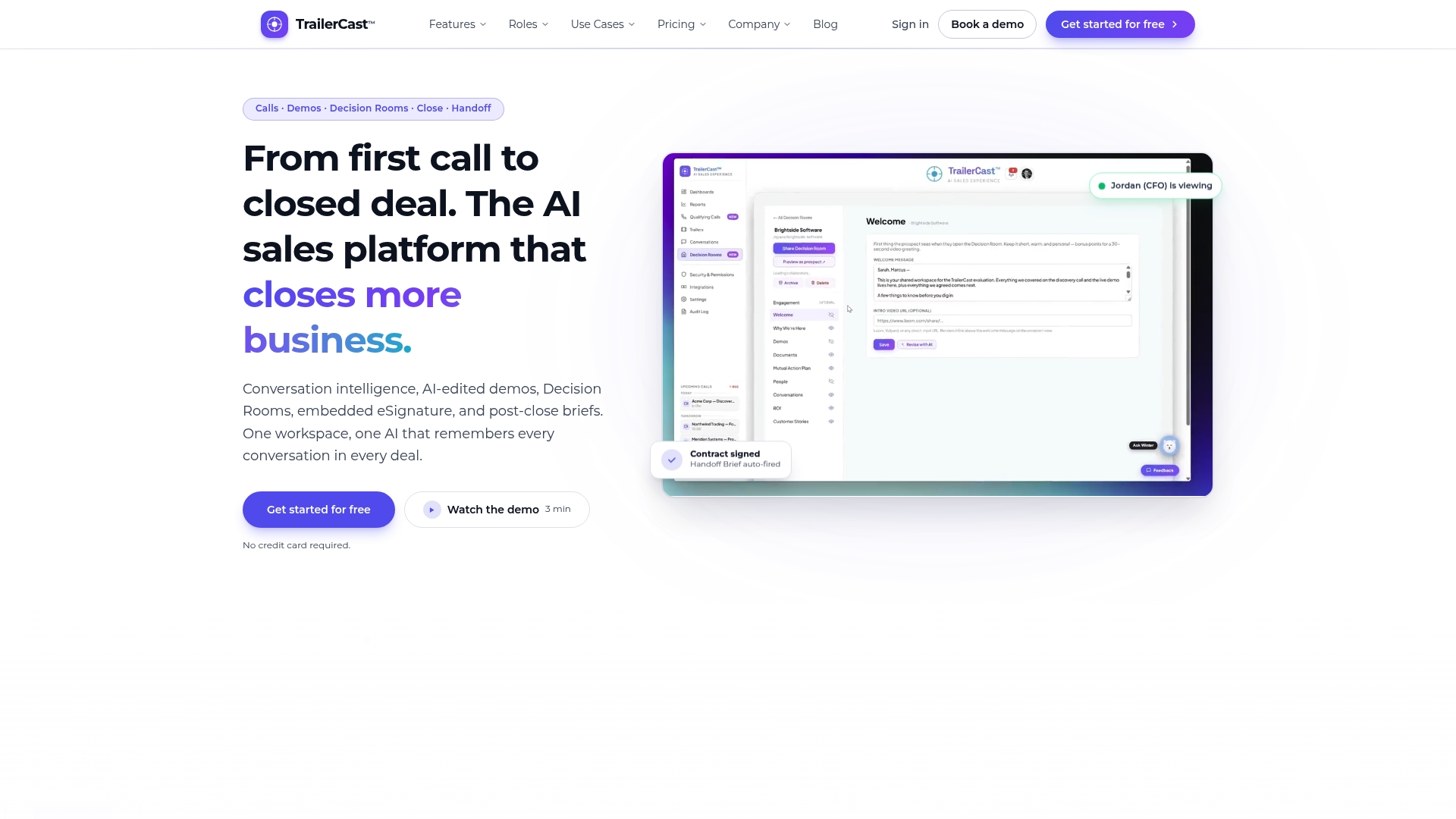
Pilots stall in the space between conversations: the champion who has to re-sell the product to a CFO who was never on the call. We built our platform to close that gap in one workspace.
- Conversation intelligence captures every call, so pilot context never lives in one person’s memory.
- Demo trailers turn recordings into short, forwardable proof for each stakeholder.
- Decision rooms keep the plan, documents and engagement data in one branded place.
- Embedded eSignature closes the deal when pilot targets are met.
- Handoff briefs give customer success the full story on day one.
See how to run a pilot, or start with our platform and try it free.
FAQ
What is the difference between a feasibility study and a proof of concept?
A feasibility study asks whether an idea is practical on paper, looking at cost, risk and resources. A proof of concept tests it in practice with a small working experiment. Many teams run the study first and the PoC second.
What is a POC checklist?
It is a short list that keeps the test focused: one hypothesis, pass/fail criteria, a time box of two to four weeks, a defined environment and data access, a single owner and documented evidence. Success criteria and fixed dates should be agreed up front.
How do you draft a proof of concept?
Start with the single question you need answered, then write the success criteria, scope, timeline, owner and required access. Keep the plan to a page or two. If it needs more, the scope is probably too big for a PoC.
What is the difference between PoC and PoV?
A PoC asks whether the product works, while a PoV asks whether it delivers value worth further investment. Both need success criteria, but they answer different questions for different stakeholders.
Sources
- Deal Closing Pilot Programs: A Proven Playbook
- Proof of Concept (PoC) in Sales: PoC vs PoV vs Pilot | The PreSales Handbook