Objection Handling Scripts for SaaS Sales (With Examples)

The best objection handling script is not a rebuttal. It is a short sequence: acknowledge the concern, find the real question underneath it, answer that question with evidence, check that it landed, and agree on a next step. Below are word-for-word scripts for the objections SaaS sellers hear most (price, timing, authority, competitors, security), plus how to bend each one to the person in front of you.
A caveat before the scripts: read them out loud, then change them until they sound like you. A prospect can hear a recited line from the first syllable.
TL;DR
- Treat an objection as a question in disguise. Your first job is to find the real question, not to defend your product.
- Use one loop every time: acknowledge, clarify, answer with evidence, confirm, ask about other concerns, agree a next step.
- “I need to think about it,” “it’s too expensive” and “I’m not the decision-maker” are rarely the real blocker. Ask what sits behind them.
- Adapt the script to the role: a CFO wants cost and risk, a CISO wants documentation, a champion wants something to forward.
- The objection you can’t answer live is often the one that kills the deal in a meeting you weren’t invited to. Plan for the room you’re not in.
Table of Contents
- What objection handling actually is (and isn’t)
- The six-beat loop behind every script
- Price and budget objections
- Timing objections
- Authority and stakeholder objections
- Competitor and incumbent objections
- Security, compliance, integration and fit objections
- Adapting scripts to the role and the conversation
- Our perspective: the objection happens when you’re not there
- Put the objections where you can see them
- Common mistakes that sink good scripts
- FAQ
- Sources
What objection handling actually is (and isn’t)
An objection is a buyer telling you where the risk sits. That is useful information, and it is usually a good sign. Buyers who have already decided no rarely bother to object. They go quiet.
Objection handling is not winning an argument. If the prospect feels cornered, you may get a polite “let’s circle back” and then silence. The goal is a prospect who feels understood, has the evidence they asked for, and knows what happens next.
The approach that holds up best is also the simplest. The Founding Sales handbook’s chapter on handling objections recommends identifying the question beneath the objection, responding with quantitative and qualitative evidence relevant to that question, checking whether the explanation made sense, and asking whether other concerns remain. It treats this as a loop: answer the current concern, confirm understanding, return to the buying conversation, and surface what’s left.

Everything below is that loop with words attached.
The six-beat loop behind every script
Each script in this article follows the same skeleton. Learn the skeleton and you can write your own scripts for objections nobody has listed.
- Acknowledge. One short sentence that shows you heard it. No “but.”
- Clarify. Ask an open question to find the real concern.
- Answer. Give evidence tied to that concern: a number, a customer outcome, a document, a demo moment.
- Confirm. “Does that answer it, or is there more behind it?”
- Sweep. “Besides that, is there anything else that would stop you moving forward?”
- Next step. A specific action with a date or an owner.
Beat two is where most sellers skip ahead, and it’s the one that matters. “It’s too expensive” can mean no budget, no belief in the value, a cheaper alternative on the table, or a boss who hasn’t been convinced. Each needs a different answer.
Price and budget objections
“It’s too expensive”
Ask what it’s being compared to. Too expensive against what?
You: That’s fair, and I’d rather talk about it openly. When you say it’s too expensive, is that compared to a budget you’ve already set, to another option, or to the value you’re expecting?
Prospect: Honestly, we have a number in mind and this is above it.
You: Got it. Can I ask what the number is based on? Then I can show you where we’d be inside it and what we’d have to leave out to get there.
If the real issue is value rather than budget, move to the cost of the current approach:
You: Let’s put the cost of the current process next to ours. How many deals did your team lose or push last quarter because a stakeholder didn’t get the right information? What was a typical deal worth?
Use the prospect’s numbers, never invented ones. If they can’t give you numbers, that’s your next-step ask: “Can we spend ten minutes with your RevOps lead and size this together?”
“We don’t have budget”
There are two versions: no budget this cycle, and no budget because nobody has been shown a reason to create one.
You: Understood. Is the budget missing for this kind of tool in general, or has this problem not been prioritized yet? If it were prioritized, who would fund it?
The second question surfaces the real economic buyer. If the problem isn’t a priority, your honest move is to ask what would have to be true for it to become one, then offer to help build that case.
Proving value without overpromising
When a buyer asks for proof, give evidence that fits their question. Good teams pair numbers with stories: a measured result and a customer in a similar situation. The same idea applies to any technology purchase, as in this look at customer feedback and revenue data, where qualitative comments and quantitative results make the case together. Never promise an outcome you can’t document. “Customers in your segment have told us X” is stronger than “you’ll see X.”
Timing objections
“I need to think about it”
This is the most common stall and the most misread. It usually means one of three things: a concern you haven’t heard, a person who needs to be consulted, or a lack of urgency. Don’t push. Open the door.
You: Of course. So I can make it easy to think through, what part is still open for you: the fit, the price, or how it’d work with your team?
Prospect: Probably the price, and I’d want to run it by my VP.
You: That makes sense. What will your VP ask first? I’ll put together a one-page summary that answers it, and we can grab fifteen minutes Thursday to go through it together.
Notice what happened: a vague stall became a named concern, a named stakeholder and a booked next step.
“We don’t have a need right now”
You: Fair enough. When you said you don’t see a need, did the problems we talked about on the discovery call not ring true, or do they ring true but aren’t urgent?
If they ring true but aren’t urgent, ask what would make them urgent: a hiring plan, a renewal date, a missed quarter. Then ask permission to check in around that trigger, not at some arbitrary “next quarter.” You can see how much a good discovery call helps here: if you recorded the pains in the buyer’s own words, an AI call notetaker for discovery calls lets you quote them back accurately instead of from memory.
“Call me next quarter”
You: Happy to. Can I ask what changes between now and then? If it’s budget or a project finishing, I’ll line up around that. If it’s something else, I’d rather hear it now.
A delay with a reason is a plan. A delay without one is a soft no, and you deserve to know which you have.
Authority and stakeholder objections
“I’m not the decision-maker”
This one is almost never a problem. It’s an invitation. Your contact is a champion, and your job is to arm them.
You: Totally understood, and thanks for being straight with me. Who else will weigh in, and what does each of them care about most? I’d like to give you something that answers their questions without you having to rebuild the demo from memory.
This is the space between calls where deals die. The champion leaves a good demo, then walks into a meeting with a CFO or CISO who wasn’t there, armed with a vague recollection and a PDF. We looked at this pattern in what 500+ B2B sales demos taught us about why deals stall. The fix is to hand the champion role-specific material: a short recap for the CFO focused on cost and payback, another for security focused on documentation.
“I need to run it by my boss/committee”
You: Sure. What do you think their first question will be? And would it help if I joined that conversation, or sent something they can review without you?
Be careful not to go around your champion. Offer, don’t insist.
Competitor and incumbent objections
“We’re looking at other options” or “We already use something”
Don’t trash anyone. Compare equivalent scope and the buyer’s own decision criteria.
You: That’s smart, you should compare. What are the two or three things that will decide this for you? I’ll tell you honestly where we’re strong against those and where you might want to check another option.
On incumbents:
You: What’s working well with what you have today? And what’s the one thing you wish it did that it doesn’t?
The second answer is your opening. If you sell a consolidated platform, the gap is often the handoffs between tools: call recordings in one place, follow-up in another, signatures in a third. If your buyer is comparing against a call recorder specifically, our page on a conversation intelligence option for smaller sales teams lays out how we think about that.
Security, compliance, integration and fit objections
These are the objections where over-promising is most dangerous. A good rule: state only what is documented, provide the evidence requested, and send unresolved technical or legal questions to the person who is authorized to answer them.
“Our security team will never approve this”
You: That’s a reasonable worry. What does your review usually require: a questionnaire, a specific certification, a call with an engineer? I’d like to send the right documents up front.
Then do exactly that. Send what you have. If they ask for something you don’t have, say so plainly and name who will answer. Our guide to security questions sellers should expect from a CISO is a good way to prepare, and your prospect can read our security page before the call.
“Does it integrate with our CRM?”
You: Yes for [the systems you support], and here’s what syncs and in which direction. Which fields does your team actually care about? I’d rather show you that than say “it integrates.”
If you don’t support it: “Not natively today. Here’s what we’d do instead, and here’s whether that works for you.” Honesty here builds more trust than any pitch.
“I’m not sure it fits how we sell”
You: What does your process look like from first call to close? Let me map where this would help and where it wouldn’t, so you can judge for yourself.
If the buyer is early in building a process, our post on building a sales process at a Series A SaaS company may help them see where a tool belongs.
Adapting scripts to the role and the conversation
The same objection means different things coming from different people.
| Role | What “it’s too expensive” usually means | Best clarifying question | Evidence to bring |
|---|---|---|---|
| Champion / end user | “I can’t justify this to my boss.” | “What will your boss need to see?” | A forwardable recap, a short clip of the moment that mattered |
| CFO / finance | “Show me payback and risk.” | “What payback window do you need?” | Per-seat cost, comparison to current spend, contract terms |
| CISO / security | “I don’t have what I need to approve this.” | “What does your review require?” | Security documentation, named contact for follow-ups |
| VP of Sales / RevOps | “Another tool to manage.” | “What would you retire if this worked?” | Consolidation story, rollout plan |
| Sales engineer | “I don’t trust this fits our stack.” | “Where would it touch your stack?” | Technical detail, honest limitations |
Two more adjustments matter. First, match the channel: a live call calls for short, conversational lines, while email lets you attach evidence. Second, match the stage. An objection in discovery is a signal to dig deeper. The same objection after a demo is usually a stakeholder issue.
Scripts also go stale. Pricing changes, features ship, competitors move, and the line your team memorized last year may now be wrong. Treat your script library like a product: review it on a schedule, and consider sales enablement content upkeep so outdated claims don’t reach buyers.
Our perspective: the objection happens when you’re not there
We built TrailerCast around one observation: the calls were never the problem. The space between them was.
Most objection handling advice assumes you’re on the call, with the buyer, able to respond. In multi-stakeholder B2B deals, that’s often not where the decisive objection is raised. It is raised in an internal meeting where your champion has to answer for you. The CFO asks about pricing. The CISO asks about data handling. Your champion remembers about sixty percent of the demo and has a PDF.

So we think good objection handling has two halves. The first is what you say live, and the scripts above cover it. The second is what you leave behind so that your champion can handle the objection for you: a trailer that focuses on the part of the demo the CFO cares about, a security answer that doesn’t depend on someone rewatching an hour-long recording, a decision room where every stakeholder finds their own answers.
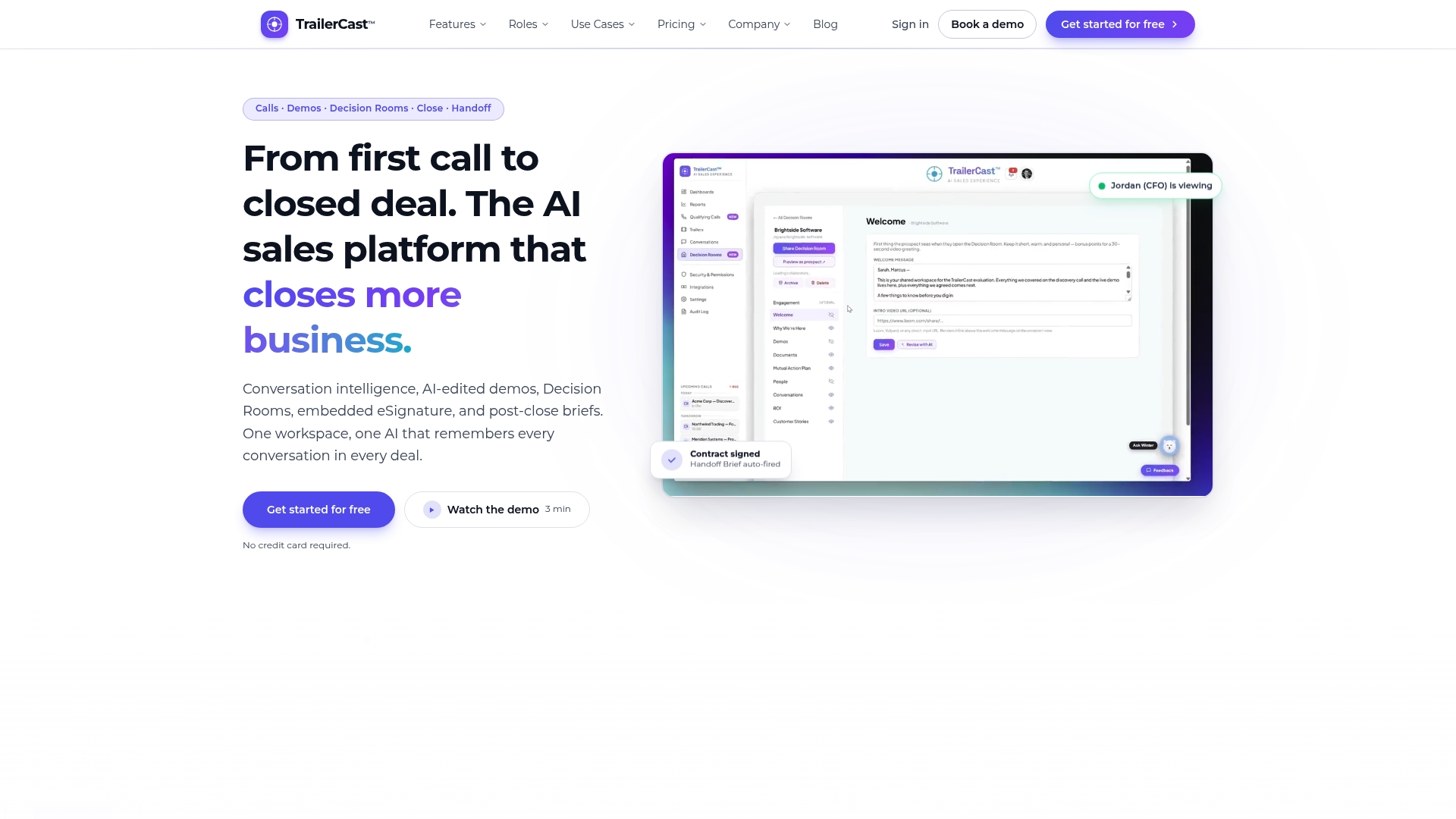
It’s also why we think your objection notes should live with the deal and not in a rep’s head. When the call, the demo, the follow-up and the signature all sit in one workspace, the next person who touches the deal knows what was raised, what was answered, and what is still open.
— Daniel
Put the objections where you can see them
You can’t improve what you don’t track. Pull the last ten lost or stalled deals and tag the objections that appeared in them. You’ll likely find three or four that repeat, and those deserve a written, tested response and a piece of supporting content.
TrailerCast records and summarizes your calls, flags the concerns buyers raise across the whole opportunity, builds role-specific demo trailers for the people who weren’t on the call, and keeps everything in one buyer-facing space. There is one plan with every feature, from $59 per month per seat. You can see how it works on the plan page, or explore AI demo trailers if forwardable follow-up is your biggest gap.
If you want the follow-up itself drafted, our AI demo follow-up tool turns what was said on the call into a personalized email, which is where many objections get answered or ignored.
Common mistakes that sink good scripts
- Answering before clarifying. You solve a problem the buyer doesn’t have, and lose credibility.
- Using “but.” “I understand, but…” cancels the first half of the sentence.
- Reciting the same line to everyone. Role and stage change the meaning.
- Making unsupported promises. Especially on security, compliance and integrations. Say what is documented and route the rest to the right owner.
- Skipping the sweep. If you don’t ask whether anything else is in the way, the second objection arrives after you’ve celebrated.
- Ending without a next step. An answered objection with no calendar date is a stall in waiting.
FAQ
What are the 5 stages of handling objections?
There’s no single official list, and different trainers name them differently. A common version is listen, clarify, respond, confirm, and move forward. The six-beat loop in this article is the same idea with an acknowledgment and a sweep for other concerns added.
How do I handle objections without sounding pushy?
Ask before you answer. A question like “What’s behind that?” shows you care about the concern, not about winning. Then answer briefly, check that it helped, and let the buyer decide the next step with you, not for you.
Should I memorize objection handling scripts?
Memorize the structure and the key evidence, not the wording. Word-for-word recitation sounds canned. Keep a short library of proof points (numbers, customer stories, documents) and phrase them naturally in each conversation.
What if I don’t have a good answer to an objection?
Say so. Tell the buyer you’ll find out, name who will answer, and give a time. For technical, security or legal questions, that is the correct answer anyway, since it routes the question to the person authorized to give it.
Sources
- Handling Objections, Founding Sales handbook
- Customer feedback and revenue growth strategies
- Sales enablement content upkeep