Best Mutual Action Plan Software for B2B Sales in 2026

What’s the best mutual action plan software right now?
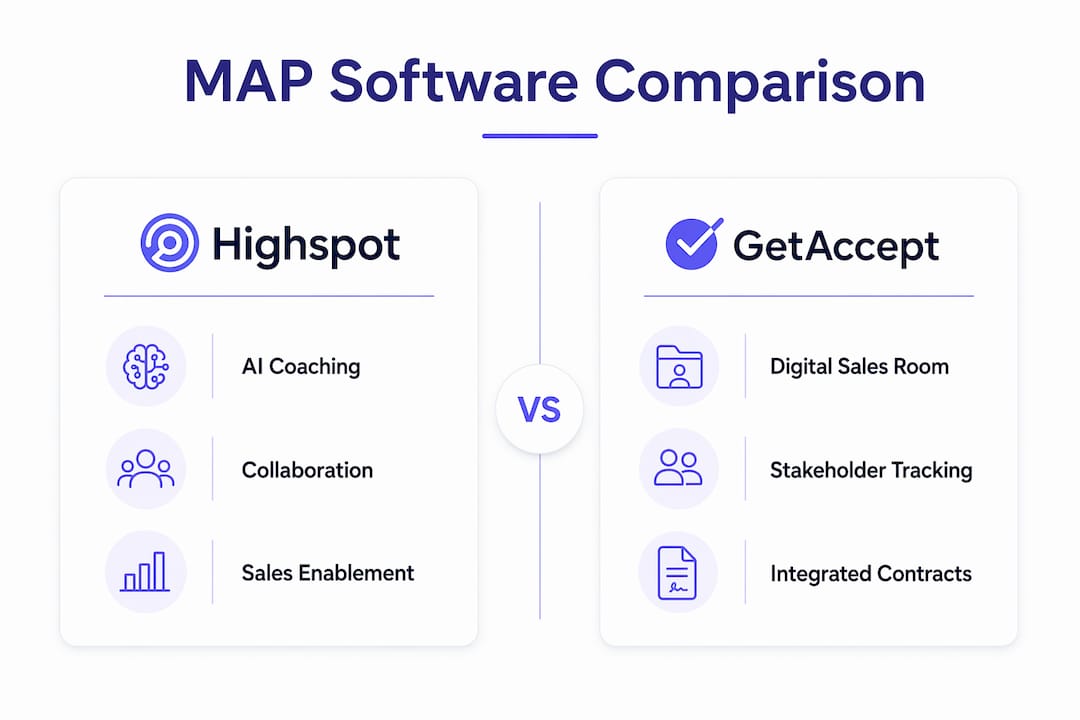
The three platforms that consistently surface for B2B sales teams in the U.S. are Highspot, GetAccept Inc, and Recapped. Each takes a different angle on the same problem: keeping buyers and sellers aligned on shared milestones so deals don’t quietly die between meetings.
| Platform | Core Features | AI and Automation | Collaboration Tools | Sales Enablement | Pricing / Trial | Best For | Rating |
|---|---|---|---|---|---|---|---|
| Highspot | Deal signal analysis, MAP tracking, pipeline forecasting | AI coaching, live deal signals, smart content ranking | Shared workspaces, stakeholder visibility | Content management, playbooks, training | Demo available | Teams needing AI-driven enablement and forecasting | 3.7★ (30 reviews) |
| GetAccept Inc | Digital sales room, proposals, e-signatures, contract management, MAPs | AI deal room, engagement tracking | Client-facing workspaces, comment threads | CPQ, content management, sales engagement | Free trial and demo | All-in-one digital sales process | — |
| Recapped | Deal scoring, playbook standardization, buyer/seller consolidation | AI deal scoring, automation | Shared buyer/seller dashboards | Playbook integration | Free trial and demo (service ends July 31, 2026) | AI-assisted deal scoring and automation | 5★ (2 reviews) |
Highspot holds a Gartner Magic Quadrant Leader position for Revenue Enablement Platforms, which matters if your organization runs formal vendor evaluations. GetAccept covers the widest feature surface of the three, folding mutual action plans directly into its contract lifecycle alongside proposals and e-signatures. Recapped is worth evaluating now if AI deal scoring is your priority, but its announced shutdown on July 31, 2026 makes it a short-term option at best.

How do these platforms compare in depth?
Highspot: AI coaching built around deal signals
Highspot’s MAP functionality sits inside a broader revenue enablement platform, which is both its strength and its scope. The platform analyzes live deal signals to surface which milestones are stalling and which stakeholders haven’t engaged, then feeds that context directly into AI coaching recommendations for reps. If your team runs large, multi-stakeholder deals and needs a single place for content management, playbooks, and MAP tracking, Highspot handles all of it.
The tradeoff is complexity. Highspot is built for enterprise GTM teams, and the implementation footprint reflects that. Smaller sales organizations may find the platform more than they need.
- Deal tracking: Milestone-level visibility with buyer engagement signals
- CRM integration: Native sync with Salesforce and other major CRMs
- AI features: Coaching recommendations, deal scoring, content ranking per deal
- Training support: Built-in enablement and rep onboarding resources
GetAccept Inc: the MAP-to-contract pipeline in one room
GetAccept’s approach is to collapse the entire late-stage sales process into a single digital sales room. A mutual success plan lives alongside the proposal, the pricing table, and the e-signature block, so the buyer never has to context-switch between tools. That continuity matters when you’re managing a buying committee of five or six people who each need different information at different times.

The platform tracks engagement at the stakeholder level, showing you who opened what and when. That data feeds back into the MAP so you can see which milestones are actually moving and which ones are waiting on a stakeholder who hasn’t logged in yet.
Recapped: strong AI, limited runway
Recapped consolidates buyer and seller information into one workspace and applies AI to score deals and standardize playbooks across the team. The deal scoring logic is genuinely useful for forecasting, and the playbook standardization helps newer reps follow proven processes without constant manager oversight. The platform offers a free trial and demo booking.
The hard constraint: Recapped has announced it will shut down on July 31, 2026. If you’re evaluating tools for a multi-year commitment, this one doesn’t qualify. For teams that want to run a short-term pilot or need a bridge solution, it’s still functional today.
How to choose the right mutual action plan software for your team
The category has expanded fast, and the differences between platforms are real. Here’s how to cut through the noise.
Start with your sales motion, not the feature list. A team running 30-day transactional deals has different MAP needs than one navigating six-month enterprise cycles with procurement, legal, and a CFO who joined the deal in month four. The software should match the complexity of your actual buying committees.
Key selection criteria to evaluate:
- Collaboration depth: Can buyers interact directly inside the plan, or are they just receiving a read-only document? Real-time collaboration between buyer and seller is what separates a MAP from a glorified checklist.
- CRM integration: Milestone progress should feed your pipeline automatically. Manual updates don’t survive contact with a busy quarter.
- AI automation: Look for AI that does something specific: deal scoring, MAP generation from call transcripts, or smart task assignment. Generic “AI-powered” labels without a concrete function aren’t worth counting.
- Security and compliance: B2B sales data includes pricing, contract terms, and stakeholder contact information. Verify SOC 2 compliance and data residency options before you sign.
- User adoption: The best MAP tool is the one your reps actually open. Prioritize clean interfaces and mobile access, and ask vendors for onboarding resources before you commit.
One timing consideration that trips up a lot of teams: MAPs work best after real multi-threading has happened, not before. Introducing a shared plan before the buyer has named their internal stakeholders and steps tends to create friction rather than remove it. Train your reps on when to introduce the plan, not just how to fill it out.
Pro Tip: When evaluating software, ask the vendor to show you how a milestone connects to a specific buyer goal and a measurable outcome. Platforms that link milestones to buyer priorities and update dependencies dynamically are the ones that actually move deals forward, not just document them.
MAPs also need to stay alive. A plan built once and never updated loses credibility fast. Look for software that makes updating milestones, reassigning owners, and adjusting timelines easy enough that reps do it without being asked.
What is a mutual action plan, and why does software make it better?
A mutual action plan (MAP) is a shared roadmap between a seller and a buyer that outlines every milestone, owner, and deadline needed to move a deal to close. It’s sometimes called a mutual success plan, a joint execution plan, or a close plan. The “mutual” part is the point: both sides have tasks, both sides have accountability, and both sides can see the full picture.
Why dedicated software beats a spreadsheet or a shared Google Doc:
- Real-time collaboration: Both buyer and seller see updates instantly, with no version confusion or attachment chains.
- Milestone tracking: Progress is visible at the task level, not just the deal stage level, which gives you earlier warning when something is slipping.
- Engagement transparency: Good MAP software shows you who on the buying committee has viewed which sections, so you know where attention is and where it isn’t.
- CRM sync: Milestone completions feed directly into pipeline data, making forecasts more accurate without extra manual entry.
- Templates and repeatability: A mutual action plan template built from your best-performing deals becomes a repeatable playbook, not a one-off document.
- Buyer experience: A clean, branded workspace signals professionalism. Buyers who receive a polished shared plan engage more than those handed a static table over email.
The co-creation dynamic is what makes MAPs effective. When a buyer helps build the plan, they take ownership of their milestones. That ownership is what keeps deals moving through procurement, legal, and executive sign-off without the seller having to chase every step. A MAP imposed on a buyer reads like a closing pressure tactic. A MAP built with a buyer reads like a partnership.
Trailercast covers the space between your MAP and your close
If you’re evaluating dedicated MAP platforms, Highspot and GetAccept are strong choices for their respective use cases. But there’s a gap most MAP tools don’t address: what happens to the deal between the calls, demos, and milestone check-ins.
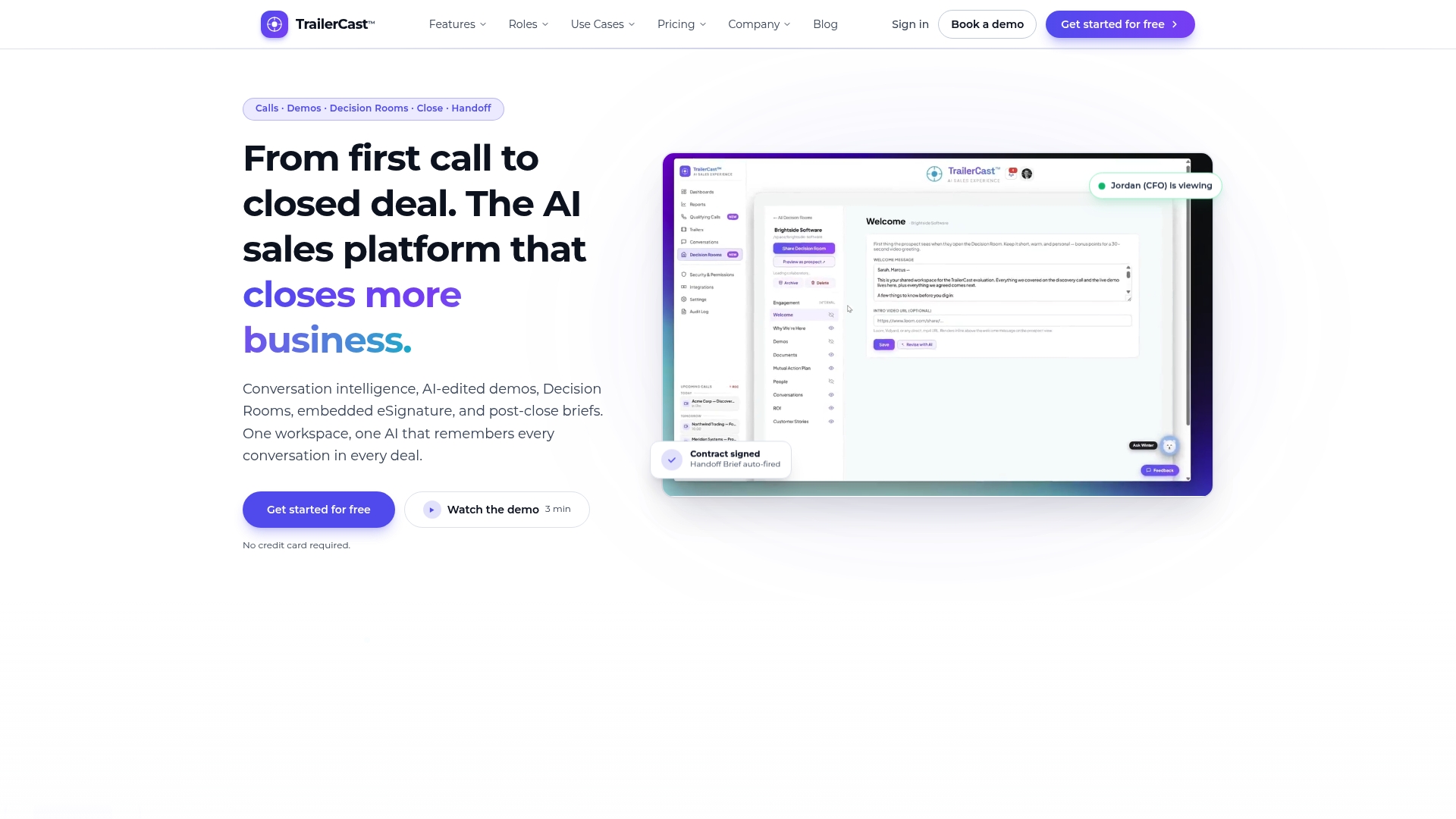
Trailercast is built for exactly that gap. It’s an AI sales platform that runs the full deal lifecycle in one workspace: conversation intelligence, AI-edited demo trailers personalized per stakeholder, a buyer-facing decision room with a built-in mutual action plan section, embedded e-signature, and an automated post-close handoff brief to Customer Success. Your champion gets a CFO-ready trailer to forward, a no-login room where the MAP lives alongside ROI docs and contract terms, and a clear path to signature without hopping between five tools.
Pricing is $79/seat/month (or $59 billed annually), one tier, every feature, no gating. Free trial, no credit card required. For B2B SaaS teams with 3–7 person buying committees, it’s the consolidation play: one AI that remembers every call, demo, and message across the full opportunity, so the deal stays coherent even when you’re not in the room. See the full platform to understand how it fits your current stack.
Key Takeaways
The most effective mutual action plan software connects live buyer engagement data to shared milestones, making both forecasting and deal momentum measurably more reliable.
| Point | Details |
|---|---|
| Top platforms for 2026 | Highspot leads on AI enablement; GetAccept covers the full digital sales room; Recapped is functional but shutting down July 31, 2026. |
| Timing matters for MAPs | Introduce a mutual action plan after multi-threading, not before; premature use creates friction rather than alignment. |
| Keep plans dynamic | Static MAPs lose credibility fast; software that makes milestone updates easy is what keeps plans relevant through close. |
| Selection criteria | Prioritize CRM integration, real buyer collaboration, and specific AI functions over generic feature lists. |
| Trailercast option | Trailercast embeds a mutual action plan inside a full deal lifecycle workspace, covering calls, demos, decision rooms, e-signature, and post-close handoff in one platform. |