24 Point MEDDPICC Checklist for Sales Reps: One Page, CRM Ready

MEDDPICC is an eight-part, evidence-first sales qualification framework that tells you whether a deal is real or just active. Score each element from 0 to 3 based on buyer-confirmed evidence, and the total tells you whether to keep pushing, forecast it, or walk away. Below is a run-after-call checklist, a scoring rubric, and a question bank you can paste into your CRM this week.
TL;DR:
- Sufficient evidence must be documented for each MEDDPICC element, with a score of 3 requiring a direct quote or confirmed document from the buyer.
- A total score of 16 or higher out of 24 indicates a forecastable deal with transparent risks, while scores below 16 suggest critical gaps needing attention.
- Regular updates and evidence collection in your CRM prevent deal score stagnation, with scores unchanged over a month signaling potential neglect.
- The dominant reason for deal failure is procurement delays or unqualified status quo, not the demo or initial pitch stages.
- Tailor your MEDDPICC question depth to deal complexity, using lightweight or comprehensive templates for transactional versus enterprise deals.
Table of Contents
- The Quick MEDDPICC Checklist to Run After Every Call
- What MEDDPICC Is and Why the Two Added Letters Matter
- Scoring Each Element From 0 to 3: What Counts as Evidence
- Turning Your Total Score Into a Forecast Decision
- Sample Questions and Templates by Deal Type
- Keeping MEDDPICC Current in Your CRM and Deal Reviews
- Why Most MEDDPICC Templates Fail Within a Quarter
- How Trailercast Turns MEDDPICC Evidence Into a Living Record
- Sources
- FAQ
The Quick MEDDPICC Checklist to Run After Every Call
Skip the theory for a second. Here’s the version you actually use fifteen minutes after you hang up, while the call is still fresh and before your notes go stale.
For each element, answer one verification prompt, capture the evidence, and assign one next action. Don’t skip the evidence field. A score without a quote behind it is a guess wearing a number.
- Metrics: Did the buyer state a number tied to cost, revenue, or time? Capture the quote, who said it, and the date. Action: confirm the number with a second stakeholder.
- Economic Buyer: Have you spoken to the person who signs the check, or only heard about them? Capture confirmation source and date. Action: get on a call with them directly.
- Decision Criteria: Did the buyer list the specific requirements they’re scoring vendors against? Capture the criteria list and its source. Action: get it in writing.
- Decision Process: Do you know every approval step and who owns each one? Capture the step list and confirming stakeholder. Action: map it against your close date.
- Paper Process: Has legal or procurement named their required steps? Capture the requirement and contact. Action: request the actual paperwork template now.
- Identify Pain: Did the buyer describe a consequence of inaction, not just a wish? Capture the quote. Action: quantify the cost of waiting.
- Champion: Has this person taken a real risk on your behalf yet? Capture what they did and when. Action: ask them to set up the EB meeting.
- Competition: Do you know what they’re comparing you against, including doing nothing? Capture the named alternative. Action: ask directly what else is on the table.
What MEDDPICC Is and Why the Two Added Letters Matter
MEDDPICC descends from MEDDIC, the qualification framework built for enterprise software deals in the 1990s. The core six elements: Metrics (the quantified business impact), Economic Buyer (the person with budget authority), Decision Criteria (how they’ll evaluate vendors), Decision Process (the steps and approvals to get to yes), Identify/Implicate Pain (the problem and its cost), and Champion (an internal advocate who acts on your behalf).
MEDDPICC adds two elements that MEDDIC leaves out, and they’re often what kills deals in the final stretch:
- Paper Process: the legal, security, and procurement steps required to sign, which can add weeks a forecast never accounted for.
- Competition: the alternatives you’re up against, including the most common one: the buyer doing nothing at all.
That distinction matters because deals rarely die in the demo. They die in procurement, or against a status quo nobody bothered to qualify against. This isn’t academic. It’s the difference between a framework built for the discovery call and one built for the entire deal.
Scoring Each Element From 0 to 3: What Counts as Evidence
A 0–3 rubric only works if every rep applies the same standard for what counts as proof. The distinction that matters most is assumed versus confirmed versus evidenced. Assumed means you inferred it. Confirmed means someone told you. Evidenced means you have a quote, a document, or a second-party confirmation you could show your manager without flinching.
-
Metrics. Score 0 if you have no number. Score 1 if the rep estimated impact without buyer input. Score 2 if the buyer gave a number verbally. Score 3 if the number is documented and a second stakeholder confirmed it independently. Red flag: a metric that only your champion has repeated, never the economic buyer. Score-raising question: “What would it cost your business if this problem persists another year?”
-
Economic Buyer. Score 0 if you don’t know who signs. Score 1 if your champion named them but you haven’t engaged. Score 2 if you’ve had a call with them. Score 3 if they’ve confirmed budget and priority directly to you, in writing or on a recorded call. Red flag: a champion who insists “I can get budget approved” without ever naming the person who approves it. Score-raising question: “Who else needs to sign off before this gets funded?”
-
Decision Criteria. Score 0 if criteria are unknown. Score 1 if your champion described them secondhand. Score 2 if the buyer stated criteria directly. Score 3 if you’ve influenced the criteria and it’s documented in an RFP or shared scorecard. Red flag: criteria that suspiciously mirror a competitor’s strengths. Score-raising question: “What does the ideal vendor absolutely have to do that others can’t?”
-
Decision Process. Score 0 if the steps are unknown. Score 1 if you have a rough guess. Score 2 if the buyer outlined the steps. Score 3 if you’ve mapped every approval with names and dates. Red flag: “it usually takes about a month” with no specifics. Score-raising question: “Walk me through every approval this needs to reach signature.”
-
Paper Process. Score 0 if you haven’t asked. Score 1 if your champion guessed at requirements. Score 2 if procurement or legal confirmed requirements verbally. Score 3 if you have the actual redline template or security questionnaire in hand. Red flag: discovering a security review exists during the week you expected to close. Score-raising question: “Can you send me the vendor onboarding or procurement checklist your team uses?”
-
Identify/Implicate Pain. Score 0 if pain is generic. Score 1 if it’s stated but not costed. Score 2 if the buyer quantified the cost of inaction. Score 3 if multiple stakeholders independently confirm the same cost. Red flag: pain articulated only by your champion, never by anyone above them.
-
Champion. Score 0 if no internal advocate exists. Score 1 if someone is friendly but untested. Score 2 if they’ve shared internal information proactively. Score 3 if they’ve taken a real risk, such as introducing you to the economic buyer or presenting your business case internally. Red flag: a champion who’s enthusiastic on calls but never available between them.
-
Competition. Score 0 if you don’t know what you’re up against. Score 1 if your champion mentioned a name. Score 2 if the buyer confirmed the alternatives directly. Score 3 if you know the specific criteria the competition is winning or losing on, including the status quo. Doing nothing is often the real competitor, and it rarely shows up unless you ask.
Pro Tip: Default every element to 0 if you don’t have a buyer quote behind it, even if your gut says higher. A conservative score today is far cheaper than an inflated forecast you have to walk back in front of your VP next month.
Turning Your Total Score Into a Forecast Decision
Once every element has a score, add them up. The total, out of 24, maps to a forecast action rather than just a feeling about the deal.
| Score band | What it means | Recommended action |
|---|---|---|
| 0–3 | Early conversation, not yet a real opportunity | Keep qualifying; don’t add to pipeline forecast |
| 4–15 | Real interest, but critical gaps remain | Work the two lowest scores before advancing stage |
| 16–20 | Forecastable, with named and tracked risks | Include in forecast with explicit risk flags |
| 16–24 | Strong evidence across every element | Commit-level forecast |
The most useful habit here isn’t the math. It’s what you do with your two lowest scores. Say Economic Buyer sits at 1 and Paper Process sits at 0. Don’t write “work EB access” as a task. Write “schedule 20-minute call with CFO Priya Shah by Friday” and “request procurement checklist from IT security contact by Wednesday.” Vague tasks don’t move scores. Named meetings with named people do.
One more rule worth enforcing across the team: date every entry, and score down whenever you’re unsure. A stale score from six weeks ago is worse than an honest zero, because it hides risk instead of surfacing it.
Sample Questions and Templates by Deal Type
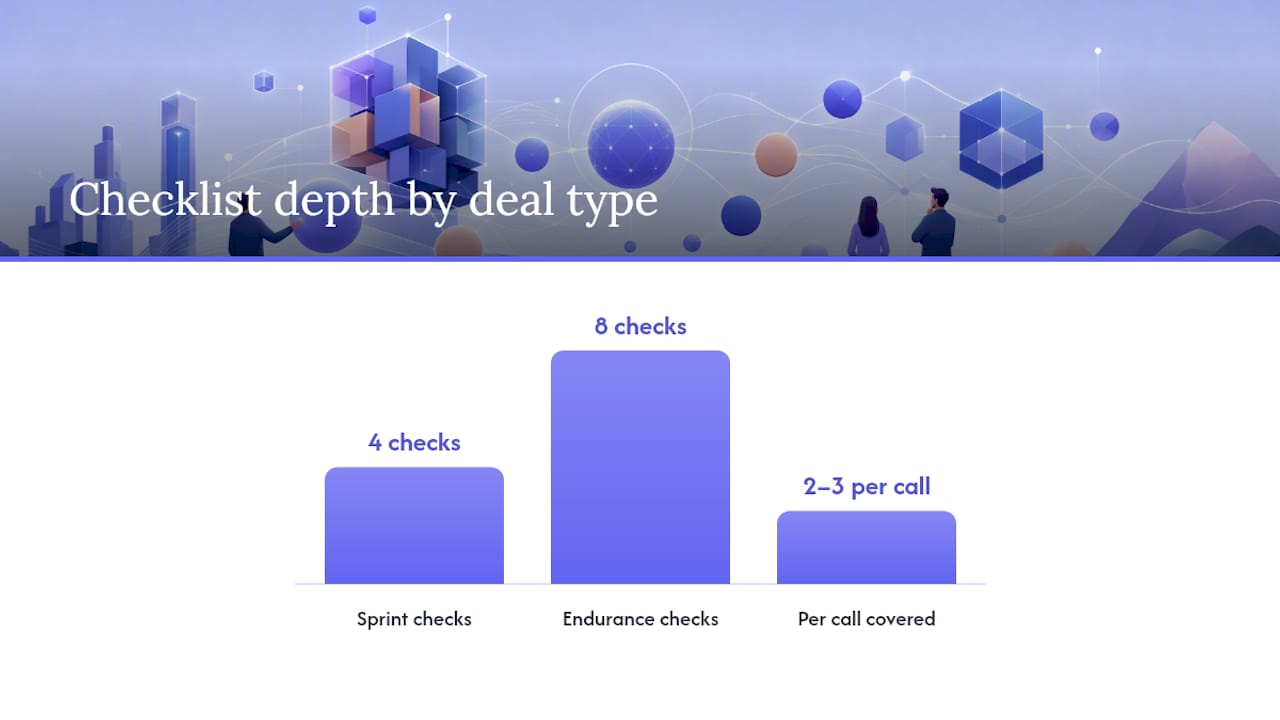
Not every deal needs the full eight-element interrogation on every call, and running it that way will make your buyer feel like they’re being processed rather than heard. Match checklist depth to deal complexity: a lightweight Sprint version for transactional deals, a full Endurance version for enterprise cycles with multiple stakeholders.
Sample questions by element:
- Metrics: “If this problem stayed exactly the same for another 12 months, what would that cost you?”
- Champion: “Would you be comfortable introducing me to your VP this week?”
- Decision Process: “Has your team bought software like this before? What slowed that down last time?”
- Paper Process: “Does your security team review every new vendor, or only ones above a certain contract size?”
- Competition: “What happens if you decide not to buy anything at all this quarter?”
A larger question bank exists if you want more variety, but the real test of a champion isn’t how many questions you ask them. It’s whether they’ll introduce you to the economic buyer, present your business case internally, and tell you honestly what happens if the project doesn’t get funded.
- Sprint template (4-5 checks): Metrics, Champion, Decision Process, Competition. Use for deals under a quarter’s typical sales cycle or low seat counts.
- Endurance template (full eight): Every element scored and dated, revisited at each stage gate. Use for multi-stakeholder, multi-quarter enterprise cycles.
Cover two or three elements per call at most. Pain and Champion belong early. Paper Process and final Economic Buyer reconfirmation belong late, once trust is established.
Keeping MEDDPICC Current in Your CRM and Deal Reviews
A checklist that lives in a spreadsheet nobody opens after week two isn’t a checklist. It’s a formality. The fix is structural: build MEDDPICC into the fields your team already touches, not a separate document they have to remember exists.
Your CRM should capture, per element: the 0–3 score, an evidence field requiring a direct buyer quote or document, a date stamp, a named next step, and an owner. That’s it. Five fields, applied consistently, beat a beautifully designed template nobody updates.
Deal reviews should spend most of their time on the two lowest-scoring elements, not a full recitation of all eight. Ask what evidence changed since last review, and require a dated, named remediation step before the deal advances stage. Embedding this into weekly deal reviews and CRM stage gates is what actually keeps scores honest, rather than treating them as a one-time snapshot from the first discovery call.
A few automation habits pay off fast:
- Flag any score untouched for more than roughly 30 days for mandatory re-verification.
- Require an attachment or transcript link before allowing a score above 2 on Metrics or Decision Criteria.
- Version each score change so managers can see drift, not just the current number.
Pro Tip: If a deal’s MEDDPICC score hasn’t changed in over a month, that’s not stability. It’s usually a sign nobody has talked to the buyer with anything substantive to report. Treat a frozen score as a red flag, not a green light.
Getting the evidence into that CRM record consistently is its own challenge, particularly when proof lives scattered across call recordings, emails, and shared docs. A tool like Trailercast’s deal room approach can help centralize that evidence so it’s attached to the deal instead of buried in someone’s inbox.
Why Most MEDDPICC Templates Fail Within a Quarter
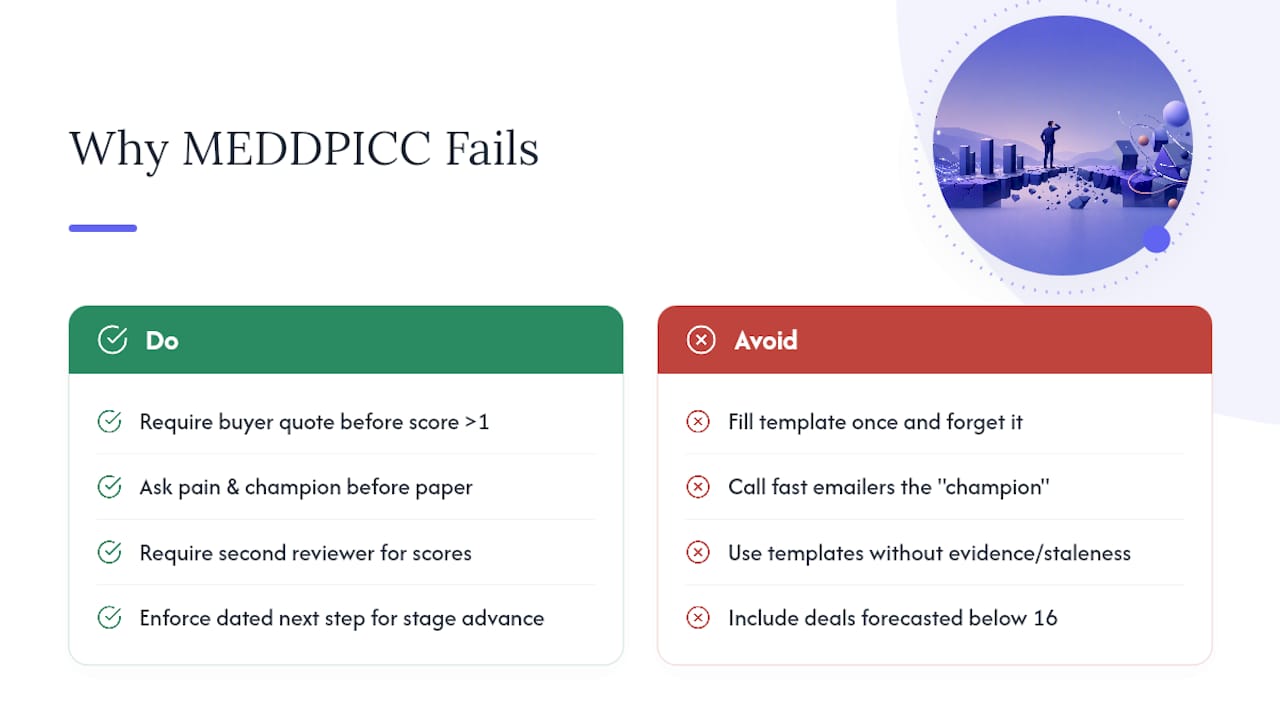
The template rarely fails because the framework is wrong. It fails because reps fill it in once during onboarding and never touch it again, or because “champion” gets applied to anyone who answers emails quickly. A manual template without a required evidence field or an automated staleness check tends to break down within about three months, which tracks with what I’ve seen in most pipelines: initial enthusiasm, then quiet drift.
The fix isn’t more discipline. It’s fewer places to hide. Require a buyer quote before any score above 1, sequence your questions so pain and champion come before paper process, and never let a rep self-score without a second set of eyes in deal reviews. For managers, the enforcement checklist is short: no score without evidence, no stage advance without a dated next step, no forecast inclusion below a 16.
— Daniel
How Trailercast Turns MEDDPICC Evidence Into a Living Record
Most MEDDPICC scores die of neglect because the proof lives in five different places: a call recording nobody rewatches, a Slack thread, a forwarded PDF, a verbal promise from procurement. Trailercast keeps that evidence attached to the deal itself, not scattered across tools.
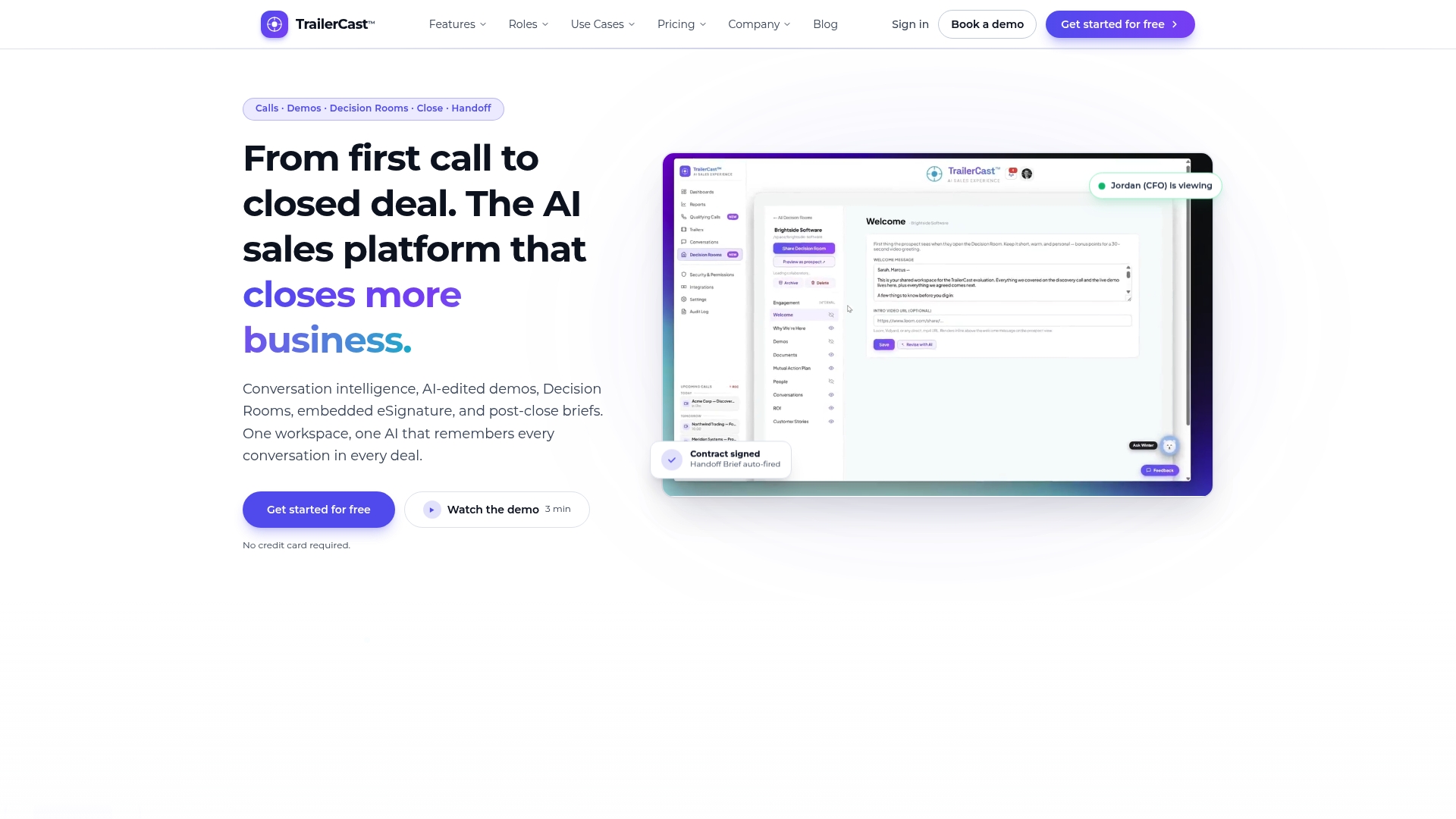
Every call gets transcribed and summarized automatically, so a Metrics quote or a Paper Process requirement is searchable instead of buried in a recording. Your Decision Room becomes the single place where champions, economic buyers, and procurement contacts interact, which means Champion and Decision Process evidence gets documented as it happens instead of reconstructed from memory during a deal review. Embedded eSignature closes the loop on Paper Process directly inside the same workspace, shortening the gap between “criteria confirmed” and “contract signed.” If you want to see how transcripts, decision rooms, and closing tools work together in one place, start a trial at Trailercast and run your next deal review with evidence that’s actually there when you need it.
Sources
- MEDDPICC template · Nimitai
- Free MEDDPICC Template + Scoring Guide · Backdrop
- MEDDPICC checklist · Federico Presicci
- MEDDPICC sales methodology · DemandFarm
FAQ
What Is MEDDPICC Scoring and How Is It Used?
MEDDPICC scoring assigns each of the eight elements a value from 0 to 3 based on buyer-confirmed evidence, then totals them to guide forecast decisions and reveal exactly which parts of a deal still need work.
What Is MEDDPICC vs. MEDDIC?
MEDDIC covers six elements: Metrics, Economic Buyer, Decision Criteria, Decision Process, Identify Pain, and Champion. MEDDPICC adds Paper Process and Competition to catch the procurement friction and competitive risk that often sink deals late in the cycle.
What Does MEDDPICC Stand For?
MEDDPICC stands for Metrics, Economic Buyer, Decision Criteria, Decision Process, Paper Process, Identify/Implicate Pain, Champion, and Competition.
How Much Does It Cost to Get Certified in MEDDPICC?
Certification pricing varies by provider and program level, and specific current rates aren’t publicly listed here; check directly with the certifying organization for its current course and certification fees.
How Many MEDDPICC Questions Should I Ask Per Call?
Cover two or three elements per call rather than all eight at once. Sequence pain and champion questions early in discovery, and save paper process and final economic buyer confirmation for later stages to avoid making the call feel like an interrogation.