Gong Coaching for Sales Managers: A Practical Guide

Quick disambiguation before we dive in: if you searched “gong coaching” and landed here expecting sound bath sessions or gong meditation, this article is about something different. Gong (the conversation-intelligence platform) uses AI to surface coachable moments from sales calls, tie them to deals, and gives managers a repeatable system for improving rep performance at scale.
The one-sentence verdict: Gong coaching turns recorded sales conversations into a measurable, manager-led coaching operation where every rep gets specific, evidence-backed feedback tied to real deals.
Here’s what you need to know right now:
- Gong captures and transcribes every call, then flags coachable moments automatically using AI signal detection.
- Gong Complete Coaching bundles scorecards, playlists, self-review, and peer coaching into a single coaching management layer.
- Trailercast is worth evaluating if you want conversation intelligence plus demo trailers, decision rooms, and post-close handoff in one workspace, covered in the promo section below.
Three things to do this week: enable call recording and transcription, define one scorecard with three to five behaviors, and schedule your first 15-minute clip-based 1:1 with a rep.
Table of Contents
- What Gong’s coaching features do in practice
- How Gong surfaces coaching moments you can actually use
- How to set up Gong coaching in week 1, month 1, and 90 days
- Three reproducible coaching playbooks you can run next week
- What to measure and how to prove coaching impact
- Common adoption pitfalls and how to avoid them
- What “How Gong Uses Gong” teaches you about running this internally
- Trailercast covers the coaching problem and the whole deal
- Key Takeaways
- What actually moves the needle in coaching programs
- Useful sources and product docs to review next
What Gong’s coaching features do in practice
Gong’s coaching features organize into four distinct modes, and understanding which one to reach for first saves you weeks of setup confusion.
Manager-led coaching is the core. You pull a clip, attach a scorecard, leave timestamped comments, and the rep gets a notification. The feedback is anchored to a real moment in a real call, not a vague post-call debrief. That specificity is what separates it from traditional ride-alongs.

Self-coaching lets reps review their own calls before a manager ever weighs in. A rep scores themselves against the same rubric you use, which surfaces self-awareness gaps fast. When a rep rates their discovery questions a 4 and you rate them a 2, that delta becomes the coaching conversation.
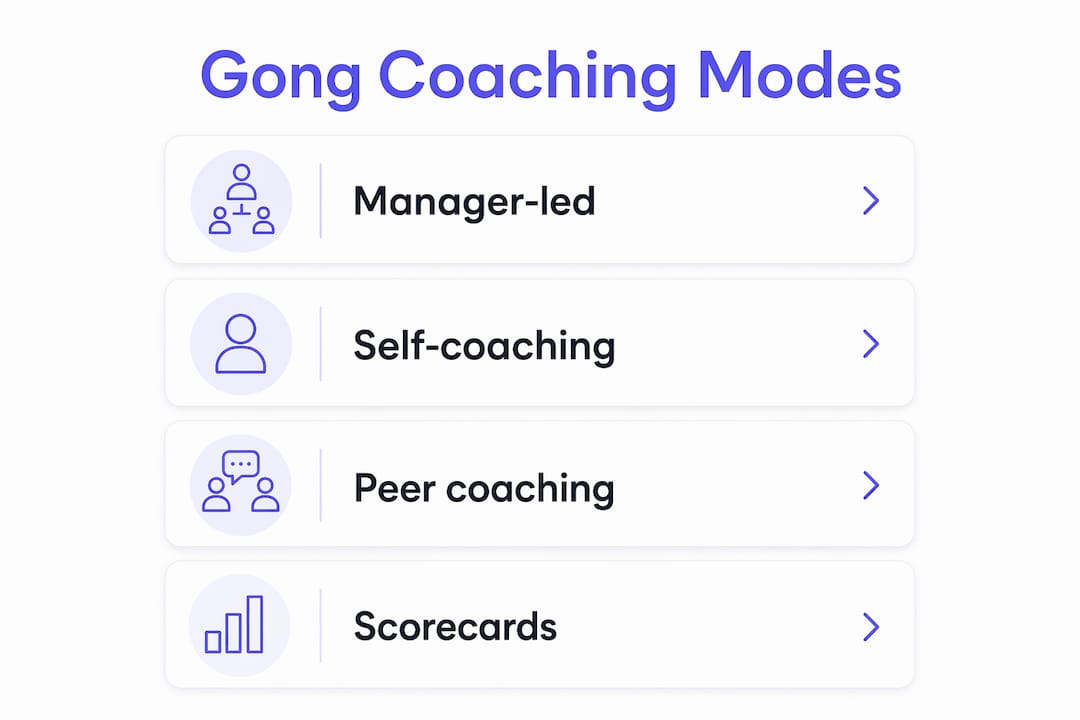
Peer coaching works through playlists. You curate a set of clips, say five examples of strong objection handling, and reps review them asynchronously. It scales 1:many without requiring a manager to be in every session.
Scorecards and calibration are the measurement backbone. Each scorecard ties behaviors (e.g., confirmed next step, pricing discussed, competitor mentioned) to a numeric rating. Calibration sessions, where two or more managers score the same call independently, keep the rubric honest.
Gong also includes Smart Trackers, which are keyword and phrase monitors that flag calls containing specific terms, like a competitor name or a pricing objection, automatically.
| Feature | Primary use case | Who runs it |
|---|---|---|
| Manager-led coaching | Targeted skill feedback on specific calls | Sales manager |
| Self-coaching | Rep self-awareness and pre-1:1 prep | Individual rep |
| Peer coaching via playlists | Asynchronous group skill practice | Manager or enablement |
| Scorecards | Objective, trackable skill measurement | Manager + calibration group |
| Smart Trackers | Automated signal monitoring across all calls | RevOps or manager |
Pro Tip: Start your pilot with one scorecard and a single Smart Tracker before enabling playlists. Managers who try to run all five features simultaneously in week one almost always stall on adoption. Nail the scorecard first, then layer in playlists at the 30-day mark.
How Gong surfaces coaching moments you can actually use
The detection pipeline runs in a specific sequence: meeting capture, speaker-by-speaker transcription, NLP signal modeling, and then routing into playlists, scorecards, or deal-risk alerts.

Natural language processing is the engine underneath. Gong’s models parse transcripts for patterns that correlate with deal outcomes, not just keywords. That distinction matters because a rep who says “let me check on pricing” and one who says “our pricing starts at” are in very different conversations, and the model treats them differently.
Signals Gong typically detects include:
- Talk-listen ratio (how much the rep talked vs. the prospect)
- Objection types (pricing, timing, competitor, internal priority)
- Competitor mentions (flagged by name when a tracker is configured)
- Next-step clarity (whether a concrete follow-up was confirmed)
- Pricing discussion (when and how pricing was introduced)
- Question quality (open vs. closed questions in discovery)
Managers see three main clip types in their coaching queue: coachable moments (behaviors that need correction), strong moments (examples worth sharing), and deal-risk flags (calls where a deal signal suggests intervention is needed).
Gong’s coaching materials frame coaching as measurable and tied to deals. Coaching moments are surfaced and then organized into playlists and scorecards so coaching can be tracked as an ops metric, not just a manager habit.
One calibration note: AI signal detection is accurate enough to prioritize your review queue, but it is not a replacement for manager judgment. Expect to dismiss a significant portion of flagged moments as false positives in the first month. That ratio drops as you tune your trackers.
How to set up Gong coaching in week 1, month 1, and 90 days
You can have a functional coaching program running within five business days. The minimal viable setup is recordings on, one scorecard live, and one manager doing one clip review per rep per week.
| Phase | Actions | Owner | Success criteria |
|---|---|---|---|
| Week 1 | Enable recording + transcription; define 1–2 scorecards; select pilot pod (4–6 reps); set feedback visibility (private by default) | Sales manager + RevOps | First scored call delivered within 5 days |
| Month 1 | Calibrate scorecards with a second manager; create first playlist; train managers on playback and rubric; connect CRM for deal tie-ins | Manager + enablement | 80% of pilot reps have at least one scored call |
| 90 days | Expand scorecards to full team; run monthly calibration sessions; define KPI baselines; automate weekly report distribution | RevOps + sales leadership | Coaching coverage metric tracked in dashboard |
A few integration notes worth flagging. CRM sync (Salesforce or HubSpot) ties coaching activity to pipeline stages, so you can see whether coached reps are converting at a higher rate in specific stages. Calendar integration with Google or Microsoft handles auto-scheduling so no call is missed. For teams that want a no-install recording option, browser-based capture removes the friction of a desktop app entirely.
Slack or email notifications for new coaching feedback keep reps engaged without requiring them to log in daily. Set these up in week one, or feedback will sit unread.
Three reproducible coaching playbooks you can run next week
These three playbooks deliver skill practice, self-awareness, and peer accountability respectively. Each one is timeboxed, repeatable, and requires nothing beyond what Gong already captures.
Playbook 1: The 15-minute manager 1:1
Preparation: Pick one clip (2–4 minutes), select one scorecard behavior to focus on, and write two questions before the meeting.
- Send the clip to the rep 24 hours in advance with a note: “Watch this before we meet. Think about how you handled the objection at 4:12.”
- Open the 1:1 with: “What did you notice about that moment?”
- Share your score and your reasoning (2 minutes).
- Ask: “What would you do differently?” (3 minutes).
- Agree on one specific behavior to practice in the next three calls.
- Log the score in the scorecard before the meeting ends.
The whole session runs 12–15 minutes. The rep leaves with one concrete behavior to work on, not a list of five.
Playbook 2: Rep self-review
Preparation: Rep selects three calls from the past two weeks, scores each against the active scorecard, and writes a 5-minute reflection.
- Rep reviews calls independently and scores each behavior.
- Rep submits the scored scorecard and a written reflection to the manager before their 1:1.
- Manager reviews the self-scores before the meeting and notes any gaps versus their own assessment.
- The 1:1 opens with the delta, not a recap of the call.
This playbook cuts manager prep time in half and surfaces blind spots faster than any other format.
Playbook 3: Peer playlist session
Preparation: Manager curates a playlist of 4–6 clips illustrating a specific skill (e.g., handling a “we’re happy with our current vendor” objection).
- Two to four reps review the playlist asynchronously (30 minutes each).
- Each rep scores at least two clips using the shared scorecard.
- Group meets for 30 minutes to compare scores and discuss the best response they heard.
- Manager captures the consensus “best practice” in a written note and pins it to the playlist.
The playlist becomes a living training asset. New reps onboard against it, and the group calibration session keeps the standard current.
What to measure and how to prove coaching impact
Prioritize activity metrics first, then outcome metrics. You need to prove the program is running before you can prove it is working.
Activity metrics (track from day 1):
- Coaching coverage: meetings reviewed per rep per week
- Adoption: percentage of reps who completed at least one self-review per month
- Manager consistency: number of scored calls per manager per week
Outcome metrics (track from 30 days):
- Skill-score delta: change in scorecard ratings over 30/60/90 days
- Stage conversion rate for coached vs. uncoached reps
- Average deal size and sales cycle length by coaching cohort
| Metric | Baseline | 30 days | 60 days | 90 days |
|---|---|---|---|---|
| Coaching coverage (calls/rep/week) | — | 1 | 2 | multiple calls per week |
| Avg. scorecard rating (1–5 scale) | Measure and record | positive improvement | positive improvement | positive improvement |
| Stage 2→3 conversion rate | Measure and record | Track | Track | Compare vs. baseline |
| Self-review adoption | none | notable adoption | increasing adoption | widespread adoption |
For ROI, use this formula: (incremental revenue from conversion lift × gross margin) minus coaching program cost = net coaching ROI. Example: if a team of several reps improves stage 2-to-3 conversion on a sizable average deal size with multiple opportunities per rep per quarter, that can generate substantial incremental pipeline each quarter. Subtract the platform cost and manager time, and the math is usually favorable within 90 days.
One statistical caution: do not declare impact from a sample of fewer than 20 coached calls per rep. Skill-score improvements in the first two weeks often reflect rep familiarity with the rubric, not actual behavior change. Wait for 30 days of consistent data before drawing conclusions.
For teams that want automated QBR brief preparation tied to coaching data, that workflow saves significant prep time at the quarterly review.
Common adoption pitfalls and how to avoid them
Most coaching programs stall for three reasons: too many signals, an unclear rubric, and feedback delivered in a way that feels punitive rather than developmental.
Problem → Fix:
- Signal overload: Managers get 40+ flagged moments per week and stop reviewing them. Fix: configure Smart Trackers to surface only three coachable behaviors per rep per week. More is not better.
- Vague rubric: Reps score themselves a 4 and managers score them a 2 with no shared definition. Fix: write one behavioral anchor per score level before you launch. “A 3 means the rep confirmed a specific next step with a date. A 2 means they said ‘I’ll follow up.’”
- Feedback as surveillance: Reps disengage when coaching feels like monitoring. Fix: set feedback to private by default, share only with the rep and their direct manager, and frame every session as “here’s what I heard, what do you think?”
- Low-quality clips: A 45-minute call with no clear moment is not a coaching asset. Fix: require managers to timestamp the specific moment in every clip they share. No timestamp, no submission.
- Privacy and access concerns: Legal and HR teams sometimes flag recording policies. Fix: set role-based access so only managers and the rep can see individual feedback. A quick legal review of your recording consent language is a one-time checklist item, not an ongoing blocker. Review your security and access settings before the pilot launches.
Manager rubric template (copy this):
| Behavior | 1 (Needs work) | 3 (Meets standard) | 5 (Exceeds) |
|---|---|---|---|
| Discovery question quality | Mostly closed questions | Mix of open and closed | All open, prospect-led |
| Next-step confirmation | No next step set | Next step mentioned | Specific date + owner confirmed |
| Objection handling | Deflected or ignored | Acknowledged and addressed | Acknowledged, reframed, confirmed |
What “How Gong Uses Gong” teaches you about running this internally
Gong used its own platform to scale coaching internally and tie coaching moments directly to business outcomes. The internal case and the Complete Coaching announcement both point to the same operational pattern: centralized visibility, consistent rubrics, and coaching tied to pipeline data.
Three takeaways you can copy directly:
- Tie coaching to deal stages, not just call quality. Gong’s internal teams reviewed calls in the context of where the deal was in the pipeline. A discovery call coaching session looks different from a late-stage negotiation review. Segment your playlists by stage.
- Make coaching coverage a leadership metric. Gong tracked how many reps received coaching each week as a management KPI, not just a nice-to-have. If your VP of Sales is not asking about coaching coverage in the weekly pipeline review, it will not happen consistently.
- Use the platform’s own data to coach the coaches. Manager calibration sessions, where two managers score the same call and compare, are how Gong kept its rubrics honest over time. Schedule one calibration session per month per team.
The Complete Coaching announcement positioned centralized coaching visibility as the primary value driver for enterprise sales leaders. The internal use case validates that framing: when coaching is tracked like pipeline, it gets treated like pipeline.
Trailercast covers the coaching problem and the whole deal
If you are evaluating whether a single workspace can replace your current coaching tool plus your demo tool, deal room, and post-close handoff, Trailercast is built for exactly that consolidation.
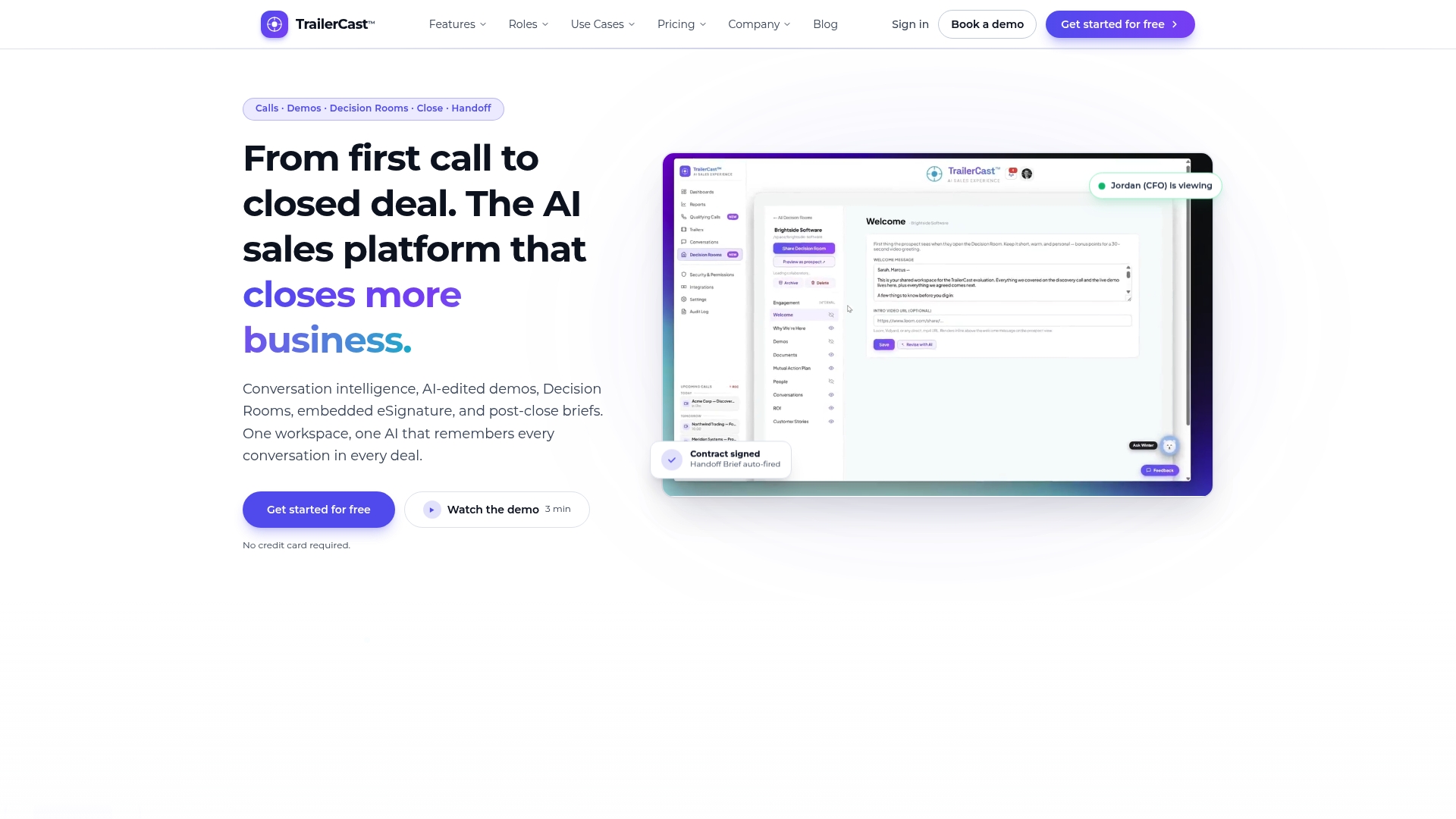
Where Gong focuses on the call layer, Trailercast follows the full deal. Conversation intelligence captures and transcribes every call. The AI then auto-edits the demo into a branded trailer your champion can actually forward to the CFO who missed the call. A decision room holds the mutual action plan, ROI summary, and stakeholder thread. And when the contract signs, an AI Handoff Brief fires to Customer Success automatically.
| Capability | What Trailercast does |
|---|---|
| Conversation capture | AI notetaker on Zoom, Meet, Teams; speaker-by-speaker transcription |
| Clip and trailer creation | AI-edited demo trailers, personalized per stakeholder |
| Deal room and playlisting | Buyer-facing decision rooms with engagement analytics and content library |
| CRM and pipeline tie-ins | Deal Brief spans every call; pipeline and QBR reporting built in |
| Cost per seat | $59/seat/month billed annually; one tier, no feature gating |
Pricing is publicly listed at $59/seat/month annually, with a free trial and no credit card required. The first 100 paid teams lock in 20% off for the life of the account.
If you want to see how it maps to your current stack, start a free trial at Trailercast or review the full feature breakdown before your next planning cycle.
Key Takeaways
Gong coaching works when you treat it as an operational system, not a feature you turn on: one scorecard, consistent coverage, and metrics tied to pipeline outcomes are what separate programs that stick from ones that fade.
| Point | Details |
|---|---|
| Start with one scorecard | Define three to five behaviors with behavioral anchors before your pilot launches. |
| Run three playbooks | Manager 1:1, rep self-review, and peer playlist sessions cover the full coaching spectrum. |
| Track activity before outcomes | Measure coaching coverage and adoption in weeks 1–4 before drawing conclusions on conversion lift. |
| Calibrate monthly | Two managers scoring the same call once a month keeps your rubric honest and your scores comparable. |
| Trailercast consolidates further | For teams that want conversation intelligence plus demo trailers, deal rooms, and post-close handoff in one workspace, Trailercast offers a single-tier, no-gating alternative at $59/seat/month annually. |
What actually moves the needle in coaching programs
Most managers who struggle with coaching programs are measuring the wrong thing. They track talk-time ratios and call scores, then wonder why quota attainment does not move. The problem is that talk-time is a proxy metric, not a behavior. A rep with a 40% talk ratio who never confirms a next step is not a better rep than one who talks 55% of the time and always leaves with a specific commitment.
The managers I have seen run the most effective programs share one habit: they do a 15-minute clip-based 1:1 every single week, without exception. Not a monthly review. Not a quarterly calibration. Weekly, one clip, one behavior. The cadence is what compounds. A rep who gets 50 specific, evidence-backed coaching moments in a year improves in ways that quarterly reviews simply cannot replicate.
The other thing worth saying plainly: coaching programs fail when managers treat them as an HR exercise rather than a revenue lever. If your VP of Sales is not asking “what is our coaching coverage this week?” in the same breath as “what is our pipeline coverage?”, the program will drift. Tie the metric to the pipeline review and it will get done.
Useful sources and product docs to review next
These are the resources worth bookmarking before you configure anything:
- Gong Help Center: Introduction to Coaching — The official product documentation for scorecards, playlists, and coaching moments. Read this before your week-one setup to avoid configuring features in the wrong order.
- WebMD: What Is a Sound Bath? — If colleagues or reps search “gong coaching” and land on sound bath content, this is the kind of result they are finding. Worth knowing so you can point them to the right docs.
- Healthline: Gong Baths — Another high-ranking result for the same keyword. Useful context for why disambiguation matters when you are sharing resources internally.
- Mindworks: What Is Gong Meditation? — Explains the sound-healing practice that shares the keyword. Helpful for anyone who wants to understand why the search results are split between two completely different topics.
- Trailercast conversation intelligence page — If you are evaluating Gong alternatives for a smaller team or a consolidated stack, this page maps the capability comparison directly.