Best GetAccept Alternatives for B2B SaaS Teams (2026)

If your team runs multi-stakeholder deals with 3 or more buyers involved, a full deal-lifecycle AI platform is the right replacement for GetAccept. If your needs stop at document creation and eSignature, a focused proposal or eSignature tool will serve you better and cost less.
Here’s the honest split:
- Full deal-lifecycle AI platform (Trailercast): best for B2B SaaS teams with a small to medium number of employees and multiple stakeholders per deal, and a need for conversation intelligence, AI demo video, buyer-facing decision rooms, and post-close handoffs in one workspace.
- Proposal/eSignature tool (PandaDoc, Proposify, DocuSign): best when your process starts at the proposal stage and you don’t need to track what happens between calls. Teams that primarily need eSignatures or simple proposals can save real cost by choosing a focused tool.
Decision signals to check before you read further:
- More than 3 stakeholders per deal? You need between-call engagement tracking, not just a signed PDF.
- Losing deals in internal meetings you weren’t part of? That’s a deal-room and champion-enablement gap, not a signature gap.
- Paying for conversation intelligence AND a deal room as separate tools? That’s the consolidation signal.
- CRM sync breaking your pipeline hygiene? Ask every vendor specifically about bidirectional CRM sync before you commit.
Table of Contents
- How do GetAccept alternatives actually compare?
- How to pick the right alternative for your team
- Key Takeaways
- What most teams get wrong when switching platforms
- Trailercast covers the full deal lifecycle in one place
- Useful sources for deeper research
How do GetAccept alternatives actually compare?
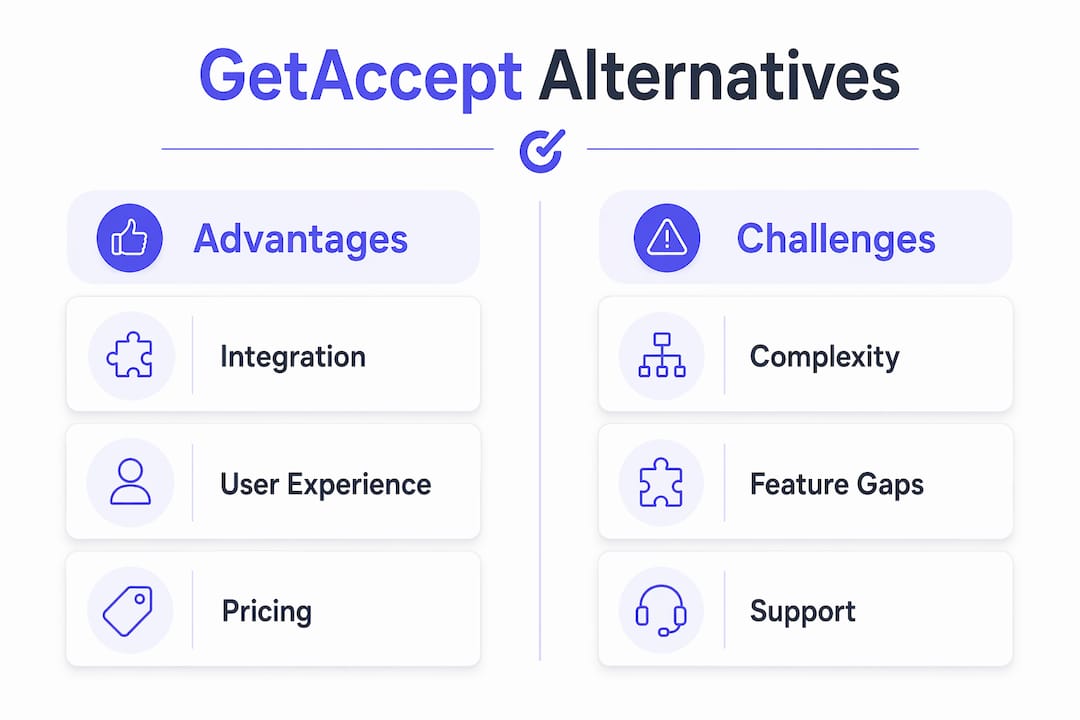
GetAccept’s architecture separates deal rooms and contract rooms, which creates friction for teams that want one continuous workspace from first call to signed contract. That’s the core gap most teams are trying to close.
A common misconception is treating eSignature capability as full sales enablement. Real enablement tracks stakeholder engagement between calls and keeps deal momentum alive when your champion walks back to a CFO who wasn’t on the demo.
| Dimension | Trailercast | Proposal/eSign tools (e.g., PandaDoc, Proposify) | DocuSign |
|---|---|---|---|
| Deal lifecycle coverage | Calls → Demos → Decision Rooms → Close → Handoff | Proposal creation and signing only | Contract execution only |
| AI features | Conversation intelligence, moment detection, AI-edited demo trailers, AI handoff briefs | Template suggestions, basic content AI | Minimal; contract analytics at enterprise tier |
| Buyer-facing experience | Branded no-login decision rooms, per-stakeholder engagement analytics, champion attribution tree | Proposal viewer with open/view tracking | Document viewer; no deal-room layer |
| eSignature / negotiation | Embedded in-app; no third-party hop | Native eSign included | Core product; deep audit trail |
| CRM & calendar integrations | Auto-log to HubSpot and Salesforce; Google/Microsoft calendar auto-scheduling | HubSpot, Salesforce connectors; varies by tier | Salesforce-native; broad connector library |
| Pricing & trial | — | Freemium to mid-market tiers; trial available | Per-envelope or seat pricing; trial available |
| Best fit | B2B SaaS, 11–200 employees, multi-stakeholder deals | SMB to mid-market, document-first workflows | Enterprise legal/ops teams, high-volume contracts |
Vendor snapshots:
- Trailercast replaces five disconnected tools with one AI workspace: conversation intelligence, AI-edited demo trailers, branded decision rooms, embedded eSignature, and post-close handoff briefs. One AI follows the entire deal, not just the call.
- PandaDoc is a document management platform built around creating, approving, tracking, and signing proposals. Strong template library and CRM connectors make it a solid document-first choice.
- Proposify focuses on proposal design and approval workflows. It fits teams whose primary bottleneck is proposal creation speed and brand consistency, not stakeholder engagement between calls.
- DocuSign is the category-defining eSignature platform. It excels at high-volume contract execution and audit trails. It is not a sales enablement tool.
Where the differentiators actually live:
- Trailercast’s AI-edited demo trailers auto-cut the 8–15 minutes that mattered from a full demo recording, personalized per stakeholder. Your CFO gets a pricing-focused trailer; your CISO gets a security-focused one.
- DocSend-style per-page engagement analytics (time on page, scroll depth) are rare in digital sales rooms. Trailercast’s decision rooms track per-stakeholder activity across every touchpoint.
- Advanced AI features are frequently gated behind enterprise tiers across most platforms. Trailercast ships every feature in one tier with no AI quota gating.
How to pick the right alternative for your team
RevOps leaders recommend mapping your current stack before deciding whether you need a direct replacement or a consolidation play. Map your use cases across calls, demos, proposals, negotiation, and handoff first. Then score each gap.
Priority criteria (score each 1–3):
- Deal complexity: how many stakeholders, how many internal approvals?
- AI needs: do you need call transcription, demo editing, or just document AI?
- CRM depth: is bidirectional sync a hard requirement or a nice-to-have?
- Security/compliance: HIPAA, GDPR, SSO, or custom DPA required?
- Pricing predictability: can you absorb per-envelope or usage-based overages?
- Time-to-first-value: do you need live in two weeks or can you absorb a six-week implementation?
Questions to ask every vendor:
- Is bidirectional CRM sync included in the base tier, or is it an enterprise add-on?
- Which AI features are gated, and what are the usage limits?
- Can deal rooms and contract rooms live in the same workspace, or are they separate products?
- What does post-close handoff look like? Is it automated or manual?
- What’s the API rate limit, and how does it affect high-volume CRM syncs?
Red flags to walk away from:
- Hidden AI quotas that only appear after you’ve signed
- Core CRM integrations sold as enterprise add-ons
- Separate deal room and contract room products requiring two logins
- No post-close workflow or handoff automation
- “All-in-one” positioning that breaks down when you ask about specific AI features
Migration checklist:
- Export all active deal data, templates, and signed contracts from GetAccept (allow a few business days).
- Map field relationships between your current tool and your CRM before touching any integration settings.
- Run a sample record sync with some test records before connecting production data.
- Scope your pilot to a small group of reps on several active deals, not your entire team.
- Set a 30-day measurement window with clear success metrics: time-to-close, stakeholder engagement rate, and handoff friction score.
- Build a rollback procedure before go-live. Deep CRM bidirectional syncs can take weeks if not scoped correctly.
Pro Tip: Treat CRM sync as a mini-implementation: include API quota checks, field-mapping verification, sample record syncs, and a documented rollback procedure in your pilot scope. Skipping this step is the single most common reason pilots stall at week three.
If you’re evaluating tools that feed pipeline into your new platform, AI prospecting tools that automate early-stage outreach pair well with a deal-lifecycle platform handling everything from first call onward.

Key Takeaways
The right GetAccept alternative depends on deal complexity, not feature count. Teams running multi-stakeholder B2B deals need a full deal-lifecycle platform; teams with document-first workflows need a focused proposal or eSignature tool.
| Point | Details |
|---|---|
| Match tool to deal complexity | Multi-stakeholder deals (3+ buyers) need conversation intelligence and decision rooms, not just eSignature. |
| Watch for hidden costs | Advanced AI and CRM integrations are often gated at enterprise tiers, raising total cost of ownership. |
| CRM sync needs scoping | Bidirectional sync can take weeks without API quota checks, field mapping, and rollback procedures. |
| Pilot before you commit | Scope to a small group of reps on several active deals with a short measurement window before full rollout. |
| Trailercast for consolidation | Trailercast covers calls, demos, decision rooms, eSignature, and handoff in one tier with no AI gating. |
What most teams get wrong when switching platforms
The biggest procurement mistake is buying by feature checklist. A platform can check every box on paper and still fail because nobody accounted for the space between calls. Your champion leaves a great demo, walks back to a buying committee that wasn’t there, and tries to re-sell from memory using a PDF you sent two days ago. That’s not a signature problem. It’s a between-call engagement problem.
Teams that shift from document-first tooling to a full deal-lifecycle platform consistently report two changes: deals move faster because champions have something worth forwarding to stakeholders who weren’t on the call, and CS onboarding improves because the handoff brief arrives automatically with context instead of a blank Salesforce record. The non-obvious pitfall is that without between-call functionality, most teams end up buying a second tool anyway, which costs more and creates more churn than the original switch was supposed to solve.
On pilot design: don’t measure adoption. Measure deal velocity on the pilot cohort versus your baseline. If time-to-close doesn’t move in 30 days, the tool isn’t the right fit regardless of how much the reps like the interface.
Trailercast covers the full deal lifecycle in one place
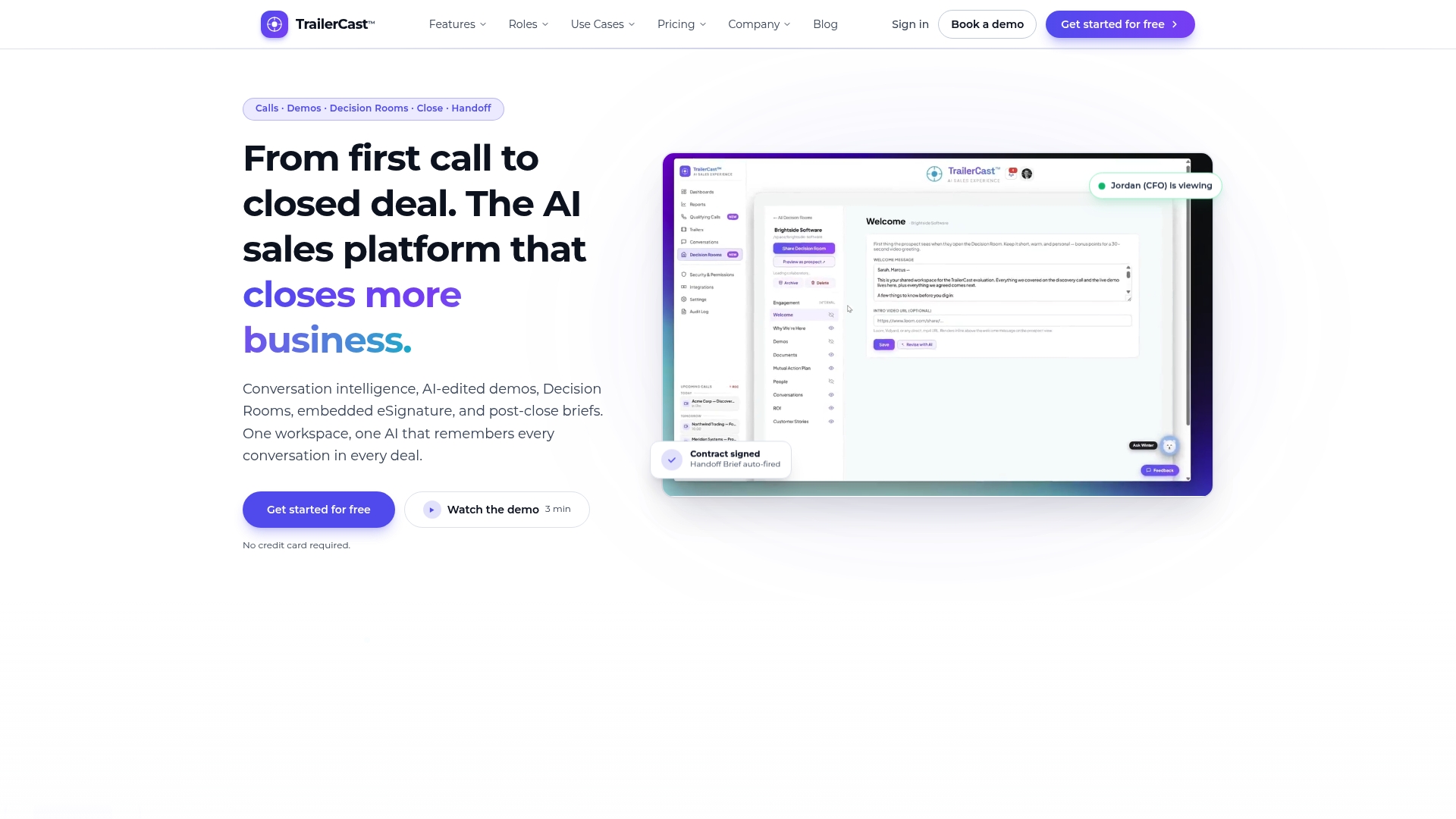
Five tools replaced by one workspace. Trailercast gives your team conversation intelligence, AI-edited demo trailers personalized per stakeholder, branded decision rooms with per-stakeholder engagement analytics, embedded eSignature, and an AI-generated handoff brief that fires to Customer Success the moment a contract signs. No separate deal room and contract room. No AI features locked behind an enterprise negotiation. Every capability ships in one tier.
The full feature set is available on a free trial with no credit card required. For a pilot, scope 3–5 reps on your most complex active deals, run for 30 days, and measure time-to-close and stakeholder engagement rate. Enterprise add-ons (SSO/SAML, custom DPA, white-label, native CRM sync) are available via custom contract for teams that need them.
Start your free trial at trailercast.io and see what your deal lifecycle looks like when one AI follows every call, demo, and handoff.
Useful sources for deeper research
- Best GetAccept Alternatives in 2026 | Toolradar — Covers the distinction between document-first tools and full deal-lifecycle platforms; useful for understanding where AI feature gating typically occurs.
- Best 10 GetAccept Alternatives & Competitors 2026 | Signaturely — Explains pricing limits, CRM integration gaps, and when a focused eSignature tool is the right call.
- GetAccept Alternatives: 10 Better CLM Tools | Oneflow — Details the deal room vs. contract room architecture issue and engagement analytics depth comparisons.
- Best GetAccept Alternatives for HubSpot Teams | Portant — HubSpot-specific comparison covering PandaDoc, DocuSign, Proposify, and native HubSpot quoting for teams already in that ecosystem.
- Trailercast Features | The AI Sales Platform, Stage by Stage — Full feature breakdown for each deal stage: calls, demos, decision rooms, close, and handoff.
- Trailercast Use Cases | The Full Deal Cycle, One Platform — Role-based examples for AEs, RevOps leaders, and sales engineers evaluating fit.