Close Vendor DPAs Faster: U.S. Clause Playbook for Legal & Security

You need a custom DPA for vendors whenever a supplier touches personal data on your behalf, whether that’s call recordings, customer PII, or transcripts flowing through a state-privacy-law trigger like CCPA/CPRA. The document has to nail six clause groups: roles and definitions, a processing details annex, technical and organizational measures (TOMs), subprocessor controls, incident response, and data return or deletion at termination. Skip any one of them, and you’ve got a signature on paper, not real protection.
TL;DR:
- Custom DPAs should precisely define the vendor’s data processing scope, including specific data types, processing purpose, and processing duration to ensure enforceability.
- The processing details annex must specify categories of data subjects, personal data involved, transfer frequency, and actual data flows based on the vendor’s product functionality.
- Restrictions on AI training and data sharing should be explicitly included, preventing vendors from using your data for their own model training or resale unless otherwise approved.
- Security controls in Annex 2 require concrete measures such as AES-256 encryption, multi-factor authentication, and clear data retention policies, not vague marketing claims.
- Engage cross-functional teams early, map data flows thoroughly, and review security evidence like SOC 2 or ISO 27001 reports upfront to expedite DPA negotiations and reduce delays.
Table of Contents
- What Is a Custom Vendor DPA, and Why Generic Templates Fall Short
- Anatomy of a Custom Vendor DPA: Clause-by-Clause Breakdown
- How to Customize a DPA for a Vendor Relationship and Complete the Annexes
- Negotiation Playbook and Red Flags: What to Accept, What to Push Back On
- Audit and Evidence: What SOC 2 and ISO Reports Actually Prove
- Practical Perspective: Aligning Procurement, Security, and Legal to Speed DPA Completion
- Fewer Vendors, Fewer DPAs: A Different Way to Shrink the Problem
- Sources
- FAQ
What Is a Custom Vendor DPA, and Why Generic Templates Fall Short
A vendor data processing agreement is the contract that spells out how a supplier may handle personal data your company controls. Most legal teams start with a generic data processing agreement template pulled from a compliance vendor or bar association resource. That’s fine as a skeleton. The problem is that generic templates describe processing in the abstract: “personal data” and “processing purposes” are written so broadly they could apply to a payroll vendor or a photo storage app with zero changes.
A custom DPA for vendors replaces those placeholders with the actual facts of the relationship. What data fields does this specific vendor see? Where does it store them? Does it use any of that data to train machine learning models? Those answers only exist once you sit down with the vendor’s actual product and your own data flows, which is why “custom” isn’t a luxury tier of DPA. It’s the only version that does its job.
The standard term you’ll see in privacy circles is data processing addendum, sometimes just “DPA,” and it typically attaches to a master services agreement (MSA) as an addendum rather than standing alone. A modern U.S.-focused DPA template should limit processing to documented customer instructions, define TOMs, set incident notification timelines, control subprocessors, and address both state privacy law obligations and AI/ML usage limits. That’s the backbone. Everything below builds on it.
Anatomy of a Custom Vendor DPA: Clause-by-Clause Breakdown
Roles, Definitions, and Why Precision Controls Obligations
Get the roles wrong and everything downstream breaks. Most vendor DPAs designate your company as the “business” or “controller” and the vendor as the “service provider” or “processor,” language borrowed from CCPA/CPRA and GDPR respectively. But some vendors process data for their own purposes too (analytics, product improvement) which can shift them toward an independent controller role for that slice of data. If your DPA doesn’t call that out explicitly, you have no basis to object when the vendor later claims it can use your customer data however it wants.
Write role definitions that map to what the vendor actually does with the data, not what a template assumes. If a vendor records sales calls to build product features on top of aggregated data, say so and cap it.
The Processing Details Annex Is Where Vagueness Dies
Annex 1 (processing details) is the single most skipped section in a rushed DPA negotiation, and it’s the one that matters most when a regulator or auditor asks what actually happens to the data. A complete Annex 1 states:
- The categories of data subjects involved (employees, customers, prospects, end users).
- The specific categories of personal data (names, emails, call recordings, transcripts, payment details).
- The purpose and duration of processing (service delivery for the length of the subscription, not “as needed”).
- The frequency of transfers (continuous, batch, on-demand).
A vendor DPA example worth studying comes from Solarwinds’ published data processing addendum, which structures its exhibits around exactly this kind of granularity, plus regional transfer addenda layered on top. Copy that structural discipline even if the specific language doesn’t fit your vendor.
Processing Instructions: Say What the Vendor Can’t Do
Every custom DPA needs an instructions clause that limits processing to documented, written direction from you. But the real value comes from the exclusions you spell out. Vendors increasingly build AI features into everyday tools, so your instructions clause should explicitly state:
- No use of your data to train models that benefit other customers.
- No resale, rental, or sharing with data brokers.
- No processing beyond what’s needed to deliver the contracted service.
If a vendor’s own DPA is silent on AI training rights, don’t assume the silence protects you. Assume the opposite and add the restriction yourself.
Annex 2: Turning Security Promises Into Verifiable Controls
Technical and organizational measures are where legal teams often over-trust marketing copy. A vendor’s website might say “bank-level encryption” and stop there. Annex 2 needs specifics: encryption at rest and in transit (and which standard, typically AES-256), role-based access controls, multi-factor authentication for administrative access, and a stated data retention and deletion schedule.
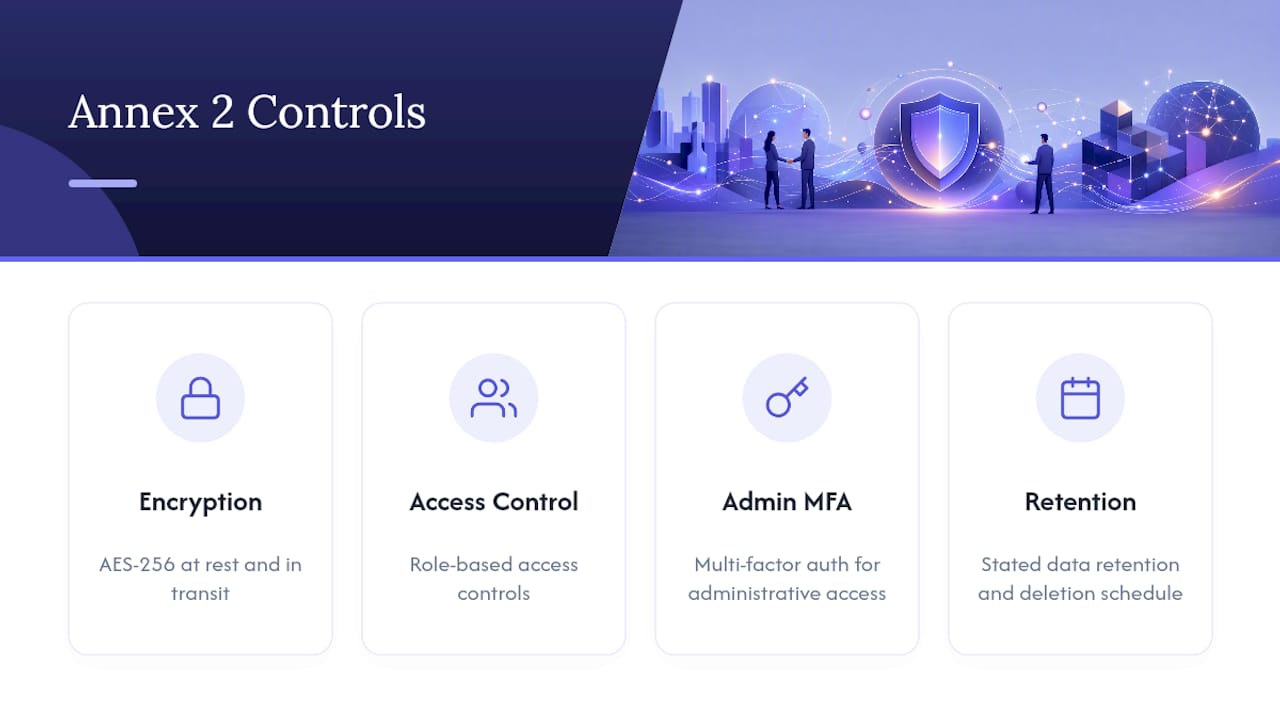
The SecurityScientist DPA template includes a worked Annex 2 example that pairs each control category with the kind of engineering answer you should expect back, which is a useful reference before you draft your own version. Ask for specifics, and expect vendors to answer with what they actually have deployed, not aspirational language.
Subprocessor Controls: Notice, Objection, and Flow-Down
Almost every SaaS vendor relies on subprocessors: cloud hosting, transcription engines, email delivery, analytics. Your DPA has two structural choices here. General authorization lets the vendor add subprocessors freely as long as it maintains a public list and notifies you of changes. Specific authorization requires your written approval before each new subprocessor goes live.
Most enterprise vendors push for general authorization because specific authorization creates operational drag on their side. A reasonable middle ground: general authorization with a 30-day advance notice period and a right to object on reasonable grounds (a subprocessor operating in a jurisdiction with weak data protection, for example) within that window. Some negotiations land on 60 or 90 day notice for higher-risk data categories. Whatever you agree to, the subprocessor clause must flow down the same data protection obligations you’re imposing on the primary vendor.
Incident Response: The Clock Starts When They Know, Not When You Ask
Breach notification timing is where negotiations get contentious, because vendors want flexibility and you want certainty. A defensible baseline is initial notice within 72 hours of the vendor becoming aware of a security incident affecting your data, with a follow-up requirement to provide details as the investigation progresses: scope of affected data, root cause, remediation steps, and whether regulatory notification is triggered on your end.
Data Return and Deletion at Termination
Termination clauses often get rubber-stamped, which is a mistake because this is where lingering data exposure actually happens. Specify a return or deletion window, commonly 30 to 60 days post-termination, and require written certification of deletion rather than a vague promise. If the vendor retains data for legal or backup purposes, the clause should cap that retention period and restrict any further processing during it.
How to Customize a DPA for a Vendor Relationship and Complete the Annexes
Turning a generic data protection agreement template into a working document is a sequencing problem more than a legal drafting problem. Here’s the order that actually works:
- Map the data flow before you touch the template. Sit down with the business owner of the vendor relationship and trace exactly what data the vendor will see. If it’s a sales tool, that might mean call recordings, transcripts, and fields like prospect email addresses and deal values. If it’s an HR platform, it’s employee PII and possibly health data. This map becomes the raw material for Annex 1, and skipping it is why so many DPAs ship with a vague, copy-pasted processing description.
- Draft Annex 1 from the map, not from memory. List categories of data subjects, categories of data, and purpose of processing using the vendor’s actual product functionality as the reference point, not a boilerplate description of “customer data.”
- Translate engineering answers into Annex 2 language. Ask your security team or the vendor’s security questionnaire response for concrete control descriptions, then write Annex 2 to match what’s actually implemented. Don’t let marketing language (“enterprise-grade security”) stand in for a specific answer about encryption standards or access logging.
- Decide your subprocessor authorization model and set the notice window. Pick general or specific authorization based on the sensitivity of the data involved, then commit to a notice period you can realistically monitor, not one that sounds good on paper but nobody checks.
- Set the breach notification SLA and evidence requirements. Beyond the 72-hour initial notice, specify what evidence the vendor must produce (forensic summary, affected record count, remediation timeline) and require assistance with any regulatory notices or data subject requests you’re obligated to handle.
- Reconcile the DPA against the MSA. Check that governing law, liability caps, insurance requirements, and termination effects in the DPA don’t quietly contradict the MSA. A DPA that caps liability differently than the MSA it’s attached to creates ambiguity a court will have to resolve, not you.
Pro Tip: Draft Annex 1 and Annex 2 before you send the DPA to the vendor for redline. A filled-in annex signals you’ve done the work and gives the vendor concrete language to react to, which moves negotiations faster than sending a blank template and asking them to fill in their own answers.
Cross-functional timing matters as much as clause quality. SaaS procurement research points to early collaboration between procurement, security, and legal as the single biggest lever for shortening onboarding cycles, because each function is filling in a different annex and none of them can finish alone.
Negotiation Playbook and Red Flags: What to Accept, What to Push Back On
Large vendors, particularly ones selling to thousands of customers, will almost always insist on their own standard DPA rather than accepting yours wholesale. That’s not a bluff so much as an operational reality: a vendor supporting 5,000 customers can’t maintain 5,000 custom DPA versions without creating compliance chaos on their end. Practitioner guidance on vendor DPAs recommends treating your own template as a gap checklist rather than a replacement demand. Compare it clause by clause against what the vendor offers, and negotiate the differences that actually matter instead of insisting on a full swap.
Must-have protections, worth spending negotiation capital on:
- Explicit data deletion obligations at termination with written certification.
- A defined breach notification timeline, not “without undue delay.”
- A restriction on using your data to train AI models for other customers.
- Subprocessor notice rights, even if you settle for general rather than specific authorization.
Acceptable concessions, if the vendor’s standard terms are otherwise reasonable:
- General subprocessor authorization instead of specific approval, provided notice and objection rights exist.
- A published subprocessor list instead of individual written notices for each addition.
- Standard audit rights limited to questionnaire responses and evidence review rather than an on-site audit clause.
That last point deserves its own explanation, because unlimited audit rights are one of the most common sticking points in negotiation. Vendors resist granting customers the right to show up and audit their infrastructure, largely because doing that for every customer would be operationally impossible. A workable compromise: accept a SOC 2 Type II report or ISO 27001 certification in lieu of an on-site audit, paired with a right to request updated reports annually and a penetration test summary on a defined cadence. This isn’t a downgrade if the vendor’s evidence is current and scoped correctly. It’s often more informative than a one-day audit visit would be anyway.
Pro Tip: When a vendor pushes back on audit rights, ask for their most recent SOC 2 report before conceding anything. A vendor that can’t produce one, or produces one with major exceptions noted, tells you more about actual risk than any clause negotiation will.
Watch for these red flags, which warrant escalation to counsel or procurement leadership rather than a quick sign-off:
- A vendor refusing any deletion obligation, or offering only “commercially reasonable efforts” with no timeline.
- Subprocessor lists that are vague, outdated, or hidden behind a login wall you can’t access before signing.
- Broad AI training rights buried in a separate terms-of-service document that the DPA doesn’t reference or restrict.
- No breach notification timeline at all, just a promise to notify “as required by law.”
Any one of these should stop the signature, not just slow it down.
Audit and Evidence: What SOC 2 and ISO Reports Actually Prove
A SOC 2 report doesn’t certify that a vendor is secure in some absolute sense. It certifies that an independent auditor tested specific controls against a defined framework (Security, Availability, Confidentiality, Processing Integrity, or Privacy, depending on scope) over a specific audit period, usually six to twelve months for a Type II report. That distinction matters when you’re relying on it as your primary audit substitute in the DPA.
Ask the vendor for the full report, not just the one-page attestation letter. The full report lists any exceptions the auditor found, and a report with a handful of minor exceptions clearly remediated is a stronger signal than a flawless report from a firm you’ve never heard of running a scope so narrow it excludes the systems that actually touch your data.
ISO 27001 certification works similarly but certifies an information security management system rather than testing specific controls over a period. The two aren’t interchangeable proof points, and a vendor that has one but not the other isn’t automatically weaker. It just means you’re evaluating a different kind of evidence.
Build evidence requests into your DPA rather than treating them as a one-time onboarding favor. Require the vendor to provide updated SOC 2 reports annually and to notify you if a report is issued with material exceptions. That single clause turns a point-in-time trust exercise into an ongoing verification habit.
Practical Perspective: Aligning Procurement, Security, and Legal to Speed DPA Completion
The DPAs that drag on for months almost never stall because of a genuinely hard legal disagreement. They stall because nobody ran discovery before the redline started. Legal gets a blank template, security hasn’t been asked what controls the vendor actually has, and procurement is negotiating price on a parallel track with no visibility into either. By the time someone tries to reconcile all three, you’re three redline rounds deep on language that should have been settled before the first draft went out.
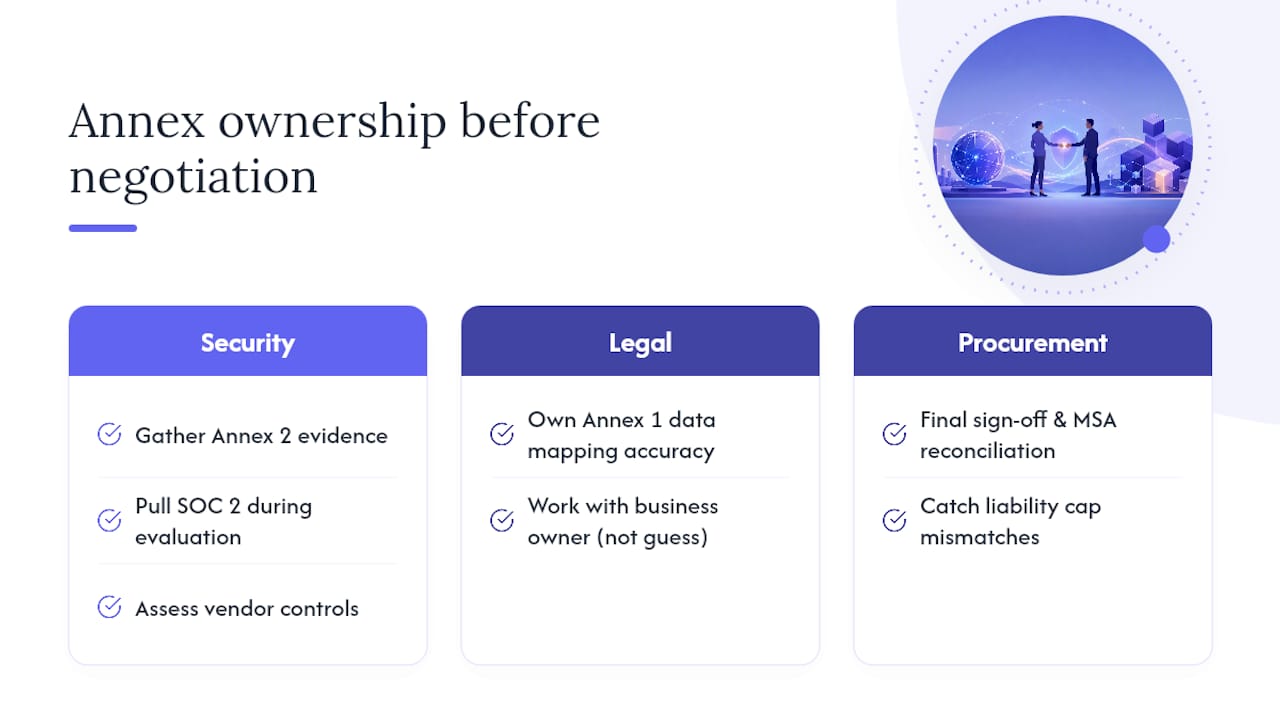
The fix is unglamorous: assign an owner for each annex before negotiation starts. Security owns gathering the Annex 2 evidence, ideally during vendor selection rather than after a contract is already verbally agreed. Legal owns Annex 1’s data mapping accuracy, working directly with the business owner of the relationship rather than guessing. Procurement owns final sign-off and MSA reconciliation, catching the liability cap mismatches nobody else is looking for. Cross-functional discovery run early, before the vendor is even selected, removes most of the handoff friction that turns a two-week negotiation into a two-month one.
An evidence-first approach compounds this advantage. If security pulls the SOC 2 report and control documentation during vendor evaluation instead of after the deal is verbally committed, you walk into DPA drafting with facts instead of assumptions. The vendors who can’t produce that evidence quickly usually reveal something worth knowing before you’ve signed anything.
— Daniel
Fewer Vendors, Fewer DPAs: A Different Way to Shrink the Problem
Every vendor that touches call recordings, transcripts, or demo assets is another Annex 1 to write, another subprocessor list to track, another SOC 2 report to chase down annually, especially when you use HIPAA compliant speech to text services for healthcare transcription. Some platforms consolidate the tools that normally sit behind multiple vendor contracts—such as conversation intelligence, AI-edited demo trailers, buyer-facing deal rooms, eSignature, and post-close handoff—into one workspace, which means one DPA to negotiate instead of multiple.
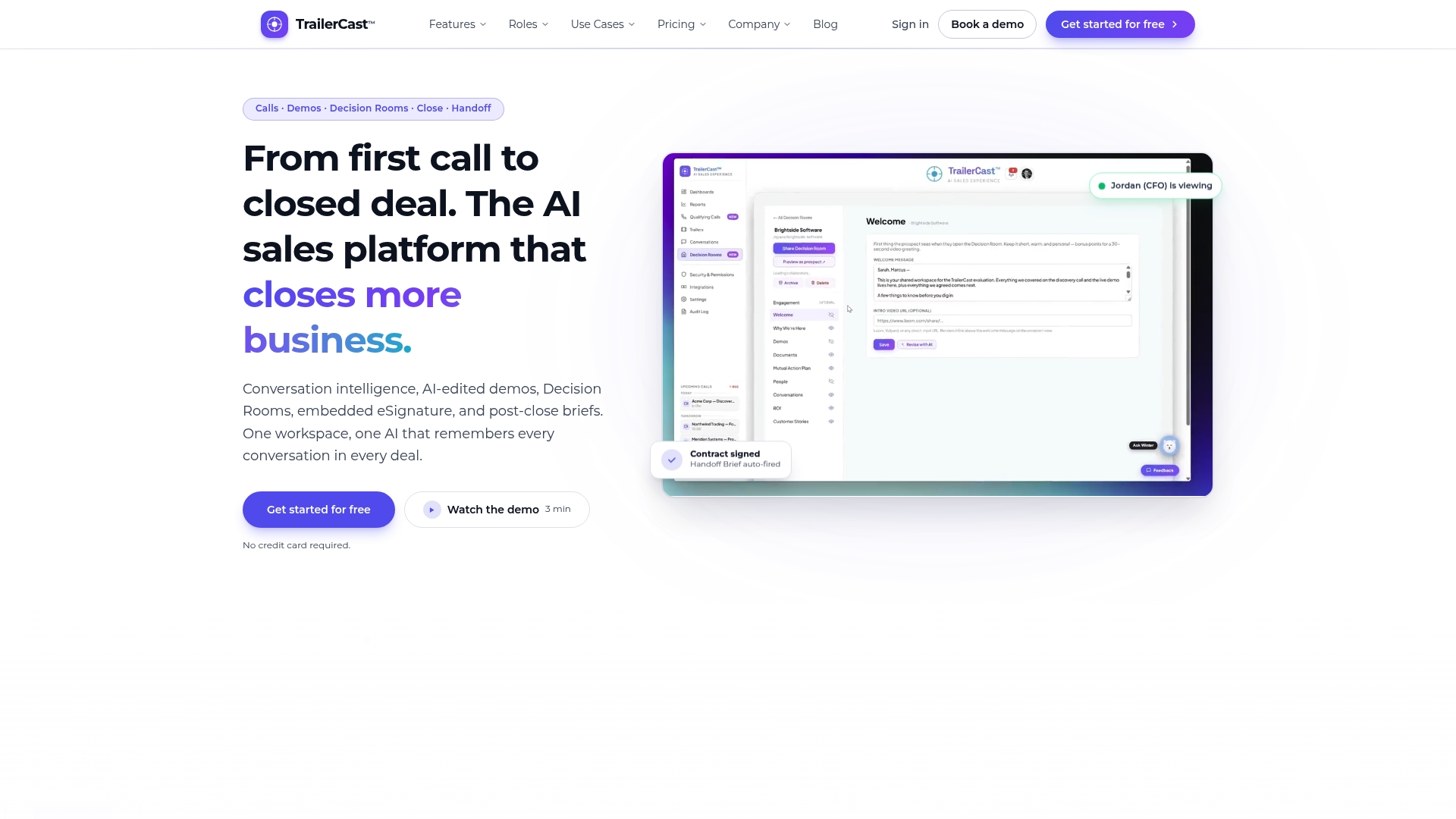
That’s a meaningfully different data governance footprint than running a call recording tool, a video editor, a deal room platform, and a separate eSignature vendor, each with its own subprocessor list and its own annual evidence request. Fewer vendors means fewer contracts to manage, a clearer data flow diagram for Annex 1, and centralized access controls your security team only has to audit once. Enterprise customers evaluating Trailercast can also request add-ons like SSO/SAML and a custom DPA built around their specific processing needs, on top of the standard terms every account gets.
If you’re mapping out how many vendors currently touch your sales data, it’s worth reviewing the full feature set to see how much of that footprint one workspace could absorb, and starting a free trial to evaluate the fit before your next vendor security review comes due.
Sources
- SaaS procurement process benefits, strategies explained
- Data processing agreements (practitioner guidance)
This article is general information, not a substitute for advice from a qualified lawyer. Consult a qualified legal professional about your own circumstances before acting on anything here.
FAQ
What Must a DPA Include?
A complete DPA needs defined roles (controller/processor or business/service provider), a processing details annex, technical and organizational measures, subprocessor controls, breach notification obligations, and data return or deletion terms at contract end. U.S.-focused agreements should also address state privacy law compliance and any AI/ML usage limits.
What Are the Core Principles a DPA Should Enforce?
While frameworks vary by jurisdiction, most vendor DPAs are built to enforce purpose limitation (data used only for stated purposes), data minimization, confidentiality, security through documented TOMs, accountability through audit rights or evidence requirements, controlled subprocessor use, and defined retention with deletion at termination.
Does a DPA Have to Be Signed?
Yes. A DPA creates binding legal obligations on both parties, so it needs to be executed the same way as the master services agreement it attaches to, typically through signature blocks or incorporation by reference with a linked execution date and version number.
Is a DPA Mandatory for Every Vendor?
A DPA is required whenever a vendor processes personal data on your behalf, which includes most SaaS tools handling customer records, employee data, or call recordings. If a vendor never touches personal data covered by applicable privacy law, a full DPA may not be necessary, but that determination should come from a documented data flow review, not an assumption.
How Long Should Breach Notification Take Under a Vendor DPA?
A defensible standard is initial notice within 72 hours of the vendor becoming aware of an incident, followed by ongoing updates as the investigation develops, including scope, root cause, and remediation status.