Best AI Sales Agents for Sales Leaders in 2026

Gong.io, Clari, Amplemarket, and Creatio lead the pack for most U.S. sales teams evaluating AI sales agents in 2026. Each targets a distinct problem: revenue intelligence, pipeline forecasting, outbound prospecting, and CRM workflow automation. The right pick depends on where your deals break down, not which platform has the longest feature list.
Here is a fast-reference comparison of the top options:
| Product | Best For | Core Features | AI Capabilities | Automation Level | Pricing Model | Rating |
|---|---|---|---|---|---|---|
| Clari | Revenue ops and forecasting | Pipeline management, forecasting, retention | Predictive revenue AI | Autonomous with human oversight | Custom enterprise | 4.2★ (18) |
| Creatio | Custom CRM workflows | AI CRM, marketing and sales automation, low-code design | AI-enabled business workflows | Human-in-loop with AI assist | Tiered, custom | 4.4★ (14) |
| Amplemarket | Outbound prospecting at scale | Multichannel sequences, signal detection, AI agent Duo | Generative AI personalization | Largely autonomous | Custom | 4.4★ (7) |
| Gong.io | Revenue intelligence | Deal risk prediction, pipeline analytics, churn forecasting | AI OS for revenue teams | Autonomous insights, human action | Custom enterprise | 3★ (2) |
| AI Agent Pro | Secure multilingual support | 24/7 AI agents, CRM integration, conversation analytics | Multilingual AI conversations | Autonomous with escalation | Custom | 5★ (1) |
| Clay | Lead enrichment | Lead data enrichment, hyper-personalization | AI-powered data sourcing | Human-in-loop | Custom | — |
| Alta | Workflow automation | AI sales assistance, workflow tools | AI-powered sales workflows | Human-in-loop | Not publicly listed | — |
| Relevance | Community-led sales | Signal tracking, funnel optimization | Sales signal AI | Human-in-loop | Not publicly listed | — |
Key differences worth knowing before you go deeper:
- Gong.io serves 5,000+ customers including LinkedIn and Dropbox, making it the most battle-tested option for enterprise revenue intelligence.
- Clari manages over $5T in revenue across 1,500+ customers, a scale that reflects genuine enterprise trust.
- Amplemarket’s Duo is the only agent on this list recognized as a Gartner Cool Vendor in Generative AI for Sales.
- AI Agent Pro is the only platform here with verified SOC 2, GDPR, and CCPA compliance, which matters if your sales data touches regulated industries.
- Creatio holds Gartner and Forrester leader status, a credential that carries weight in procurement conversations.
What sets each AI sales agent apart?
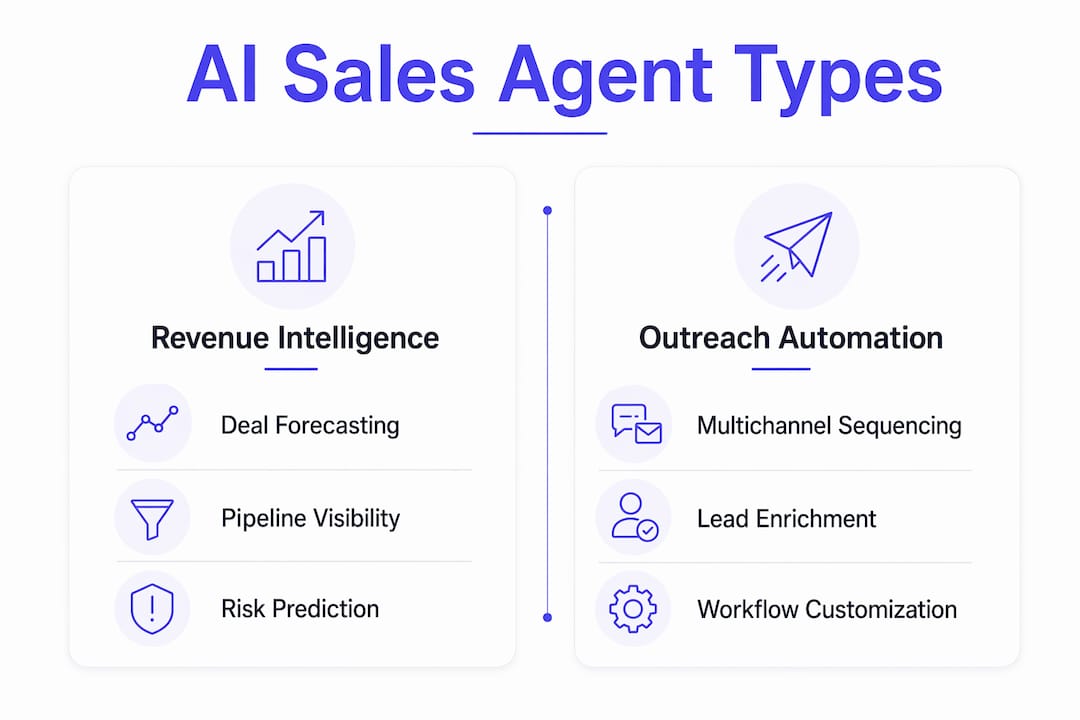
The tools above split into two broad camps: revenue intelligence platforms and prospecting or workflow agents. Understanding which camp fits your team’s biggest bottleneck saves months of evaluation time.
Gong.io functions as an AI operating system for revenue teams. It predicts deal risk, forecasts pipeline accuracy, and automates handoffs between sales stages. The platform’s strength is turning conversation data into pipeline decisions, not just call summaries.
Clari sits one layer above individual deals. Its AI monitors every deal stage across your entire sales motion and feeds that signal into forecasting. For VP-level leaders who need to call the quarter with confidence, Clari’s revenue operations depth is hard to match.

Amplemarket takes a different angle entirely. Its AI agent Duo handles multichannel outbound sequences, including email, phone, and social, with personalization driven by real-time sales signal detection. Teams that need to fill the top of the funnel without adding headcount find it particularly useful.
Creatio is the most configurable option on this list. Its low-code design lets RevOps teams build custom sales workflows without engineering support, and its AI CRM ties marketing and sales data into one view. The Gartner and Forrester recognition reflects genuine enterprise adoption.
AI Agent Pro targets a specific gap: 24/7 multilingual sales and support conversations with enterprise-grade security. SOC 2 compliance and built-in GDPR and CCPA controls make it a credible choice for companies in healthcare, finance, or any sector where data handling gets scrutinized.
Clay specializes in lead enrichment and hyper-personalization. It pulls data from multiple sources to build richer prospect profiles, which feeds better outreach. It works best as a layer on top of your existing outbound motion rather than a standalone agent.
Alta and Relevance round out the list. Alta focuses on sales workflow automation for U.S.-based teams, while Relevance tracks community signals to surface buying intent earlier in the funnel. Both have limited public documentation on specific features, so treat them as options worth a demo call rather than a deep-dive comparison.
How to choose the right AI sales agent for your team
The single biggest mistake sales leaders make is evaluating AI agents by feature count. The right question is: where does your pipeline actually break?
Start with your workflow, not the vendor’s demo. Map your current sales process from first contact to closed deal. Identify the two or three stages where deals stall, slow down, or die quietly. An AI agent that solves your real bottleneck beats a full-featured platform your team never fully adopts.
Check integration depth before anything else. An AI sales agent that doesn’t sync cleanly with your CRM creates more work, not less. Verify whether the platform offers native CRM sync with Salesforce or HubSpot, or whether it relies on Zapier-style connectors that break under volume.
Evaluate the automation level honestly. Fully autonomous agents work well for top-of-funnel tasks like prospecting and lead qualification. For deal-stage decisions and customer-facing conversations, human-in-loop setups tend to produce better outcomes and fewer costly mistakes.
Common red flags to watch for during evaluation:
- No free trial or sandbox environment before a contract commitment
- Pricing that requires a full enterprise negotiation before you can test the product
- AI outputs that can’t be audited or traced back to source data
- Compliance certifications that are claimed but not independently verified
Plan for a 30–60 day onboarding window. Most teams underestimate the time needed to configure AI agents to their specific sales motion, train reps on new workflows, and establish baseline metrics. Budget that time before you measure ROI.
Pro Tip: Before signing any contract, ask the vendor for a reference call with a customer in your industry and at your company size. A reference from a 2,000-person enterprise tells you almost nothing about how the tool performs for a 50-person sales team.
What types of AI sales agents actually exist?
“AI sales agent” covers a wide range of tools, and conflating them leads to bad buying decisions. There are three distinct categories worth understanding.
Autonomous AI agents handle tasks end-to-end without human input at each step. Amplemarket’s Duo is a clear example: it identifies prospects, builds personalized sequences, and executes multichannel outreach on its own. These agents work best for repeatable, high-volume tasks where speed matters more than nuance.
Human-in-loop AI assistants surface recommendations and draft outputs, but a rep reviews and approves before anything goes out. Creatio and Clay operate largely in this mode. The tradeoff is more control at the cost of speed.
AI virtual sales assistants handle specific functions within a broader workflow, such as conversation intelligence, call transcription, or deal room management. Gong.io and Clari fall here. They don’t replace reps; they make reps faster and more informed.
Typical use cases across all three types:
- Lead qualification and scoring based on behavioral signals
- Personalized outbound prospecting across email, phone, and social
- Conversation intelligence and call summarization for discovery calls
- Pipeline management and deal risk prediction
- Post-sale handoff briefs for customer success teams
The benefits compound when these functions connect. A team using conversation intelligence to qualify leads, an AI agent to run outbound sequences, and a deal room to manage the buying committee is operating at a fundamentally different level than one relying on manual processes.
Pro Tip: Don’t deploy an autonomous agent on your highest-value accounts first. Start with mid-market or SMB segments where the cost of an AI misstep is lower, then tune the model before rolling it up-market.
How Trailercast covers the full deal lifecycle in one platform
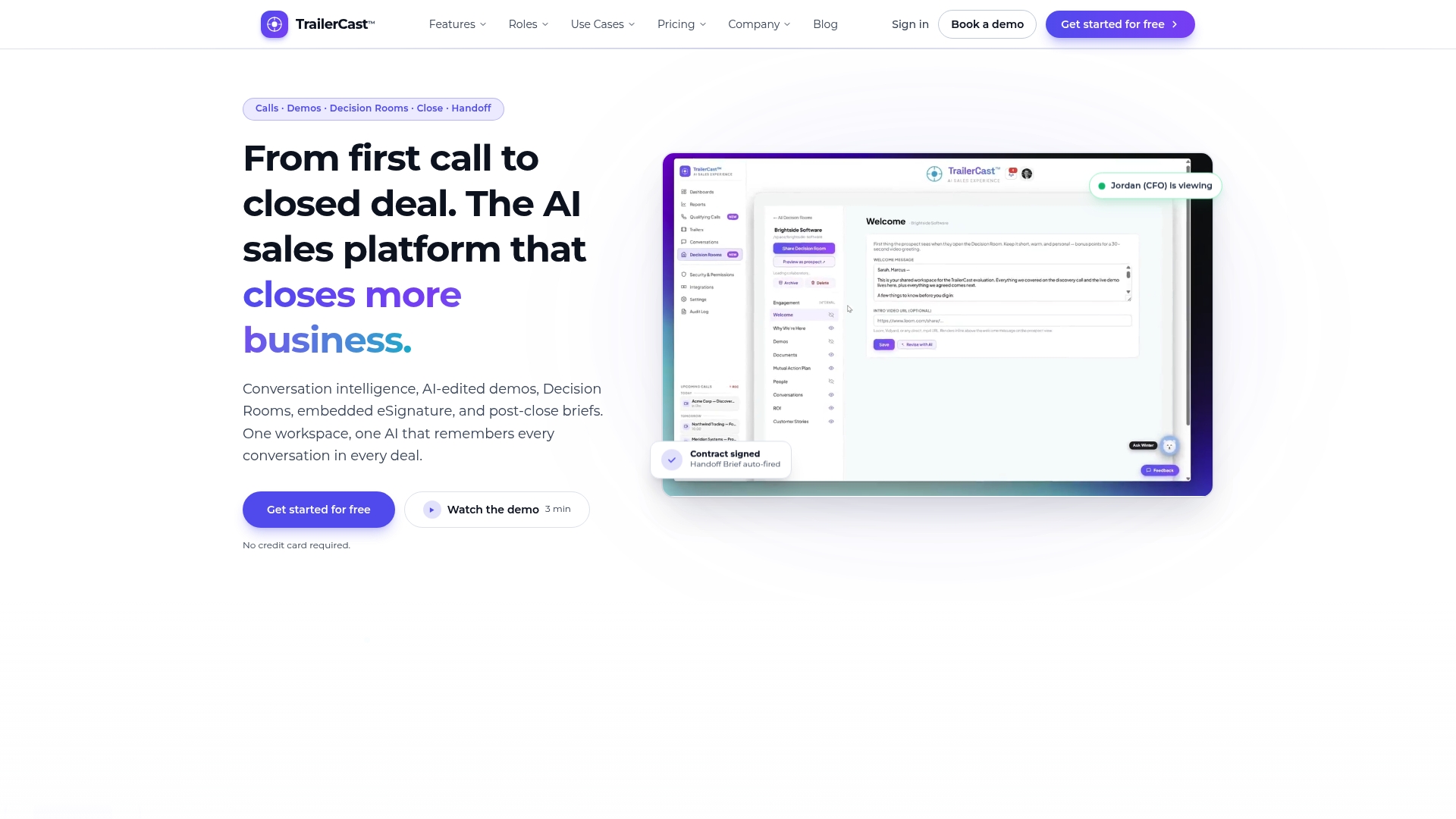
Most AI sales tools solve one layer of the problem. Trailercast is built to cover all five: calls, demos, decision rooms, close, and post-sale handoff, in a single workspace where one AI follows the entire opportunity.
The core insight behind the platform is that the calls were never the problem. The deal dies in the space between them, when your champion walks back to a CFO who wasn’t on the demo and tries to re-sell from memory. Trailercast owns that space.
What the platform includes:
- Conversation intelligence with AI-generated summaries, talk-time analysis, and qualification verdicts across Zoom, Meet, and Teams
- AI-edited demo trailers that compress a full demo into the 8–15 minutes that mattered, personalized per stakeholder (a CFO version, a CISO version) in 15+ languages
- Decision rooms where the buying committee can review content, ask questions, and track a mutual action plan without logging in
- Embedded eSignature so the deal closes in-app, with no third-party hop
- AI Handoff Briefs that fire automatically to Customer Success the moment a contract signs
The AI layer runs on Claude, with Winter as the in-app assistant that reads live call transcripts and deal data. Ask it which calls mentioned pricing, or what a specific prospect said about security, and it answers with streaming results.
Pricing is $79/seat/month, or $59/seat/month billed annually, with every feature included and no gating. The first 100 paid teams lock in 20% off for the life of the account.
Trailercast is worth a look if you’re running multi-stakeholder deals
If you’re already comparing Gong, Clari, or Amplemarket, you’re evaluating tools that each solve one layer of the deal. Trailercast is a different kind of option: one platform that covers conversation intelligence, demo follow-up, deal room collaboration, eSignature, and post-close handoff together.
For B2B SaaS teams with buying committees of 3–7 people, the consolidation argument is real. Instead of paying for Gong plus Loom plus a deal room plus DocuSign, one workspace handles the full cycle at $59/seat/month annually. The full platform features are available on a free trial with no credit card required, which makes it easy to test against your actual deals before committing.
Key Takeaways
The best AI sales agent for your team depends on where your pipeline breaks, not which platform has the most features.
| Point | Details |
|---|---|
| Match tool to bottleneck | Identify where deals stall before evaluating vendors; the right agent solves your specific gap. |
| Gong.io leads on scale | Trusted by 5,000+ customers, Gong.io is the most widely adopted revenue intelligence platform on this list. |
| Compliance matters for regulated industries | AI Agent Pro is the only platform here with verified SOC 2, GDPR, and CCPA compliance. |
| Autonomous vs. human-in-loop | Use autonomous agents for high-volume prospecting; keep humans in the loop for deal-stage decisions. |
| Trailercast for full-cycle teams | Trailercast costs $79/seat/month, or $59/seat/month billed annually, with every feature included and no gating, and the first 100 paid teams lock in 20% off for the life of the account. It covers calls, demos, deal rooms, eSignature, and handoff in one platform. |