TrailerCast for Instrumented Asynchronous Sales Demos, B2B SaaS

An asynchronous sales demo is a buyer-specific, instrumented video you send after discovery, not a generic pitch you lead with. It exists to do one job: get a faster second meeting or hand your champion something they can actually forward to the CFO who wasn’t on the call. Send it once you understand the buyer’s pain, never as a cold prospecting tool; to help your sales team master this approach, consider role-focused seller enablement that sharpens buyer-specific communication.
TL;DR:
- Sending a buyer-specific, tracked asynchronous demo after discovery reduces the risk of losing engagement between calls and helps reach stakeholders who are rarely on live meetings.
- The ideal demo length varies: 4-5 minutes for discovery replays, 6-9 minutes for mid-funnel objections, 8-12 minutes for technical deep-dives, and 2-3 minutes for executive summaries.
- Personalizing demos by mentioning the buyer’s company and pain in the first 15 seconds significantly increases viewing and engagement.
- Tracking engagement through view rates, watch depth, and forwarding behavior makes demo performance measurable and helps forecast deal progress.
- The best practices include sending demos within 24 hours of discovery, using trackable links, having a single clear call to action, and integrating automation for follow-up based on engagement signals.
Table of Contents
- What an asynchronous sales demo is and why it matters now
- The four high-converting async demo templates and when to use each
- How to build an effective async sales demo (step-by-step workflow)
- Distribution and handoff: how to send the demo and drive the next step
- Measure and instrument: the engagement signals that make demos forecastable
- Common mistakes and best practices when rolling out async demos
- How TrailerCast maps this playbook to one workflow
- Accessibility considerations in asynchronous demo production
- Legal and compliance aspects related to recording and sharing demos
- Techniques for personalizing asynchronous demos to different buyer personas or industries
- Strategies for integrating asynchronous demos into a broader omni-channel sales process
- Optimal lengths by demo type and stage-based attention data
- Tooling requirements at a high level
- Timing and sequencing guidance for sending demos
- What analyzing hundreds of sales demos actually taught me
- Putting the playbook into one workspace with TrailerCast
- Sources
- FAQ
What an asynchronous sales demo is and why it matters now
An async demo is different from a marketing explainer or an evergreen product video sitting on your website. Those are built for anyone. An async demo is built for one buyer, based on what they told you in discovery, and it’s tracked so you know what happened after you hit send.
This matters more in 2026 than it did a few years ago because the buying journey has quietly moved without the seller in the room. A Gartner sales survey found 67% of B2B buyers prefer a rep-free experience, and Gartner recommends building modular, AI-ready enablement content that buyers and sellers can both use on their own terms. That’s not a rejection of salespeople. It’s a preference for self-direction at certain points in the deal, particularly the parts that happen between calls, when your champion is doing the internal selling for you.
Gartner’s analysis of the B2B buying journey adds a useful nuance here: buyers who engage with supplier-provided digital tools alongside a seller are 1.8 times more likely to complete a high-quality deal, even though most of the journey still happens without a rep present. The takeaway isn’t “go fully self-service.” It’s that your job is to arm the buyer with something good enough to carry the conversation when you’re not there.
That’s the gap an async demo fills. It sits right after discovery and right before the internal buying committee starts arguing about budget. Done well, it speeds up the next meeting, cuts down on no-show discovery calls where the buyer never really understood the product, and reaches stakeholders you’ll never get on a live call, like a security lead who only shows up once, late, with three objections.
The four high-converting async demo templates and when to use each
Not every deal stage needs the same demo. Sending a 12-minute technical walkthrough to a CFO is how you lose the CFO’s attention in the first 90 seconds. Here are four templates worth building, each aimed at a different buyer and moment.
- Discovery-replay (4 to 5 minutes): Replay the 2 to 3 pains the buyer named in discovery, then show the exact workflow that solves each one. Use this right after the first call, while the pain is still fresh in the buyer’s mind.
- Mid-funnel teardown (6 to 9 minutes): Address the objections procurement or IT will raise, with screenshots or clips that answer them directly instead of hand-waving. Use this once a second stakeholder enters the deal.
- Technical deep-dive (8 to 12 minutes): Built for engineers, security reviewers, or solutions architects who need implementation detail, not a sales pitch. Use this when a technical evaluator is blocking the deal.
- Executive summary (2 to 3 minutes): One ROI number, one clear ask, nothing else. Use this for the executive sponsor who will never watch anything longer.
The pattern across all four: shorter for higher-seniority audiences, longer for technical audiences, and always anchored to something the buyer actually said rather than a generic feature tour. A well-made product demonstration example makes this obvious once you see it: the best ones open with the buyer’s own words, not your company’s tagline.
How to build an effective async sales demo (step-by-step workflow)
Building an async demo isn’t a production project. It’s a five-step workflow that a rep can run in under an hour once they’ve done it a few times.
- Prep from discovery. Pull 2 to 3 pains directly from your discovery notes or call recording and map each one to the exact product screen or workflow that resolves it. Skip anything the buyer didn’t mention.
- Script in three beats. Structure every demo as problem, workflow, measurable outcome. End with one explicit call to action, never a menu of options.
- Record with the buyer named out loud. Say the buyer’s company name and the stakeholder’s name in the recording itself. A browser-based screen recorder with no install requirement removes the friction that keeps reps from doing this consistently.
- Edit down, don’t edit up. Trim to the 8 to 15 minutes that actually matter, add a short intro and outro with your branding, and if you’re sending to multiple stakeholders, cut a version that leads with pricing for the CFO and a version that leads with security for the CISO.
- Package and send. Wrap the video in a unique link, attach a one-page summary for anyone who forwards it without watching, and include one explicit instruction: what you want the recipient to do next.
Pro Tip: Limit every script to the top 3 moments from the call. Reps who try to cover everything end up with 20-minute videos nobody finishes.
The recording step deserves more attention than most reps give it. Say the company name in the first 10 seconds. It sounds small, but it’s the single fastest way to signal “this was made for you” instead of “this is a template with your logo pasted on.” If you’re using narration over a screen share, keep your pacing close to a live call: pause after key points the way you would if the buyer were actually there asking questions.
Editing doesn’t need to be a production job either. The goal is a tight cut, not a polished film. Reuse modular clips you’ve already recorded for common objections rather than re-recording the same explanation for every deal. This is the difference between a rep who sends one demo a week and a rep who sends five.
Packaging matters as much as the video itself. A demo with no clear next step is a video, not a sales tool. Whether you’re hosting it in a dedicated deal room or a simple shared link, the packaging should answer three questions in the first ten seconds: who is this for, what does it cover, and what happens if they click the button at the end.

Distribution and handoff: how to send the demo and drive the next step
Timing and framing matter as much as the content of the demo itself. Send it soon after the discovery call, while your name and the conversation are still fresh, and open your message with one sentence that names the buyer’s specific pain rather than a generic “thanks for your time.”
- Host it somewhere trackable. A no-login deal room or a unique per-recipient link lets you see who opened it and whether they forwarded it, which matters because champion forwarding is often the real signal of deal health.
- Give it exactly one call to action. A single ask, whether that’s booking a follow-up or reviewing pricing, converts better than a menu of next steps.
- Build in a fallback. If the primary CTA is a meeting, include a secondary link to pricing or a calendar invite so the buyer isn’t stuck if they’re not ready to talk yet.
- Send midweek. Buyer behavior research found that midweek sends, Tuesday through Thursday, tend to produce stronger engagement than Monday or Friday sends, and that buyers often take several days to open demo content in the first place.
That last point changes how you should think about follow-up. If a buyer typically waits days before opening a demo, a follow-up sent the next morning reads as impatient. A better cadence is a short nudge around day 3, then a second, more direct message around day 6 if there’s still no view recorded. Embedding a scheduling link, through something as simple as a Calendly booking page, removes one more step between “they watched it” and “they booked time.”
Measure and instrument: the engagement signals that make demos forecastable
An async demo without tracking is a video you hope someone watches. The entire value of the format depends on knowing what happened after you hit send, and that requires instrumentation, not guesswork.
- View rate: whether the link was opened at all, which tells you if your subject line and opener worked.
- Watch-depth: how far into the video the viewer got, which tells you if your pacing and length were right for that audience.
- Forward attribution: who shared the demo with whom inside the buying committee, which is often the clearest signal of internal momentum.
- Time-to-open: how long it took the buyer to click, which helps you calibrate follow-up timing instead of guessing.
- Reply rate: whether the send (to send) generated a response, the most direct measure of whether the demo did its job.
New Relic’s guidance on async instrumentation makes the general principle clear even outside a sales context: you instrument the parts of a system you can’t observe directly, and you set thresholds that trigger action rather than just logging data for later review. Applied to sales, that means setting a watch-depth threshold, commonly around 75%, that automatically triggers a CRM task or a sales notification the moment a buyer crosses it.
A useful benchmark: buyer behavior data shows average demo engagement time runs well below the produced length of the video, which means most of your audience never reaches your closing slide unless the first third earns their attention.
A CRM automation built around that 75% threshold turns a passive video into an active pipeline signal. Instead of a rep manually checking whether a prospect opened a link, the CRM fires a task the moment engagement crosses the line, which is what makes async demos forecastable rather than anecdotal.
Common mistakes and best practices when rolling out async demos
Most teams that try async demos and give up made one of a small number of avoidable mistakes.
- Using it as a prospecting tool. A demo sent cold, before discovery, reads as generic marketing and gets ignored. Save it for after you understand the buyer’s specific pain.
- Skipping instrumentation entirely. Without view tracking, you have no idea whether the deal stalled because the buyer didn’t watch or because they watched and weren’t convinced.
- Overloading the CTA. A demo that ends with three possible next steps gets none of them taken. Pick one.
- Re-recording from scratch every time. Reps who rebuild the entire demo for each deal burn hours they don’t have and eventually stop sending them.
Pro Tip: Keep a small library of modular clips for your most common objections and swap them into a fresh intro rather than starting from zero each time.
The fix for most of these is discipline, not new technology. Limit every script to three moments, personalize the opening, instrument the send, and stop the moment the point is made.
How TrailerCast maps this playbook to one workflow
I built TrailerCast after watching the same pattern across hundreds of deals: the call goes well, then the deal goes quiet because nothing carries the conversation forward. TrailerCast is built to close that gap.
The AI notetaker joins your calls, produces a searchable transcript, and builds a Deal Brief that spans the whole opportunity. From a demo recording, the AI picks the 8 to 15 minutes that mattered and edits them into a branded trailer, with separate versions for a CFO or a CISO when the deal calls for it. That trailer lives in a no-login Decision Room where you can see exactly who opened it, how far they watched, and who they forwarded it to. Once the deal closes, an eSignature and an AI-generated handoff brief fire automatically to your customer success team.
It’s built for B2B SaaS teams with multi-stakeholder deals, typically 11 to 200 employees, where champions need something better than a PDF to carry internally.
Accessibility considerations in asynchronous demo production
An async demo that only works for a viewer with sound on and full vision isn’t reaching everyone on the buying committee. Accurate captions matter more here than in most video content, since stakeholders often watch demos on mute in open offices or during a commute, and a caption error on a pricing number or a feature name can create real confusion later in the deal.
Color contrast and font size in any on-screen text or slide overlays should hold up on a small laptop screen, not just a presentation monitor. If your narration references something happening visually, like “notice this dropdown here,” say what it does in words too, since a screen reader user or someone skimming with sound off will miss the visual cue entirely.
Keep transcripts available alongside the video itself. A searchable transcript, not just captions burned into the video, lets a stakeholder scan for the two minutes that matter to them instead of watching the whole thing, which also supports the shorter attention spans most async demos are competing against. None of this requires special tooling beyond what most recording and editing platforms already include. It just requires treating captions and transcripts as a required step in the packaging phase, not an afterthought added if there’s time.
Legal and compliance aspects related to recording and sharing demos
Recording a sales call and turning it into a shareable demo touches consent rules that vary by jurisdiction, so the safest practice is to get clear consent to record at the start of every call, stated out loud, rather than relying on a buried line in a calendar invite. Many video conferencing tools now prompt for this automatically, but a verbal confirmation from the buyer removes any ambiguity later.
Once a demo is recorded, treat it like any other piece of buyer communication: don’t share it outside the deal team without the buyer’s knowledge, and be careful about what sensitive information ends up on screen, particularly during technical deep-dives where a screen share might expose a customer’s internal data or another client’s account. If your company operates under specific data protection obligations, those obligations apply to recorded calls and demo videos the same way they apply to any other stored customer communication, so check with your own legal or compliance team on retention and storage rules rather than assuming a general rule applies to your situation.
Access control matters too. A demo shared through an open link that anyone can find is a different risk than one shared through a unique, trackable link limited to the intended recipient. The latter is better practice for both security and measurement.
Techniques for personalizing asynchronous demos to different buyer personas or industries
Generic demos get generic engagement. The single highest-leverage personalization move is naming the buyer’s company and their specific pain out loud in the first 15 seconds, which immediately separates your video from the templated marketing content most buyers scroll past.
Beyond that opener, personalization should track the stakeholder’s actual job, not just their title. A CFO wants a number and a timeline, so a finance-facing cut should open with cost or ROI and skip the feature tour entirely. A CISO wants to see security architecture and compliance posture, so a security-facing cut should lead with access controls and data handling, not the interface. A hands-on user wants to see the workflow they’ll actually use every day, so their version should show clicks and screens, not slides.
Industry context helps too, though it doesn’t require a fully custom demo for every vertical. Referencing the buyer’s industry language, the metric they care about, or a workflow specific to how their team operates signals that the demo was built for them rather than pulled from a shared folder. The goal isn’t a unique video for every persona in every industry. It’s a small set of modular openings and closings you can swap into a shared core recording, so the personalization is real without doubling your production time for every deal.
Strategies for integrating asynchronous demos into a broader omni-channel sales process
An async demo works best as one step in a sequence, not a standalone tactic. It should follow directly from a live discovery call, get reinforced through email and any deal room or shared workspace the buyer is using, and connect cleanly to whatever scheduling or proposal step comes next.
Treat the demo send like an email marketing send in terms of timing discipline: track opens, track engagement depth, and follow up based on behavior rather than a fixed calendar cadence. If a buyer watches the whole thing and forwards it internally, that’s a different next move than a buyer who never opens the link at all, and your outreach should reflect that difference instead of sending the same generic nudge to both.
The demo also shouldn’t live in isolation from your other channels. If your team runs LinkedIn outreach, cold email, or in-person events alongside the sales process, the async demo becomes the artifact that ties those touches together: a rep can reference it in a follow-up email, a champion can drop it into an internal Slack channel, and a stakeholder who missed the live call can catch up through the video instead of asking for a repeat meeting. The goal is a single thread the buyer can follow across channels, not a disconnected library of assets.
Optimal lengths by demo type and stage-based attention data
Length is the most common mistake in async demo production, and it’s usually in the wrong direction: too long, not too short. Buyer behavior data shows the average engagement time on a demo is well below its produced length, which means most viewers stop well before the end.
The stage-based lengths worth building toward: a discovery-replay demo at 4 to 5 minutes, a mid-funnel teardown at 6 to 9 minutes, a technical deep-dive at 8 to 12 minutes, and an executive summary at 2 to 3 minutes. These aren’t arbitrary. Earlier-stage buyers and senior stakeholders have less patience and less context, so the video needs to earn attention fast and get to the point. Technical evaluators are willing to sit through more detail because they’re actively trying to solve an implementation question, not being sold to.

The practical implication is to write your script backward: decide the length target first, based on the stage and audience, then choose which 2 to 3 moments earn a place in that runtime. If you find yourself needing 15 minutes to cover everything, that’s a sign you’re building a demo for every stakeholder at once instead of one specific person, which is the exact mistake the four-template approach is meant to prevent.
Tooling requirements at a high level
You don’t need an elaborate stack to run this playbook, but a few capabilities make the difference between a system and a pile of one-off videos. First, some kind of canvas or live-whiteboard layer for recording, so a rep can screen-share, narrate, and annotate without juggling separate tools mid-call.
Second, view tracking tied to a unique link per recipient, not a shared public URL. Without this, you’re back to guessing whether anyone watched, which defeats the entire purpose of building a measurable, instrumented sales motion.
Third, CRM integration that can receive engagement signals and act on them. A watch-depth threshold that fires a task, a notification, or a stage change in your CRM is what turns a video into pipeline activity your forecast can actually use. A stack that records, edits, and hosts demos but doesn’t talk to your CRM leaves the most useful signal, buyer behavior after the call, sitting in a dashboard nobody checks. The specific tools you choose matter less than whether these three pieces, recording, tracking, and CRM integration, are connected rather than stitched together after the fact with manual exports.
Timing and sequencing guidance for sending demos
When you send an async demo matters almost as much as what’s in it. Send within 24 hours of the discovery call that generated the content, while the conversation and the buyer’s specific language are still fresh enough to reference directly in your opener.
On day of week, buyer behavior research points to Tuesday through Thursday as the stronger window, avoiding the Monday inbox backlog and the Friday drop-off in attention. The same research found buyers often take several days to open demo content at all, which should shape your follow-up cadence: a check-in around day 3 rather than the next morning, and a more direct nudge around day 6 if there’s still no recorded view.
Sequencing after the send matters too. If your instrumentation shows a view with strong watch-depth, that’s the moment for a direct, specific follow-up referencing what they likely saw, not a generic “just checking in.” If there’s no view at all after a week, a different message, maybe a shorter, more urgent version of the same content, tends to work better than repeating the same ask.
What analyzing hundreds of sales demos actually taught me
The surprise wasn’t production quality. It was how often a rough, personal recording outperformed a polished one, because our review of what separates demos that convert from demos that stall kept turning up the same pattern: buyers respond to being named and understood, not to slick editing.
Try this experiment this week: take your next two demos, keep one exactly as you’d normally produce it, and on the other, just say the buyer’s name and their stated pain out loud in the first 15 seconds. Track which one gets watched further. My bet is the one that sounds like it was made by a person who was listening.
— Daniel
Putting the playbook into one workspace with TrailerCast
If you’ve read this far, you already know the hard part of async demos isn’t the idea, it’s the execution across five disconnected tools: a call recorder, a video editor, a hosting link, a way to track views, and a separate system for handoff. TrailerCast runs all five stages, calls, demos, decision rooms, close, and handoff, in one workspace, so the instrumentation and CRM triggers this playbook depends on are built in rather than bolted on.
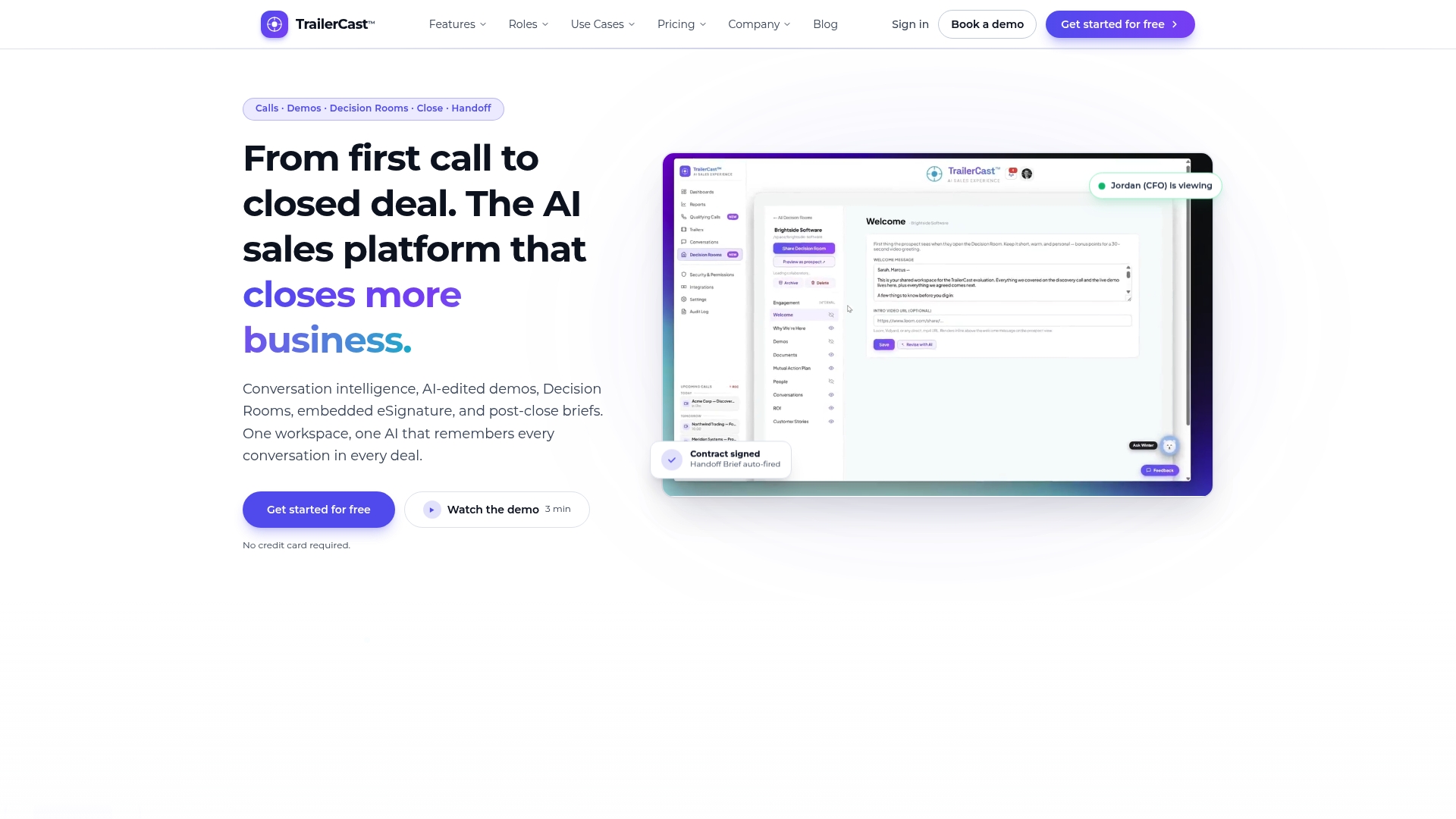
It fits best for B2B SaaS sales teams with multi-stakeholder deals, typically 11 to 200 employees, where reps are currently losing hours a week stitching a recorder, an editor, and a tracking link together by hand. One plan, every feature is available; for current pricing, please see the TrailerCast website. If the workflow in this article sounds like what your team needs, the TrailerCast product page is the place to start a trial and see it against your own deals.
Sources
- Gartner sales survey finds 67% of B2B buyers prefer a rep-free experience
- Buyer Behavior Report 2025 (Consensus)
- New Relic — introduction to async instrumentation
FAQ
Can you give me an example of a sales demo?
A discovery-replay demo is a common example: a 4 to 5 minute video recorded after a discovery call that replays the buyer’s stated pains and shows the exact product workflow that solves each one. It typically ends with a single call to action, like booking a follow-up meeting with the stakeholders who weren’t on the original call.
What is the 2-2-2 rule in sales?
Definitions of this rule vary across sales teams, and there is no single authoritative version tied to async demos specifically. If your team uses a version of this rule, apply it consistently rather than assuming it matches another company’s definition.
What are some examples of asynchronous work?
Asynchronous work includes any task completed without both parties present at the same time, such as recorded video updates, shared documents with comments, and pre-recorded sales demos sent for later review. Research on distributed work patterns points to asynchronous formats as a growing part of how distributed teams and buyers manage their time and attention.
What are the 7 golden rules of sales?
There’s no single, universally agreed list of seven golden rules of sales, and different sales organizations teach different versions. What does hold up across the async demo playbook specifically is personalizing to the buyer’s stated pain, keeping a single clear call to action, and instrumenting every send so you know what happened after it left your inbox.
How much does TrailerCast cost?
TrailerCast runs on one plan with every feature included, starting from $59 per seat per month, with a free trial available and no credit card required to start.